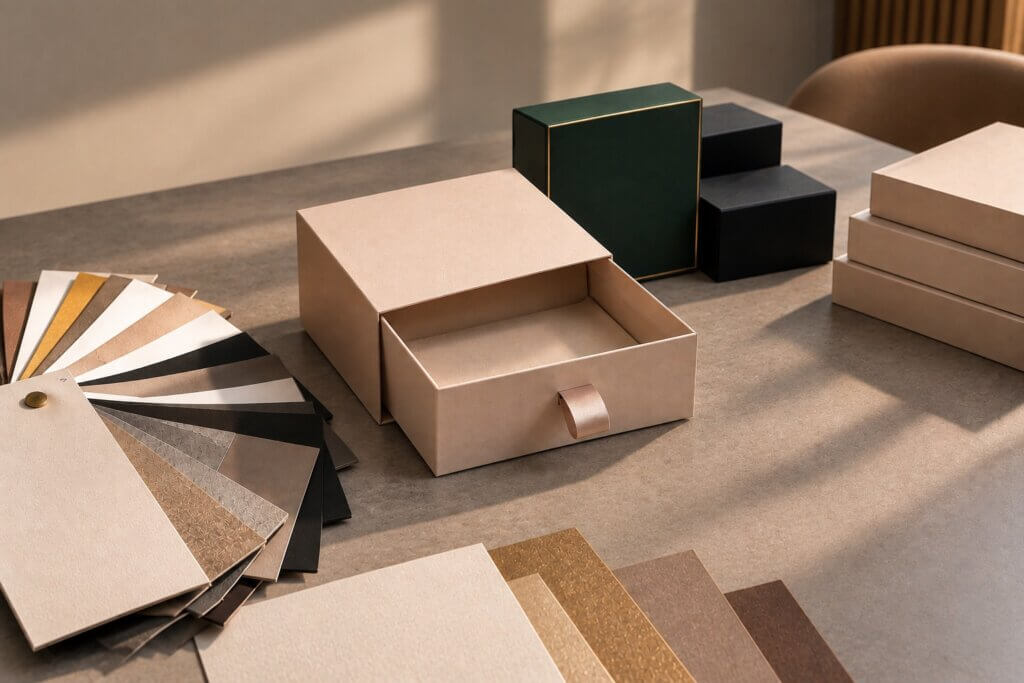

A drawer box has a relatively simple construction: an outer sleeve and an inner tray that slides in and out. Depending on the product, it may also include an insert, ribbon pull, finger notch, or another opening feature. Yet this apparently simple structure can be surprisingly sensitive to small variations in board thickness, wrapping paper, adhesive, assembly position, and dimensional tolerance.
For buyers evaluating custom drawer boxes, a good-looking sample is only the starting point. The real question is whether the box works with the actual product and whether the same fit, appearance, and opening experience can be reproduced consistently in mass production. That means quality needs to be considered during structural development and sampling—not only during final inspection.
Start With the Fit Between the Drawer and the Outer Sleeve
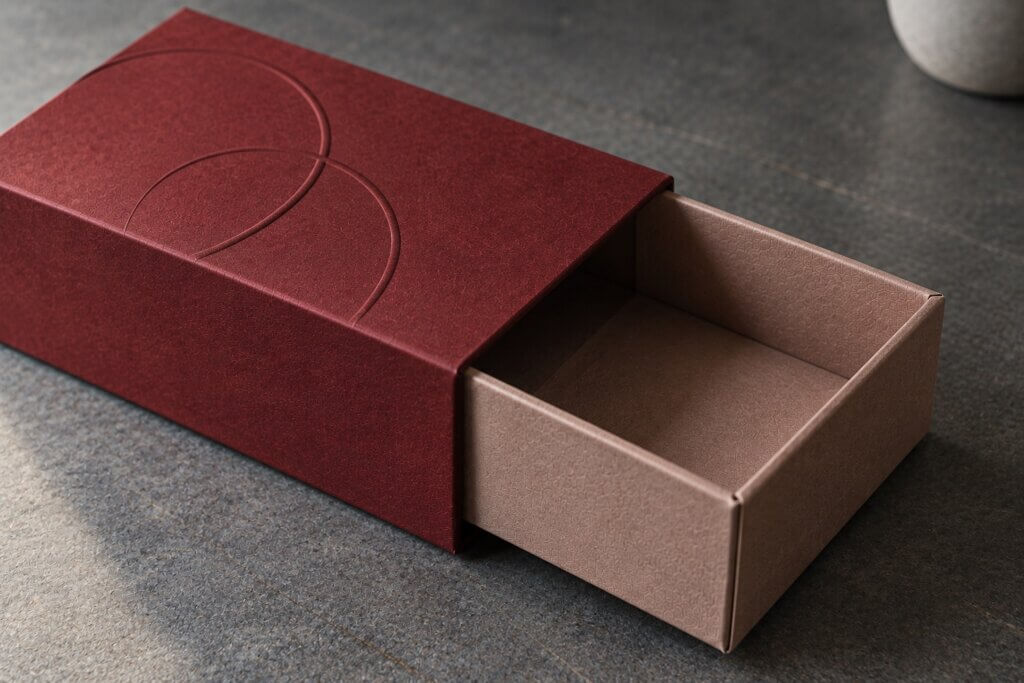
One of the most important details in a drawer box is something users barely notice when it works correctly: the clearance between the inner drawer and outer sleeve. If the fit is too tight, friction increases and the drawer becomes difficult to open; if it is too loose, the inner tray can move inside the sleeve and make the package feel less precise. The correct fit therefore depends on more than the dimensions shown on a structural drawing.
This relationship is particularly important in a sleeve drawer box, where the inner component needs to move smoothly while remaining closely aligned with the surrounding sleeve. Board thickness, wrapping paper, adhesive, folded edges, and assembly tolerances all contribute to the final dimensions. With custom size drawer boxes, changing the overall size, paper specification, or board thickness can therefore require the sliding clearance to be adjusted as well.
How Much Clearance Does a Drawer Box Need?
There is no universal clearance value for every drawer box. A small cosmetics package and a large gift box may require different allowances because their dimensions, board thickness, wrapping materials, and product weight are different. The desired opening experience matters as well: some boxes are designed for a relatively close, controlled slide, while others require easier movement.
For this reason, the final fit should be confirmed with a fully assembled prototype. The important measurement is not simply the theoretical difference between two dieline dimensions, but the actual relationship between two finished, wrapped components.
Board Thickness Must Match the Box and the Product
Using thicker board does not automatically create better packaging. For a rigid drawer box, the board needs enough strength to maintain the structure and support the product without making the package unnecessarily heavy or reducing the space needed for smooth drawer movement. A lightweight skincare set, for example, does not necessarily require the same board specification as a larger gift box containing several glass bottles.
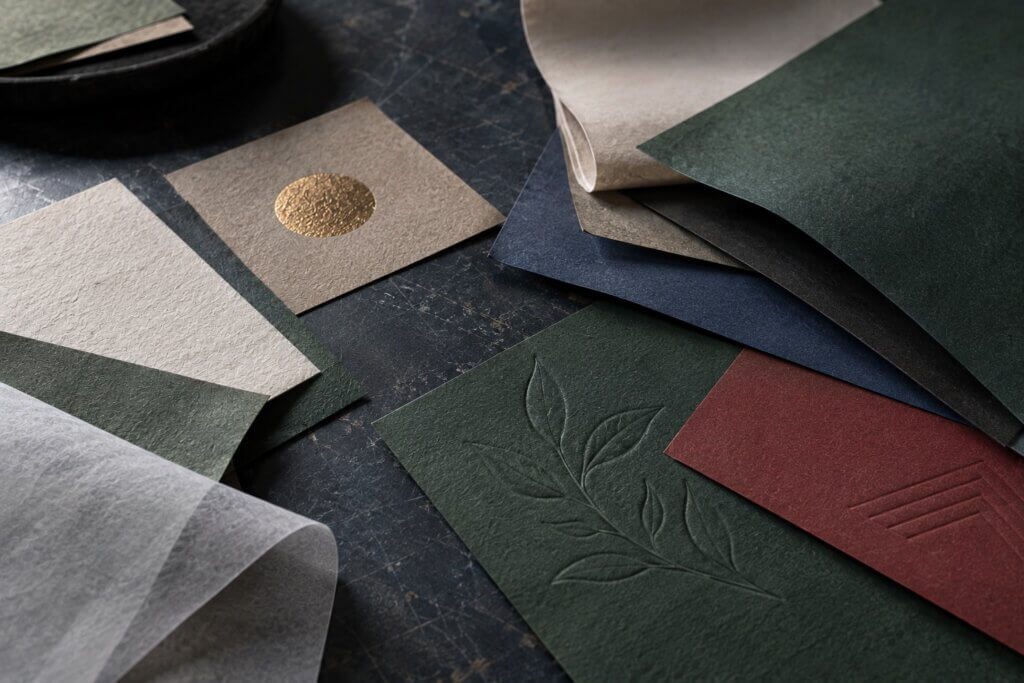
The covering paper must also be considered as part of the finished construction. Once it is wrapped around the board, folded over the edges, and bonded with adhesive, it contributes to the dimensions of the completed component. Board thickness, wrapping paper, structural dimensions, and sliding clearance should therefore be evaluated together rather than specified independently.
Sometimes the better solution is not to make the drawer box heavier. If the product requires a significantly different level of protection, shipping performance, or opening method, comparing different packaging structures may produce a more efficient result.
The Opening Mechanism Needs to Work With the Product Inside
A drawer box with handle may use ribbon, a fabric tab, a paper pull tab, a finger notch, or another pulling feature. These options affect appearance, but they also change how force is transferred to the inner drawer and how many components need to be assembled during production.
A ribbon pull, for example, needs a secure attachment point so repeated use does not loosen it. A finger notch eliminates a separate component, but the exposed area must be large enough for comfortable gripping. Product weight is equally important: a pull mechanism that feels smooth on an empty sample can behave differently once the drawer contains a heavy perfume bottle, candle, electronic device, or multi-product gift set.
Is a Ribbon Pull Better Than a Finger Notch?
Neither solution is automatically better. Ribbon pulls can create a more visible opening gesture and work well when presentation is important, while finger notches simplify construction and reduce additional components and assembly steps. The choice should depend on product weight, desired opening experience, durability, manufacturing complexity, and cost.
This is why the opening mechanism should be considered during structural development rather than added at the end as decoration. A good drawer-box design should be evaluated with the actual product weight inside, because opening performance is part of the functional structure rather than simply a visual feature.
Test the Insert With the Actual Product
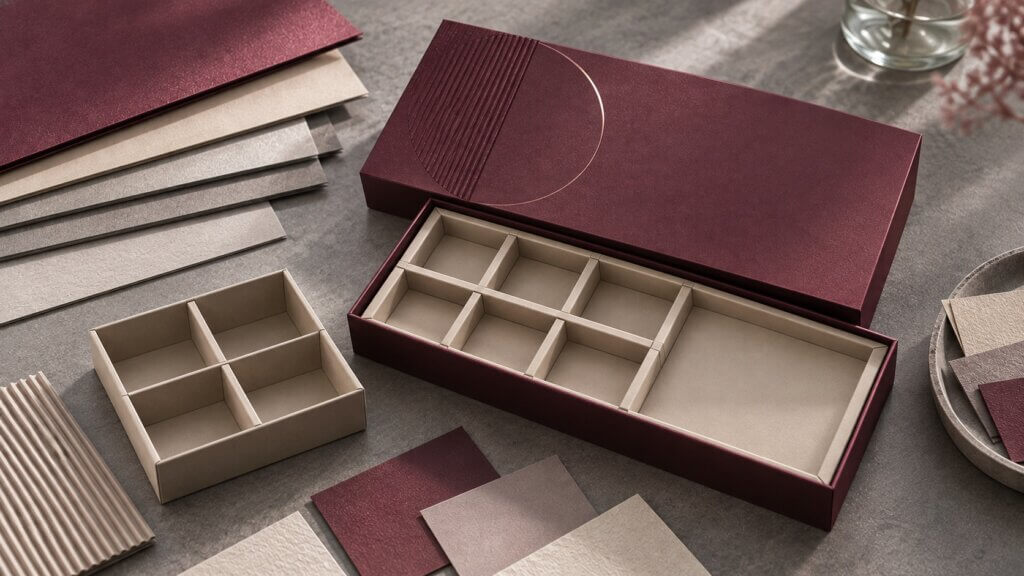
The inner drawer is only one part of the complete packaging system. For cosmetics, fragrance, electronics, accessories, and gift sets, a drawer box with insert often depends on the insert as much as the outer box itself for product protection. Paperboard inserts, folded paper structures, molded pulp, foam, and other solutions all occupy space inside the drawer, so the usable internal dimensions are always smaller than the empty cavity suggests.
A cavity that is slightly too large can allow a bottle or device to move during handling and transportation. If the fit is too tight, the product may become difficult to remove or experience unnecessary pressure. Insert walls, folded sections, locking tabs, and material thickness also reduce usable space, which is why simply adding a few millimeters to the product dimensions is not always enough to create a reliable structure.
For products requiring greater cushioning, a drawer box with foam insert may also be considered. In this case, the density, thickness, cavity dimensions, and position of the foam need to work with the drawer dimensions rather than being designed independently after the box structure has already been finalized.
Should You Test the Actual Product Before Approving the Sample?
Whenever possible, yes. Testing the real product reveals issues that drawings and renderings cannot fully predict, including removal difficulty, movement inside the insert, weight distribution, drawer balance, and the actual opening experience. This is particularly important when a custom drawer box contains glass bottles, electronics, several components, or products with irregular shapes.
A physical product-fit test also gives the buyer and manufacturer a clearer approval standard. Instead of approving the box and insert as separate objects, both sides can evaluate how the product, insert, inner drawer, and outer sleeve perform together as one packaging system.
Wrapping Quality Is More Than a Cosmetic Detail
A drawer box can operate correctly and still fail quality inspection because of poor wrapping. Rigid boxes depend on covering paper to create the finished exterior, and small positioning differences can lead to uneven edges, exposed board, inconsistent corners, visible adhesive marks, or slight shifts in printed graphics. These problems become particularly noticeable on clean designs with large areas of solid color.
Corners deserve special attention because several layers of paper may overlap within a very small area. Printed graphics crossing an edge require accurate positioning, while foil stamping, embossing, debossing, and other finishes should be evaluated on the assembled box rather than only on flat artwork. The outer sleeve and inner drawer should also be compared together because even small visual inconsistencies between the two components can become obvious when the drawer is partially opened.
A physical sample therefore does more than confirm artwork. It shows how paper, board, printing, finishing, and assembly behave after they have been combined into the final package.
A Good Sample Must Be Repeatable in Mass Production
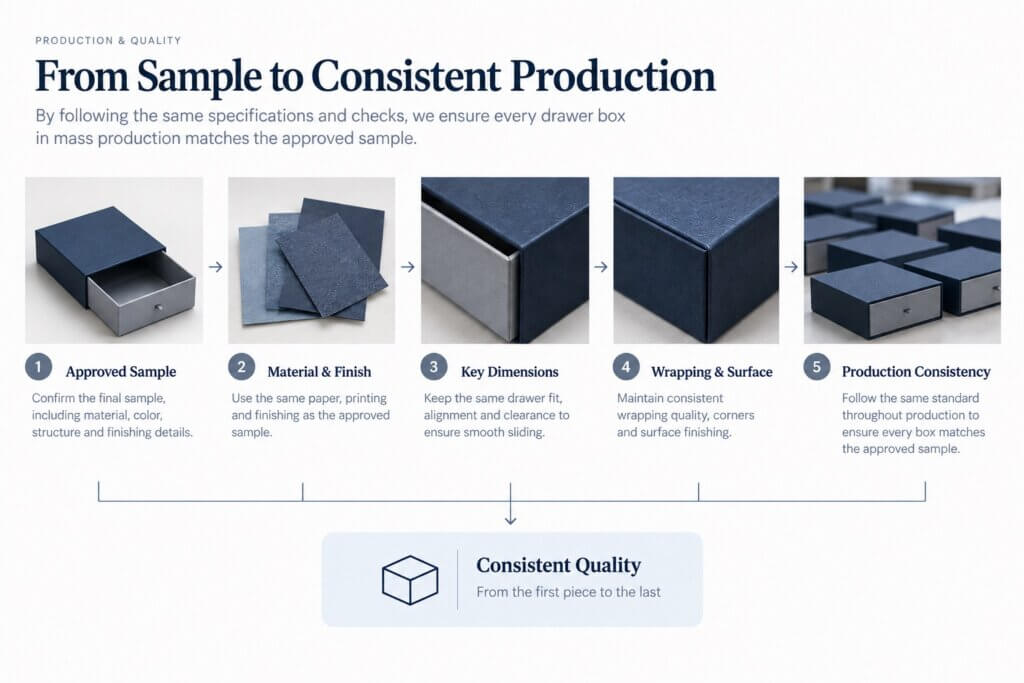
One carefully adjusted prototype does not guarantee that hundreds or thousands of production boxes will behave exactly the same way. Handmade samples may receive more individual adjustment, while mass production introduces normal variations during board cutting, wrapping, gluing, positioning, and assembly. These variations are especially important in drawer boxes because two separate rigid components must fit together closely while still being able to slide.
Critical dimensions should therefore be designed around realistic manufacturing tolerances rather than an ideal zero-tolerance fit. The approved sample should also use materials that are as close as possible to the final production specification. Changing paper thickness, board grade, adhesive, or insert construction after sample approval can alter not only appearance but also the functional relationship between the drawer and sleeve.
Why Can Production Drawer Boxes Feel Tighter Than the Approved Sample?
Usually, the problem is not one large dimensional error but several small variations accumulating. Paper may be slightly thicker, adhesive application may vary, board dimensions can move within tolerance, or wrapping and assembly positions may shift slightly. Each difference may be acceptable on its own, but together they can reduce the clearance enough to change sliding resistance.
Quality control should therefore identify the dimensions and assembly points that actually affect function. Checking only the overall length, width, and height of the finished box may not reveal why one drawer opens smoothly while another feels noticeably tighter.
Approve Function, Appearance, and Production Standard Together
Before approving drawer boxes for mass production, buyers should evaluate function, appearance, and repeatability as one system. Function includes smooth drawer movement, secure product placement, correct insert fit, and a comfortable opening mechanism. Appearance covers wrapping, corners, print registration, color, and finishing, while repeatability determines whether the approved materials, dimensions, and construction can realistically be reproduced under normal manufacturing conditions.
These factors also affect one another. Increasing board thickness may improve rigidity but reduce clearance; changing the insert may improve product protection but alter usable space or weight distribution; adding a pull component may improve the opening experience but create another assembly point that needs to remain consistent. A production-ready package is therefore not created by approving each specification separately—it comes from verifying that the complete system works together.
What Should You Check Before Approving a Drawer Box for Mass Production?
Start with the drawer-to-sleeve fit and open the box repeatedly to check sliding resistance. Confirm finished dimensions and board rigidity, then place the real product inside to evaluate the insert, product removal, weight distribution, and pull mechanism. Finally, inspect wrapping, corners, print registration, color, and finishing against the approved standard.
For more complex custom drawer boxes, it is useful to identify which dimensions and visual details are critical before production begins. This gives the buyer and manufacturer a clearer quality standard and reduces the risk of relying on subjective judgments after the order has already been produced.
A sample that looks excellent but cannot establish a repeatable production standard is not yet production-ready.
Good Drawer Box Quality Comes From Controlling the Whole System
High-quality custom drawer boxes are rarely defined by one material or one decorative process. Board thickness affects dimensions, dimensions affect clearance, clearance affects opening, the insert changes usable space, and wrapping and assembly influence the final fit again. Quality therefore needs to be built into structural development, sampling, material specification, and production control rather than inspected only at the end.
When the structure, materials, insert, opening mechanism, and manufacturing tolerances are tested together, a custom drawer box becomes more than an attractive package. It becomes a repeatable packaging system that protects the product, provides the intended opening experience, and can be manufactured consistently at scale.