
A round packaging box may look structurally simpler than a rectangular gift box because there are fewer visible corners and panels. In manufacturing, however, removing those corners changes much more than appearance. The body has to maintain a consistent curve, the lid has to interact with that curve around an entire perimeter, wrapping paper has to follow a continuous surface, and artwork no longer sits naturally within four clearly defined side panels.
That is why round boxes should not be treated simply as rectangular rigid box designs with the corners removed. Both can belong to the broader family of custom rigid packaging, but their geometry creates different requirements for forming, dimensional control, wrapping, inserts, printing, and quality inspection. Structures such as Oval Lid & Base Box show this clearly: once a package moves away from a conventional rectangular format, the manufacturing logic begins to change with the geometry.
Round and Rectangular Boxes Start From Different Structural Logic
A useful starting question is what is a rigid box, and whether a round paper box can also be considered rigid packaging. In practical terms, many premium paper tubes and round gift boxes share an important characteristic with rigid set-up boxes: the main body is already formed and maintains its three-dimensional shape rather than being supplied as a conventional creased folding carton that is erected during packing. The similarity, however, largely ends there.
A rectangular rigid setup box is built around flat surfaces, straight edges, and defined corners. Those geometries make it possible to control length, width, and height along straight reference lines. A circular package replaces several of those references with diameter, circumference, and a continuous curved wall, while an oval or asymmetric structure changes them again. This means an Oval Lid & Base Box or Half-Moon Rigid Box cannot simply be developed by taking the specifications for a square lid-and-base box and changing the outline.
This difference also answers another common buyer question: are round boxes harder to manufacture than rectangular rigid boxes? Not necessarily in every project. Complexity depends on diameter, height, lid construction, material, wrapping, inserts, and decoration rather than shape alone. The important point is that the manufacturer is solving a different geometric problem, and that problem continues into every stage that follows.
The Curved Wall Changes How the Box Carries Its Shape
Once the geometry is established, the next manufacturing decision is how the package will maintain it. In rectangular rigid box manufacturing, corners contribute strongly to the finished geometry. A cylindrical package has no equivalent four-corner framework, so the body instead depends on a consistently formed curved wall and accurately made upper and lower components.
That becomes particularly important when the height-to-diameter relationship changes. A shallow Two-Tier Round Gift Box behaves differently from a tall Wine Paper Tube Box, even though both belong to the broader family of round boxes. A tall tube has a longer vertical wall and may carry a product whose weight is concentrated differently from a shallow gift set. Core construction, wall stability, and the way the product is supported therefore need to be considered together rather than selected from appearance alone.
This also explains why the question “How are round paper boxes made?” does not have one universal answer. Different tube and rigid-round structures can use different forming methods and component arrangements. What remains consistent is the engineering sequence: the cylindrical or shaped body must first hold its intended geometry before wrapping, lid fitting, printing alignment, and internal product support can be judged properly.
A Round Lid Has to Fit Around an Entire Perimeter
After the body is formed, dimensional fit becomes much more important. On a conventional rectangular box, length, width, corner formation, and board thickness all contribute to the relationship between lid and base. On a circular package, the interaction continues around the entire circumference. A small change in body diameter or wrapping build-up can therefore influence how evenly the lid engages.
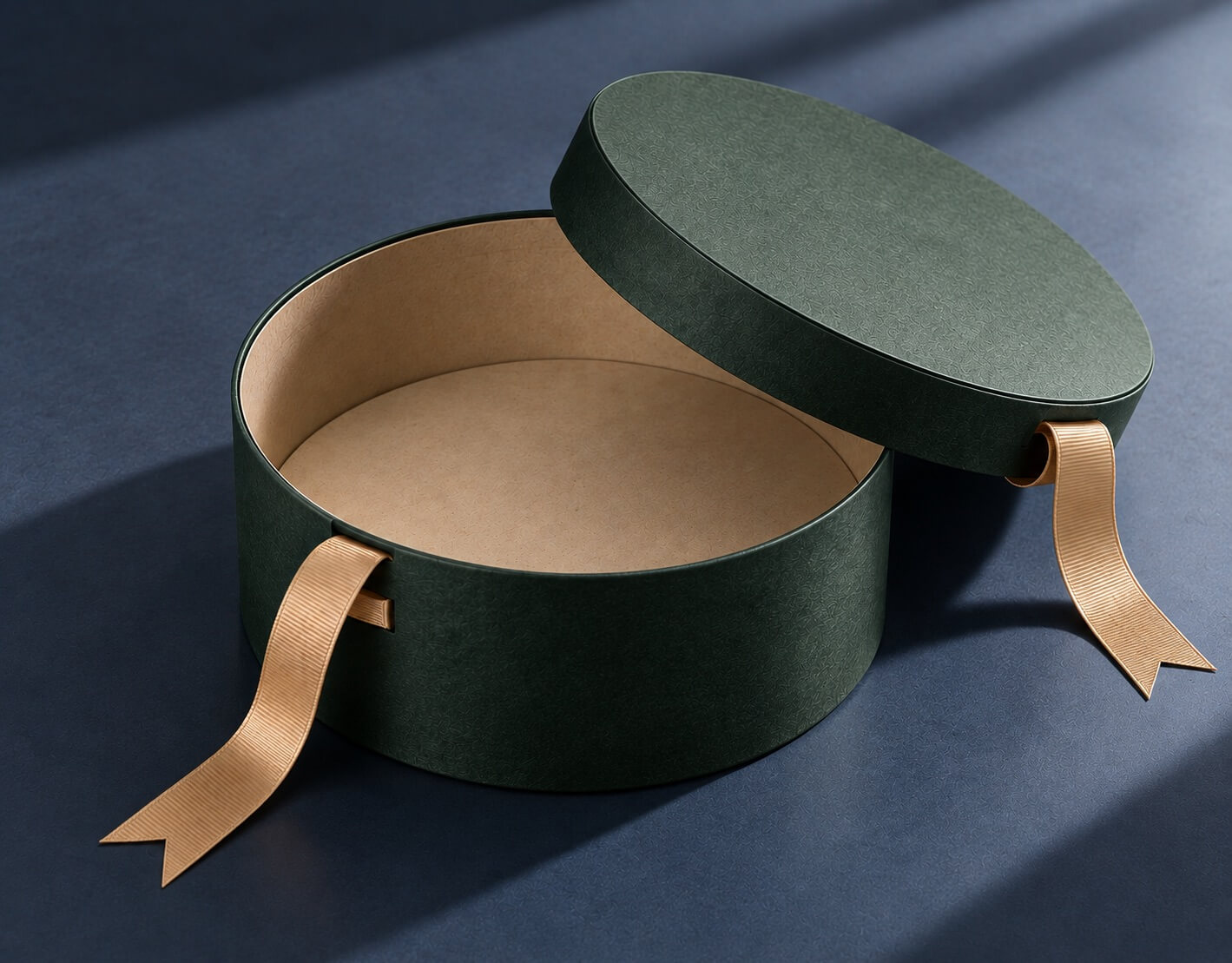
This leads to another frequent question: should a round gift box lid fit tightly? It should feel controlled, but tighter does not automatically mean better. Excessive resistance can make the package difficult to open or cause the lower body to rise with the lid, while too much clearance can make a premium round box gift feel imprecise. The appropriate fit depends on the structure, lid depth, wrapping material, manufacturing tolerance, and intended opening experience.
More unusual formats make this relationship even clearer. A Ribbon Pull Round Box introduces another interaction between the package geometry and the opening sequence. The manufacturing target is therefore not simply a nominal diameter or perimeter; it is repeatable opening and closing after the structural board, wrapping paper, adhesive, and assembly process have all contributed to the finished dimensions.
Curved Surfaces Change the Way Printing and Wrapping Are Planned
Only after the structure and fit are understood does it make sense to move fully into graphics and finishing. One of the most common commercial questions is “Can round boxes be custom printed?” Yes. But a cylindrical surface changes where artwork starts, where it ends, and where a wrapping seam can be positioned without interfering with important visual elements.
On rectangular custom printed rigid boxes, a designer can usually organize information around front, back, and side panels. A cylinder has no natural front panel unless one is deliberately established through artwork or product orientation. This means the graphics, wrapping direction, and seam position need to be coordinated before production rather than treated as unrelated approvals.
A Perfume Paper Tube Box or Luxury Perfume Tube Box makes this especially important because the curved wall may carry most of the brand presentation. A Window Paper Tube Box adds another structural consideration: once material is removed to create the opening, window position, product orientation, artwork, remaining wall area, and the insert behind the window have to work together. The window is therefore not simply a decorative feature added after the tube structure has been finalized.
The Product Inside May Not Follow the Shape Outside
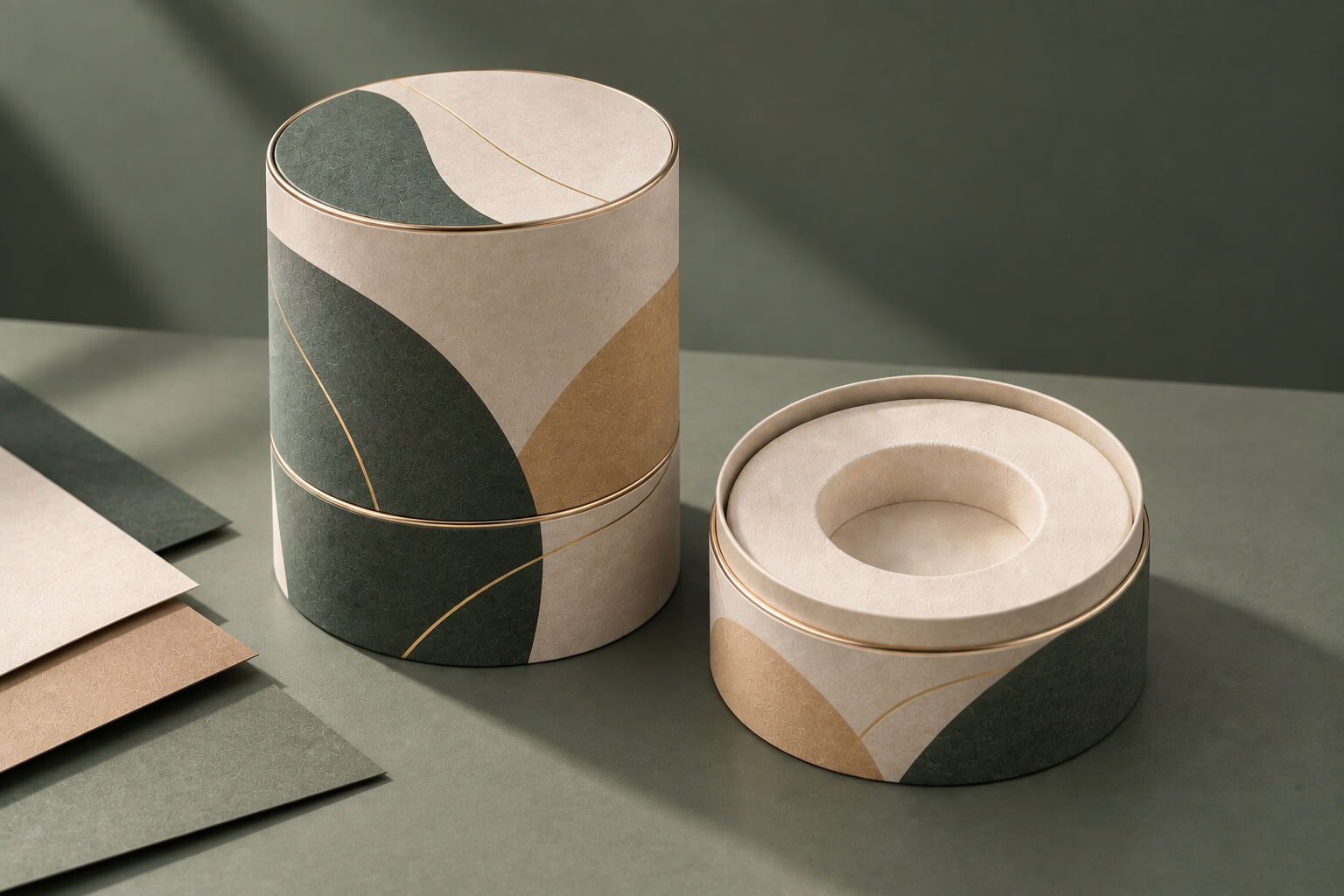
Once the exterior structure has been resolved, the same geometry continues inside the package. A round exterior does not mean the product itself is circular. Perfume bottles may be rectangular, cosmetic sets may contain several differently shaped items, and gift assortments may require separate compartments. This is why a rigid box spacer or insert should be developed from the product outward rather than simply filling whatever space remains inside the tube.
So, can a custom round box include an insert? Yes, but the appropriate insert depends on what actually needs to be supported. Paperboard dividers, molded pulp structures, and other suitable systems can be considered according to product weight, geometry, presentation, and transportation requirements. A rectangular product placed inside a circular cavity may also leave unused areas around its corners, which means directly copying an insert from a rectangular box is rarely the most efficient solution.
This relationship can also help determine whether a round format is appropriate in the first place. A Kraft Paper Tube Box may work well for certain candles, tea products, cosmetics, or compact gifts, while another product may use internal space more efficiently in a rectangular structure. The manufacturing discussion should therefore begin with the packed product rather than with a shape selected only from a reference image.
Cost Follows the Manufacturing Specification, Not the Shape Alone
Once structure, fit, wrapping, printing, and inserts have been defined, pricing becomes easier to understand. Are round boxes more expensive than rectangular rigid boxes? There is no reliable yes-or-no answer based on shape alone. Dimensions, core construction, wrapping paper, printing, finishing, insert design, tooling, assembly requirements, and order quantity can all change the production cost.
A relatively straightforward Kraft Paper Tube Box, for example, cannot be compared fairly with a highly finished Luxury Perfume Tube Box simply because both are cylindrical. Likewise, a complex rectangular gift box may contain more components and require more assembly than a simple round tube. For buyers comparing custom rigid packaging boxes, the meaningful comparison is therefore specification against specification rather than circle against rectangle.
The same reasoning applies when buyers ask “What is the MOQ for custom round boxes?” At Demei Packaging, most custom packaging projects start from 500 pieces, but the final MOQ depends on the box type, structure, materials, and finishing requirements. MOQ becomes meaningful only after the structure has been defined, because different constructions can involve different tooling, setup, printing, and assembly conditions.
A Physical Sample Connects All of These Decisions
By this stage, the development process has moved through a sequence rather than a collection of isolated choices. Geometry determined forming; forming affected dimensional fit; fit influenced opening; the curved surface changed wrapping and artwork; and the internal geometry affected product support. This is why another common question — “Should I order a sample before mass production?” — matters particularly for round and other non-standard rigid structures.
A physical sample allows the package to be evaluated as a finished system. The manufacturer can check whether the lid engages evenly, whether the curved wall maintains its intended shape, whether the wrapping seam is visually acceptable, whether the artwork sits in the intended position, and whether the product can be inserted and removed correctly. For a Window Paper Tube Box, sampling also confirms whether the product is actually positioned correctly behind the opening rather than simply appearing correct in a digital rendering.
Sampling is therefore not only a visual approval stage. For custom rigid packaging, it is the point where assumptions about geometry, material, fit, decoration, and product support become physical evidence before those decisions are repeated across a production run.
Different Geometry Ultimately Requires Different Quality Control
The final difference appears in mass production. A rectangular rigid box may be checked for squareness, corner formation, flatness, alignment, and lid-to-base fit. A cylindrical round packaging box requires some of the same principles, but it also places greater emphasis on circular consistency, wall shape, circumference-related fit, wrapping seams, and artwork alignment around a continuous surface.
A special structure such as a Half-Moon Rigid Box makes the principle even clearer. It should not be inspected as though it were either a standard rectangular box or a standard cylinder. The quality criteria have to follow the geometry that was actually approved, because a dimensional relationship that is acceptable in one structure may not be the correct reference for another.
That is ultimately why working with a rigid boxes manufacturer on round packaging involves more than choosing a different silhouette. Once the geometry changes, forming, fit, wrapping, decoration, product support, sampling, and quality control begin to respond to that geometry in sequence.
For brands developing custom rigid packaging, the more useful question is therefore not simply, “Should we use a round box or a rectangular box?” It is: “What does this geometry require from the structure, fit, wrapping, artwork, insert, and production process?” When those decisions are resolved in that order, a round box becomes more than an unusual package shape. It becomes a structure designed around the product and prepared for repeatable manufacturing.