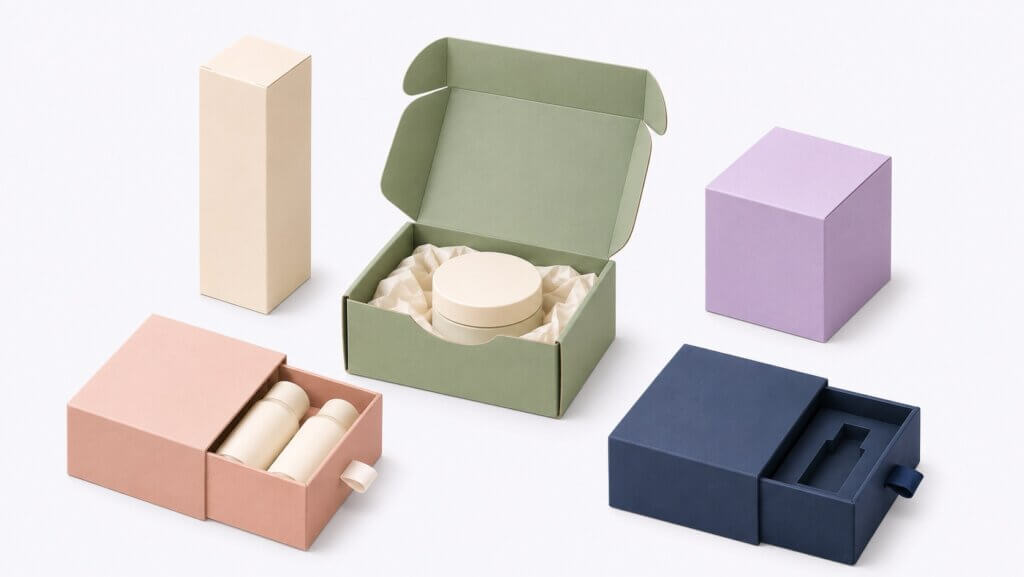

A glass candle jar can look perfectly centered in an open box and still be poorly protected during handling. The filled vessel adds weight, its lid may move independently, and a decorative coating can show rubbing before the glass itself breaks. Effective candle boxes therefore need to manage several different risks without treating every empty space as a reason to add more material.
The starting point is product-led packaging design: define the filled jar, its vulnerable features, and the intended distribution conditions before selecting the outer format. A second principle, product restraint and removal, helps separate secure positioning from an unnecessarily tight fit. Neither principle means that every candle needs a complicated insert; both help identify where support is actually needed.
Begin With the Filled Vessel and Its Distribution Route
The specification should describe the finished product rather than an empty glass container. Record the filled weight, maximum diameter, overall height, lid dimensions, label position, and any surface that should not rub against packaging. Include normal variation across production units. For custom candle boxes, these details establish the conditions that the structure must accommodate, while the sales channel explains whether the package is primarily a retail presentation, a component inside a shipping carton, or part of another distribution arrangement. For visibility requirements, review window packaging decisions alongside the structural specification.
Does a glass candle jar always need an insert? No. A correctly sized retail carton may provide adequate positioning for some products, particularly when another packaging system supplies transport protection. A heavier vessel, multiple-item arrangement, or loosely fitting presentation box may require additional support. The decision depends on movement, contact, and distribution risk rather than the visual expectation that every premium package should contain a fitted cavity. Confirm the sampling and production requirements before evaluating a prototype.
Separate Positioning, Support, and Cushioning
These functions are related, but they are not interchangeable.
Positioning limits unwanted movement; support carries and distributes load; cushioning manages impact through a suitable material and geometry. A folded collar can keep a jar centered without providing meaningful cushioning underneath it. Likewise, a stiff platform can support the filled weight while transmitting impact unless the wider package supplies an appropriate protective response. In custom packaging with inserts, identifying which function each component performs is more useful than judging protection from the neatness of the opening view.
This distinction answers a common procurement question: does a thicker outer box automatically make a glass jar safer? It does not. More rigid walls can improve shape retention and presentation, but protection also depends on how forces reach the vessel. If the jar can strike an internal edge or load an inadequately supported base, additional wall thickness may leave the main failure mechanism unchanged. Diagnose that mechanism before adding material to the entire package.
Establish a Stable Base Before Tightening the Sides
For a filled jar, the lower support must remain functional under the product’s weight and expected handling conditions. An elevated paper platform needs a structure beneath it that carries the load; a cosmetic opening cut into a flat sheet does not establish that support by itself. During development, inspect where the jar actually bears on the insert and whether the supporting panels, folds, and joints remain stable after loading.
The next question is how closely the sides should fit. There is no universal clearance that suits every jar and material. The design needs enough allowance for product and packaging variation without permitting movement that undermines protection or appearance. For packaging inserts for boxes containing coated glass, examine the contact surfaces as well as the cavity size: a narrow, rough edge can leave marks even when the overall fit appears precise. The practical goal is controlled support, not maximum contact pressure.
Preserve Access Without Releasing the Jar
Once the base and lateral positioning are established, the user still needs a reliable way to lift the product out. A closely surrounded, smooth-sided jar can be difficult to grip, particularly when the vessel sits deep inside the package. Finger access, a lifting feature, or a locally lowered insert edge may create a removal path without increasing clearance around the entire circumference. Any lifting feature needs evaluation with the actual filled weight.
Can the lid be used to pull the jar out? That should never be assumed. A removable lid may detach before the vessel moves, so the removal method should engage a suitable gripping area or a verified lifting structure. This is where custom packaging inserts should be evaluated as part of an interaction: loading the jar, closing the box, opening it, grasping the product, and removing it. A sample that looks correct while untouched has answered only part of the design question.
Choose Presentation Features After the Load Path Is Clear
The same filled jar may be presented in a printable carton or a wrapped rigid structure. Rigid candle boxes can offer a controlled opening experience and a stable presentation format, but the construction still needs a compatible internal arrangement. When comparing luxury candle packaging boxes, ask what each extra layer accomplishes. A layer that supports the base or separates vulnerable components has a defined purpose; one added only to occupy an oversized cavity should prompt a dimensional review.
Visibility creates another tradeoff. Candle boxes with window can reveal vessel color or a label, but only if the jar stays aligned with the opening. The cutout also changes the panel, so the window, remaining board, and insert need to be evaluated together. The specific check is whether the candle remains correctly presented after representative handling, without relying on a lid or label as the restraint point.
Surface appearance needs its own acceptance criteria. Printed candle boxes may remain structurally sound while developing visible scuffs at contact points or during packing. Inspect the finished jar, insert, and printed surfaces together, particularly where a coated vessel, textured wrap, or die-cut edge meets another component. Added tissue or a protective layer may help in some configurations, but it can also affect packing and fit. Evaluate the finished assembly rather than approving each material separately.
A failed sample raises a practical question: where should inspection begin? Marks at one height suggest checking the corresponding contact edge; a tilted jar suggests inspecting the platform beneath it; a displaced lid calls for reviewing headspace and contact during closure. These are investigation starting points, not proven causes. Photograph the loaded arrangement and compare the affected locations with an unused sample before deciding which component to revise.
Add Foam Only When It Solves a Defined Problem
Is foam necessary for a glass candle jar? Not automatically. Paperboard, corrugated structures, and other insert systems may provide suitable positioning and support, depending on the application. When evaluating custom packaging with foam inserts, establish why cushioning is needed and assess the foam type, compression behavior, thickness, contact area, and available deformation space. A cavity that grips the vessel firmly is not, by itself, evidence that the foam will cushion that filled product appropriately.
The comparison should use functional alternatives rather than material names alone. One paper structure may mainly locate the jar, another may incorporate deformable features, and a foam system may behave differently under a different load. Ask the supplier to explain the intended response, then verify it with representative samples. This avoids both assuming that paper always provides enough protection and specifying foam before the actual protective requirement is understood.
Validate the Shipping System, Not Just the Gift Box
A presentation box should not be treated as a proven shipping package.
For parcel delivery, evaluate the filled jar, its immediate packaging, cushioning, outer shipping carton, and closure as one system. The outer pack may need to isolate the retail box from handling impacts and compression. Can the same presentation package serve retail and shipping? Sometimes it can form part of both arrangements, but that does not establish that it can travel without additional protection. The answer depends on the distribution conditions and evidence from the complete configuration.
Agree on acceptance criteria before testing: glass damage, lid displacement, unacceptable jar movement, surface marking, insert collapse, and the ability to remove the product afterward may all matter. Select a test approach appropriate to the intended route and use representative filled products and packaging. A simple handling check can expose an obvious weakness, but it does not replace distribution testing. Changes to jar weight, inserts, materials, or the outer pack may require renewed evaluation rather than relying on an earlier result.
Approve a Repeatable Assembly, Not a Single Attractive Sample
Before committing to an order, review several representative product units and the expected manufacturing variation. Can the packing team load them without forcing the glass into the insert? Does the box close without pressing on the lid? Does the removal method still work after handling? Record the approved construction, material specifications, packing sequence, and inspection criteria so the production team knows which relationships must remain consistent. Physical sampling provides a starting point for reviewing development decisions; project-specific performance requirements still need to be agreed separately.
Avoiding overpacking does not mean minimizing material at any cost. It means identifying which components control the real risks, removing features that do not contribute, and checking that the remaining system performs as intended. With the filled jar, support structure, presentation, and distribution pack developed together, buyers can make a more defensible decision than choosing the thickest box or the tightest cavity. Demei Packaging can review the structural direction against the actual product and project requirements before the specification is finalized.