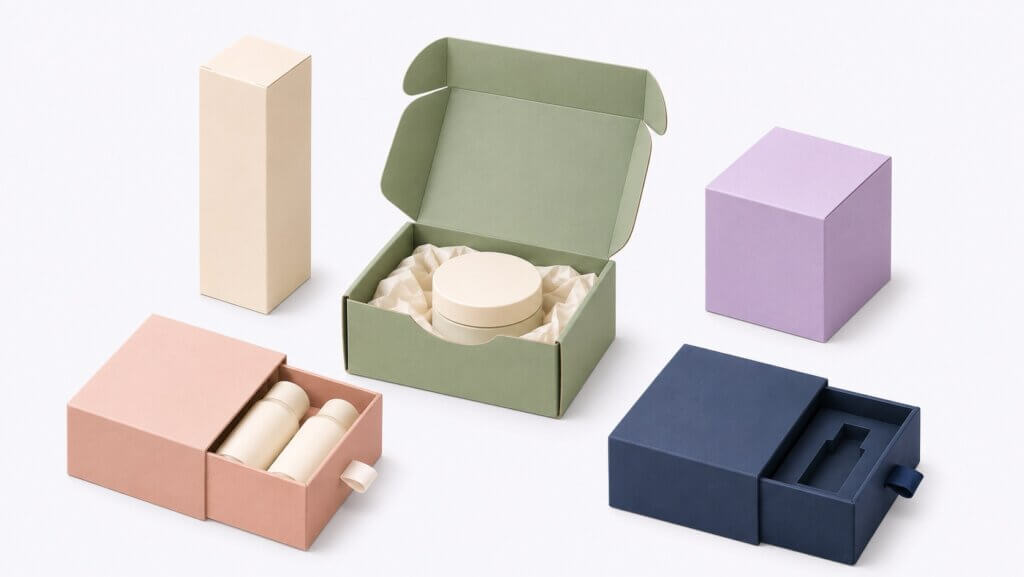

As brands expand their product ranges, packaging complexity often increases faster than the number of products themselves. A skincare company may introduce different bottle capacities, jar formats, and seasonal variants, each requiring specific dimensions, graphics, and product support. Developing separate folding cartons for every SKU can provide an individually optimized fit, but it may also create unnecessary tooling requirements, fragmented inventory, and additional purchasing complexity.
For brands developing custom folding cartons, the challenge is determining which packaging specifications can be shared without compromising product protection, usability, or presentation. This requires an understanding of structural engineering and the practical limitations of different packaging structures. Reviewing relevant Case Studies can also help brands recognize how different product requirements influence packaging decisions, while establishing clear project requirements provides a more reliable starting point for development.
Effective standardization does not mean forcing every product into one universal box. It means establishing a controlled packaging system in which shared components are intentional, necessary differences are documented, and new products can be introduced without automatically creating another independent packaging specification.
Why Should Brands Evaluate Packaging Complexity Before Standardizing Carton Sizes?
Packaging complexity develops when each new product is treated as an independent packaging project. A brand with twelve SKUs may eventually manage twelve structural specifications, multiple artwork versions, separate purchasing schedules, and different packaging inventory requirements. However, the number of products does not necessarily determine the number of structures required. Several products may share a physical carton configuration while retaining distinct printed identities, whereas products within the same category may require different structures because of their geometry, weight, or presentation requirements.
An important question is whether every product needs a different carton size. The answer depends on functional compatibility rather than product classification alone. Brands should distinguish commercially necessary product variation from packaging variation that has accumulated through independent development decisions. For companies managing folding cartons packaging across an expanding portfolio, this distinction identifies where standardization may create value without prematurely eliminating suitable packaging options.
The first objective is therefore not to reduce the number of carton specifications, but to establish which differences are necessary and which can be reconsidered. That requires examining the products before comparing their existing boxes.
How Can Brands Identify Products That Are Suitable for Shared Packaging?
The next step is to establish a SKU compatibility matrix that compares products using characteristics directly related to packaging performance. Relevant information includes maximum product dimensions, expected dimensional variation, packed weight, required orientation, vulnerable components, and the space needed for accessories or instructions. These measurements should describe the complete packed configuration rather than the primary product alone. A bottle’s nominal capacity, for example, provides little information about the height of its pump, the diameter of its cap, or the clearance required for removal.

Can products with different dimensions share the same carton? They can, provided the proposed structure accommodates each product throughout loading, storage, handling, and removal. A 30 ml serum and a 50 ml serum may be suitable for a common outer format if their physical configurations are sufficiently similar. However, a taller dispensing pump, heavier glass container, or wider closure may change the required support and clearance. These differences must be evaluated before grouping the products under one custom folding carton packaging specification.
The compatibility matrix should identify candidate SKU families, not automatically approve a shared structure. Once the products have been grouped, the brand can determine what level of packaging commonality is technically justified.
What Level of Folding Carton Standardization Is Actually Possible?
Standardization can occur at several levels, and confusing them may lead to incorrect assumptions about tooling and purchasing costs. Two products can share the same box style, such as a tuck-end construction, while requiring different panel dimensions. They may instead share an identical dieline, including the same cutting and creasing geometry, while using different printed artwork. A third possibility is that two packages have the same nominal finished dimensions but use different closure details or internal components. These are distinct forms of commonality, even when the resulting folding carton boxes appear similar.

Does the same finished box size mean that one dieline can always be reused? No. A folding carton with identical external dimensions may still require different structural features, such as altered locking tabs, partitions, or assembly details. Tooling compatibility must be confirmed from the complete structural layout rather than the external dimensions alone. Conversely, products with identical bottle geometry but different formulations may share the same dieline while requiring separate artwork and labeling information.
For custom folding carton boxes, the appropriate goal is not maximum uniformity. It is the highest practical level of structural commonality that satisfies the requirements of every product assigned to that packaging family. Once a shared outer structure has been identified, the next question is whether the products can be positioned securely inside it.
When Should Brands Use Shared Outer Cartons with Different Internal Supports?
A common outer carton may accommodate products with different dimensions, but available space alone does not establish adequate product fit. Excessive clearance can allow movement, weaken presentation, or make the product difficult to position consistently during packing. Paperboard inserts, folded supports, and partitions may compensate for these differences without changing the outer dieline. Their suitability depends on the product’s mass, geometry, fragility, and required orientation, as well as the forces likely to occur during normal handling and distribution.
Are interchangeable inserts always more economical than separate carton sizes? Not necessarily. Although shared custom folding boxes may reduce the number of outer structures, SKU-specific inserts introduce additional materials, component specifications, packing operations, and inventory requirements. A system using one outer carton with six different inserts is not automatically simpler than a system using three appropriately sized cartons with minimal internal components. The correct comparison must account for the complete packaging configuration rather than the outer box alone.
Brands should also avoid assuming that an insert can correct every dimensional mismatch. A substantially oversized carton may consume unnecessary board, increase storage volume, and compromise shelf proportions even when the product is securely retained. If the adjustments required to accommodate a product become excessive, a separate carton size may be the more appropriate solution.
How Can Brands Maintain SKU Differentiation Without Changing the Carton Structure?
Once the physical structure has been standardized, the brand must determine how different products will remain identifiable. A shared dieline can support different product names, capacities, colors, ingredient information, barcodes, and market-specific content. However, structural commonality and artwork commonality are separate decisions. For custom printed folding cartons, a master artwork template can define consistent panel orientation, information hierarchy, and designated content areas while allowing controlled variations for individual products.
Can different SKUs share one dieline but use separate printed designs? Yes, and this may be practical when products have compatible physical requirements but distinct identities. Nevertheless, separate artwork versions can still require individual prepress preparation, printing setups, or finishing arrangements. Sharing a dieline does not automatically mean that different SKUs can be combined into one production run or purchased at the same unit price. Compatibility also depends on materials, print specifications, finishing requirements, and scheduling.
Brands should additionally distinguish shared tooling from shared finished-packaging inventory. Six products using one dieline but six different preprinted designs may still require six separate finished-carton stock items. A common unprinted or partially printed carton differentiated through later labeling could consolidate some inventory, but it introduces additional application, identification, appearance, and regulatory considerations. The correct strategy depends on whether the brand wants to reduce structural development, printed packaging variants, or both.
How Can Brands Determine Whether Standardization Reduces Total Packaging Costs?
Technical feasibility does not automatically establish commercial value. Once several packaging configurations have been identified, brands should compare them using total packaging-system cost rather than the purchase price of an individual custom carton box. The comparison should include structural development, tooling, board consumption, printing versions, internal components, packing labor, inventory holding, storage volume, and replenishment requirements. These cost categories may change in different directions when packaging specifications are consolidated.
Consider a hypothetical range of six products. One proposal uses six individually optimized cartons, while another uses two shared outer structures with four product-specific inserts. The second option reduces the number of outer carton designs, but it may also increase insert costs or material consumption for smaller products. Whether it provides a financial advantage depends on actual quantities, component specifications, printing arrangements, and the frequency of replenishment. The example demonstrates why reducing structural variety should be treated as a potential source of savings rather than proof of lower overall costs.
Does a shared dieline automatically reduce production costs? No. Common tooling may eliminate duplicated development expenses, but different artwork, finishing requirements, and production quantities can preserve substantial SKU-specific costs. When comparing folding carton manufacturers, brands should request quotations that distinguish one-time tooling charges, recurring unit prices, artwork-specific preparation, and additional component costs. This also allows the effects of folding carton manufacturing decisions to be evaluated without confusing production efficiency with purchasing simplicity.
For brands sourcing custom boxes for business, the relevant measure is the cost of supplying and managing each complete packaging configuration over a defined period. Standardization is commercially justified when the value of reduced complexity exceeds the additional costs introduced by shared dimensions, internal supports, or revised operating procedures.
How Can Brands Build a Repeatable Packaging Standardization System?
The final stage is to convert individual decisions into a controlled packaging specification system. Each approved carton family should have a structural reference, a list of compatible SKUs, permitted internal configurations, artwork version rules, and documented functional requirements. When a new product is introduced, its complete packed configuration can be compared against these established references before a new structure is commissioned. This prevents unnecessary redesign while allowing exceptions when product requirements genuinely differ.
What should a brand provide to a folding carton manufacturer? A useful development brief should include the SKU compatibility matrix, maximum packed dimensions, product weights, required orientations, proposed shared structures, expected quantities, artwork variants, and relevant packing or distribution conditions. Suppliers encountered through searches such as folding cartons manufacturer should be evaluated on their ability to verify structural compatibility, identify necessary exceptions, and explain the commercial implications of each option. Broad terms such as custom folding boxes or custom carton box should ultimately be translated into precise structural specifications before quotations are compared.
How many standardized carton sizes should a product range have? There is no universal optimum. The appropriate number is the smallest practical set that satisfies product compatibility, presentation, operational requirements, and total-cost objectives. Each new SKU should be assessed against the established packaging families, with exceptions documented rather than introduced informally.
For growing brands, effective standardization is therefore not simply about using fewer boxes. It is about creating a packaging system that supports product development, maintains a coherent brand presentation, and remains manageable as the portfolio expands. The strongest approach preserves necessary product differences while preventing avoidable packaging complexity from becoming a permanent operating cost.