
Choosing the right mailer box size usually starts with the dimensions of the product, but those measurements alone are rarely enough to define a production-ready box. A product may fit within the stated length, width, and height and still create problems once an insert, corrugated board thickness, folded side panels, and the closing structure are added. This is why mailer box dimensions are better treated as part of a complete packing system rather than as three independent numbers. For a Custom Mailer Box, the practical starting point is the product in its final packing condition: its maximum dimensions, orientation, weight, accessories, surface sensitivity, and the amount of movement that can be accepted during handling and shipping.
The same principle applies whether a brand is developing custom size shipping boxes for e-commerce fulfillment or a Printed Mailer Box where presentation is equally important. The box has to provide enough room for efficient packing without creating unnecessary movement or shipping volume. It also has to close correctly after the product and insert are inside, and those relationships need to remain workable when the same structure is produced hundreds or thousands of times. A useful sizing process therefore moves outward from the packed product: first establish the space the product needs, then account for restraint and protection, then resolve the corrugated structure, and only after those relationships are understood should the finished external size be treated as final.
Start With the Product as It Will Actually Be Packed
The first question is often “What size mailer box do I need?”, but the more useful starting point is to define what the box actually has to contain. A manufacturer’s product drawing may list a clean set of dimensions, yet those numbers may not represent the final packing envelope. A bottle may have a pump that becomes its highest point; an electronic device may be packed with a cable and accessory compartment; a retail product may already sit inside a primary carton; several components may need to be arranged side by side rather than stacked. Even the orientation of a product can change the structural requirement because the same object can load the bottom, side walls, and insert differently when rotated.
For this reason, brands comparing mailer box sizes should provide the maximum dimensions of the product in its intended packing condition rather than relying only on nominal product specifications. Weight, quantity per box, orientation, fragile or protruding areas, and any components that must remain separated are also useful. If a primary package will remain around the product, its dimensions become part of the mailer’s sizing calculation. For irregular products, the relevant measurement is essentially the three-dimensional envelope required to contain the product without forcing vulnerable areas against the packaging. Starting from this envelope prevents a common development problem: selecting a box that technically accommodates the product but leaves too little room for the structure that must protect and position it.
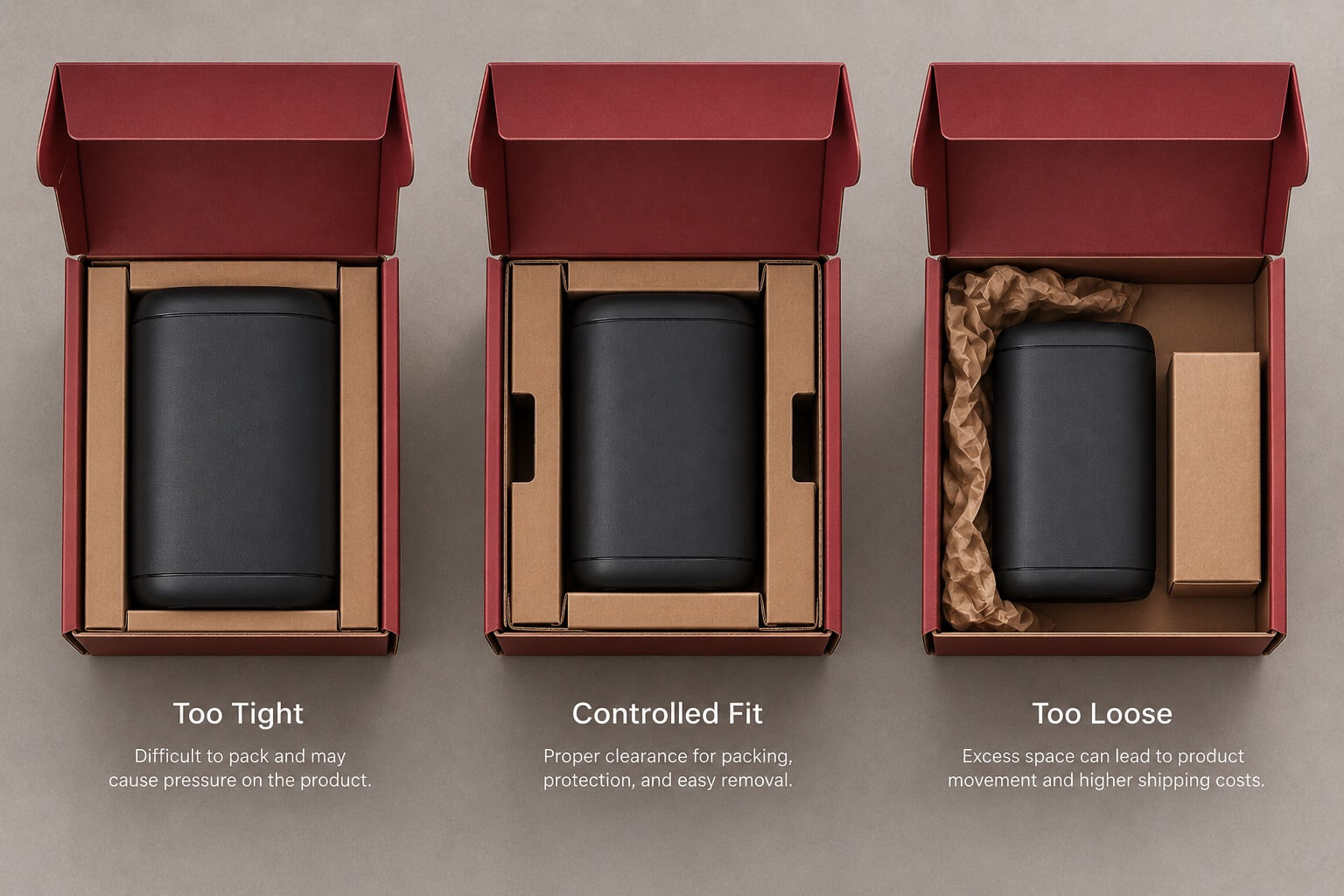
This leads directly to another common question: how much larger should a mailer box be than the product? There is no reliable universal allowance. A soft apparel item can tolerate a different relationship with the side walls than a coated cosmetics carton, a glass bottle, or an electronic device with projecting controls. Clearance also has to support the packing process. If a product only fits when an operator presses it past an insert edge or flexes the side wall, the CAD dimensions may be technically sufficient while the production fit is not. Too much clearance creates the opposite problem by allowing unnecessary movement and increasing the package volume. The useful target is therefore not the tightest possible fit, but enough functional clearance for packing, protection, removal, and realistic dimensional variation.
Internal Dimensions Need to Be Converted Into Usable Product Space
Once the product envelope and required clearance are understood, the next step is to define the cavity around them. This is where mailer box dimensions can become misleading if internal dimensions, external dimensions, and usable space are treated as the same measurement. Internal dimensions describe the nominal space within the erected structure, while external dimensions describe the overall physical envelope of the finished box. The product, however, interacts with usable space—the portion of the cavity that remains after the structure and its internal components are in their actual positions.
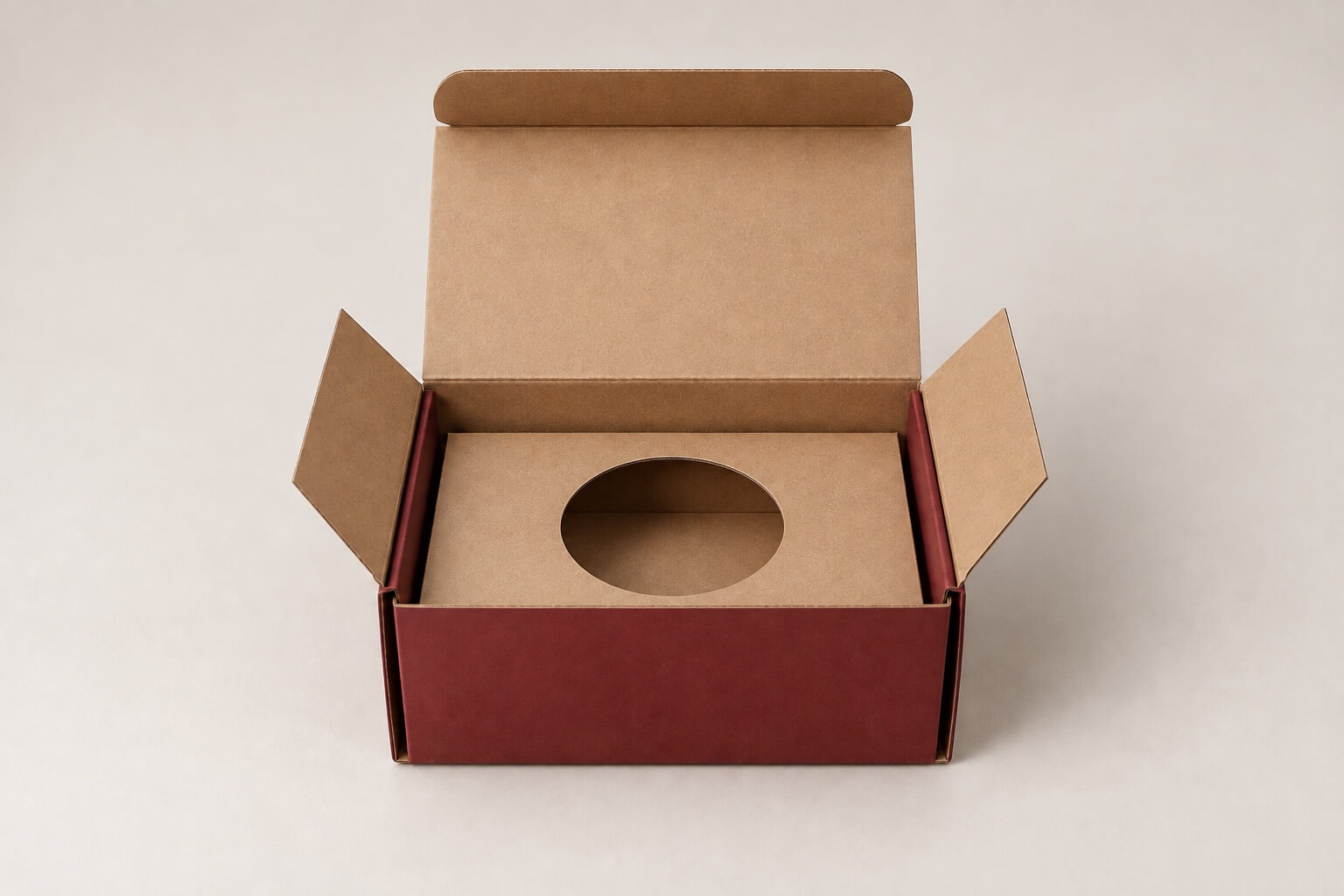
This distinction matters particularly with corrugated mailers because their walls are created by folding a flat blank into multiple layers and planes. Roll-over side walls, front panels, dust flaps, corner areas, and locking features can occupy space locally even when the nominal internal length, width, and height appear adequate. Two boxes can therefore be quoted with similar internal dimensions but behave differently once assembled if their panel arrangements are different. When someone asks “Are mailer box dimensions measured inside or outside?”, the safest answer for a custom project is that both measurements have a purpose and the basis should always be stated. Internal dimensions are generally more useful for product fit; external dimensions become important for master cartons, storage, palletization, courier restrictions, and shipping volume.
Usable space becomes even more important when the product is not a simple rectangle. A narrow protrusion may interfere with a folded side panel even though the rest of the product has generous clearance. A high point may contact the lid before the nominal internal height has been fully occupied. This is why evaluating only L × W × H can hide local conflicts. For a tight-fitting project, it is more useful to consider where the product actually contacts or approaches the packaging and whether those relationships remain acceptable during insertion, closure, transport, and removal.
Inserts and Corrugated Construction Must Be Included Before the Size Is Finalized
If the product needs additional restraint, mailer box inserts create another dimensional layer between the product and the outer box. A folded corrugated insert, for example, may use side supports, locking tabs, shoulders, compartments, or product openings to hold the contents in position. Each feature occupies space, and the insert itself needs enough clearance to assemble correctly inside the mailer. This means that the question “Should the box be sized before the insert is designed?” cannot always be answered by finalizing the outer box first. When the insert controls product position or provides meaningful protection, the two structures should be developed together.
A more reliable sequence begins with the packed product and establishes the contact points or movement that need to be controlled. From there, the insert geometry can be developed around the product, and the external envelope of that insert becomes an input for the mailer’s internal cavity. This is especially important for products with multiple components. An electronics set may require the main device to remain centered while a cable and accessory occupy separate areas; a bottle may need lateral support around the body while leaving the top easy to remove. Trying to add these functions after the outer dimensions have already been fixed can leave too little material for retaining walls, make assembly unnecessarily tight, or force the box to become larger late in development.
Not every mailer needs an insert. If the product already occupies the cavity predictably and normal handling will not create damaging movement or surface contact, an additional component may add material and packing steps without solving a meaningful problem. In other projects, a simple folded corrugated divider may provide enough control. The decision should come from the movement and support requirements of the product rather than from the assumption that a more complex interior is automatically better.
Corrugated construction then adds another variable. Board thickness is not simply something added to the outside of a finished geometric box. The material has real caliper, and that material bends, compresses, and overlaps as the flat blank becomes a three-dimensional structure. At a side wall or front roll-over section, several folds can influence the final relationship between panels. This is why changing board construction can affect not only stiffness but also folding behavior, corner buildup, closure alignment, and available internal space. A Double Wall Mailer Box illustrates the point clearly: increasing the board construction changes more than the perceived strength of the package, so the dieline and fit should be verified for the actual material rather than assumed from a thinner structure.
The same principle applies to custom kraft mailer boxes and white corrugated mailer boxes. Kraft or white liners influence appearance, printing, and brand presentation, but the structural specification underneath still has to suit the product and distribution conditions. Likewise, thicker corrugated board does not automatically mean better protection. Product weight, unsupported spans, board grade, flute construction, insert design, closure, and shipping conditions work together. A material change that improves one type of resistance may provide little benefit if the real problem is uncontrolled product movement inside the package.
A Good Fit Must Still Allow the Box to Close, Protect, and Pack Efficiently
After the product, insert, and board construction have been considered together, the box still has to close correctly. This is where a sizing exercise becomes a complete structural problem. The usable height of a mailer is not simply the distance from the bottom panel to the inside surface of the lid. The product and insert also need to remain clear of the lid’s folding path, front roll-over section, locking tabs, and any internal panel that changes position during closure. An insert that raises a product only slightly can create lid contact, while excessive lateral pressure can distort the side walls enough to change the alignment of the front locking mechanism.
This explains why an empty sample can appear correct while the same box becomes difficult to close after packing. The apparent closure problem may actually originate somewhere else: the product may be slightly too high, the insert may be pushing outward, or the usable cavity may be smaller in a local area than the nominal dimensions suggest. A secure mailer box should therefore not be defined simply as a box that fits tightly around the product. A controlled fit limits damaging movement while preserving enough room for loading, closing, and removal. If protection depends on forcing the product into the cavity, the structure may be too sensitive for efficient packing or normal production variation.
Protection and packing speed also have to be considered together. A few millimeters of additional clearance may make hand packing much easier, but unnecessary space repeated across a large order increases material and shipping volume. Reducing the cavity can improve cube efficiency, but only until it begins to increase assembly time, product abrasion, insert deformation, or closure problems. For a Retail Mailer Box, the same fit also influences presentation: the product should arrive where it was intended to sit rather than simply remain somewhere inside an undamaged box.
At this stage, the appropriate internal dimensions can finally be converted into the finished external size. This is where custom size shipping boxes have to satisfy a second set of constraints outside the product itself. External dimensions affect master-carton configuration, warehouse utilization, pallet patterns, and parcel volume. For brands with several SKUs, one standard mailer may be operationally useful if related products can share it without excessive void space or additional packing material. In other cases, the dimensional spread between products is large enough that dedicated sizes produce a better overall result. There is therefore no automatic answer to “Are standard mailer box sizes better than custom sizes?” Standardization can reduce purchasing and inventory complexity; custom sizing can improve fit and logistics. The better choice depends on the actual SKU range, order quantities, packing method, protection requirement, and distribution model.
Finished Box Dimensions Must Be Translated Into a Manufacturable Flat Structure
Once the finished size is known, another important step begins: the three-dimensional box has to be converted into a flat production blank. A finished 250 × 180 × 80 mm mailer is not manufactured as a mathematical cuboid. The flat sheet contains main panels, roll-over walls, scores, slots, tabs, and locking features that must arrive at the required positions after die-cutting, creasing, and folding. The dimensions of that flat blank therefore cannot be derived by simply unfolding the finished length, width, and height without considering the selected board and structure.
This is one of the reasons a production dieline should be treated as part of structural engineering rather than merely as an artwork template. Fold positions and panel allowances need to work with the material so that the erected box reaches the intended geometry. A change in board construction, insert arrangement, or locking detail can require a structural adjustment even when the desired finished cavity remains similar. For brands comparing custom flat mailers, custom printed rigid mailers, corrugated mailer boxes, and blank mailer boxes, this distinction is particularly important because the word “mailer” does not describe one universal construction. A thin flat mailer and a corrugated roll-over mailer use material and internal space very differently, so a dimension such as 300 × 220 × 60 mm has limited production meaning unless the structure and measurement basis are also identified.
This is also the point at which artwork should be finalized. Printed mailer boxes, custom mailers with logo, custom branded mailers, and other mailer box designs all depend on the actual production dieline. Scores, slots, folded edges, roll-over walls, and hidden panels determine what the customer eventually sees. If structural dimensions change after the graphics are approved, a centered logo may no longer appear centered on the erected panel, a pattern may break across a score, or an interior graphic may disappear behind a folded wall. A Branded Mailer Box should therefore be designed on the approved structure rather than asking the structure to accommodate artwork created too early.
The same reasoning helps distinguish useful mailer box design ideas from purely decorative ones. A colored mailer box, inside print, exterior pattern, or kraft surface can all create a distinct visual direction, but the graphic concept still has to survive converting and assembly. For custom printed mailer boxes, the relevant question is not only how the artwork looks on a flat proof, but how it appears after the board has been printed, die-cut, creased, folded, locked, packed, and handled.
The Final Size Has to Work in Production, Not Only on One Prototype
A physical prototype is where the dimensional system can finally be tested as a whole. The sample should be reviewed with the actual product whenever possible, not simply inspected as an empty box. The product should enter without excessive force; the insert should control the intended directions of movement; access for removal should remain practical; side walls should form correctly; the lid should close without being pushed upward by the contents; and locking features should engage without forcing the front or side panels out of position. If the product is presentation-sensitive, handling the packed sample in different orientations can also reveal movement that is not obvious when the box sits flat on a table.
The prototype, however, is not the end of dimensional development because one successful sample proves only that one set of components can work together. Mass production introduces normal variation in board caliper, moisture, creasing, die-cut position, folding, insert assembly, and the product itself. These variations may be individually small but can accumulate at the same interface. If a product is slightly larger while an insert opening is slightly smaller and a folded panel sits slightly farther inward, the final fit may feel considerably tighter even though no single component is dramatically out of specification.
This answers an important production question: why can an approved sample fit correctly while some mass-production boxes feel tighter? The cause is not necessarily the overall length, width, or height of the mailer. The critical dimension may be an insert opening, a folded shoulder, a local panel position, or the accumulated relationship between several tolerances. Simply enlarging the whole box can hide the symptom while creating unnecessary space elsewhere. A better approach is to identify which interface is consuming the functional clearance and establish control points around the features that actually determine fit.
For this reason, dimensional quality control on a tight-fitting project should not be limited to measuring the outside of the finished carton. Depending on the design, useful control points may include the assembled cavity, insert opening, product-support height, closure engagement, or other critical contact areas. The goal is not theoretical zero variation; paper-based packaging does not behave that way. The goal is a structure with enough functional allowance that expected manufacturing variation does not change whether the package can be packed, closed, protected, and used as intended.
At Demei Packaging, most custom packaging projects start from 500 pieces, but the final MOQ depends on the box type, structure, materials, and finishing requirements. For projects where product fit is particularly important, the approved sample and production specification should capture the relationship between the product, insert, corrugated construction, and assembled box rather than recording only three nominal dimensions.
The Right Mailer Box Size Is the Result of the Whole Packaging System
The final mailer box size may still appear on a specification sheet as length × width × height, but those three numbers should be the result of the development process rather than the entire basis for it. The product first establishes the packing envelope; functional clearance makes that envelope usable; the insert controls position; corrugated construction converts theoretical space into a physical structure; the closure places further limits on the cavity; and logistics determines whether the resulting external dimensions remain efficient. The dieline then translates that finished geometry into something that can actually be manufactured, while the prototype and production controls verify that the same relationship can be repeated.
This is why apparently similar mailer box sizes can perform differently, and why reducing or increasing a dimension by only a few millimeters can affect more than the amount of empty space around the product. The change may influence insert geometry, packing speed, closure alignment, product movement, material use, shipping volume, or artwork position. For custom printed mailer boxes, good dimensional development connects all of these factors before the final structure is released for mass production.
The objective is therefore not simply to find a box that the product fits inside. It is to establish a dimensional system in which product fit, protection, packing, closure, printing, logistics, and production repeatability continue to work together.