
A custom folding carton rarely begins as a finished packaging specification. More often, a buyer approaches a packaging manufacturer with a product, approximate dimensions, artwork, a reference package, or simply an idea of how the product should look on a retail shelf. Turning that information into a production-ready carton requires a series of connected decisions involving structure, paperboard, dielines, printing, tooling, prototyping, die cutting, folding, gluing, and quality control.
This is why developing folding packaging boxes is different from simply choosing a carton from a catalog. A change in product dimensions can affect the structural drawing; a different paperboard thickness can change folding behavior; a new finish can influence print and die-cut registration. For buyers, understanding this development process makes it easier to communicate with a supplier, review samples, and identify potential problems before mass production begins.
Start With the Product, Not the Carton
The development process should begin with what the carton actually needs to hold. Important information includes product dimensions, weight, orientation, quantity per carton, fragility, and how the product will be packed. A lightweight cosmetic tube, a glass skincare bottle, a food product, and a small electronic accessory may all use paperboard cartons, but they do not create the same structural requirements.
This is particularly important when developing folding cartons for consumer goods. A carton designed mainly for retail presentation may prioritize print quality and shelf appearance, while a heavier product may require stronger paperboard, a reinforced bottom, or an insert. The packing process also matters. A carton packed manually in small quantities may tolerate a different closure or assembly sequence from one that needs to move efficiently through a high-volume packing line.
When the product has an unusual shape or very tight fit requirements, physical samples or accurate 3D product data are useful. The objective at this stage is not to choose decorative details. It is to establish the physical and functional conditions that the package must satisfy.
Choose the Folding Carton Style Around the Product
There are many types of folding cartons, but the correct starting point is not to select the most visually interesting structure. The carton style should match the product, filling method, required protection, opening experience, production quantity, and cost target.
Common folding carton box types include straight tuck end, reverse tuck end, auto-lock bottom, snap-lock bottom and other variations. Each solves a slightly different packaging problem. For example, a simple lightweight product may work well with a conventional tuck-end structure, while a product that needs greater bottom strength may benefit from an auto-lock or reinforced bottom design.
The same principle applies when comparing folding carton box styles for presentation. Two cartons may look similar after assembly but require different amounts of paperboard, different gluing operations or different packing procedures. These differences can affect both unit cost and production efficiency.
A reverse tuck structure is therefore only one option within a much larger structural system. Buyers who need a deeper explanation of that particular construction can refer to our Reverse Tuck Folding Cartons guide, which covers its structure, materials and suitable applications in more detail.
Turn the Box Style Into a Production-Ready Structural Design
Once the basic carton style has been selected, folding carton design becomes much more precise. The structural designer must translate the product dimensions and packing requirements into panels, flaps, tabs, folds, glue areas and clearances that can actually be manufactured.
Good folding carton designs account for more than the nominal length, width and height of the finished box. Paperboard has thickness, products need loading clearance, folds consume space, and closures need enough tolerance to work repeatedly without being too loose or too tight. A carton that looks correct in a drawing can still fail during assembly if these relationships are not considered.
The designer must also think about manufacturing. Glue areas need sufficient space, folding panels should move in the intended direction, locking tabs should engage correctly, and the structure should use the sheet efficiently. If an insert is required, the outer carton and insert should be developed as one packaging system rather than as two unrelated components.
For buyers, this is one reason it is useful to provide the actual product during development whenever possible. A physical fit test can reveal problems that are difficult to judge from dimensions alone.
What Is the Difference Between a Dieline and a Folding Carton Die?
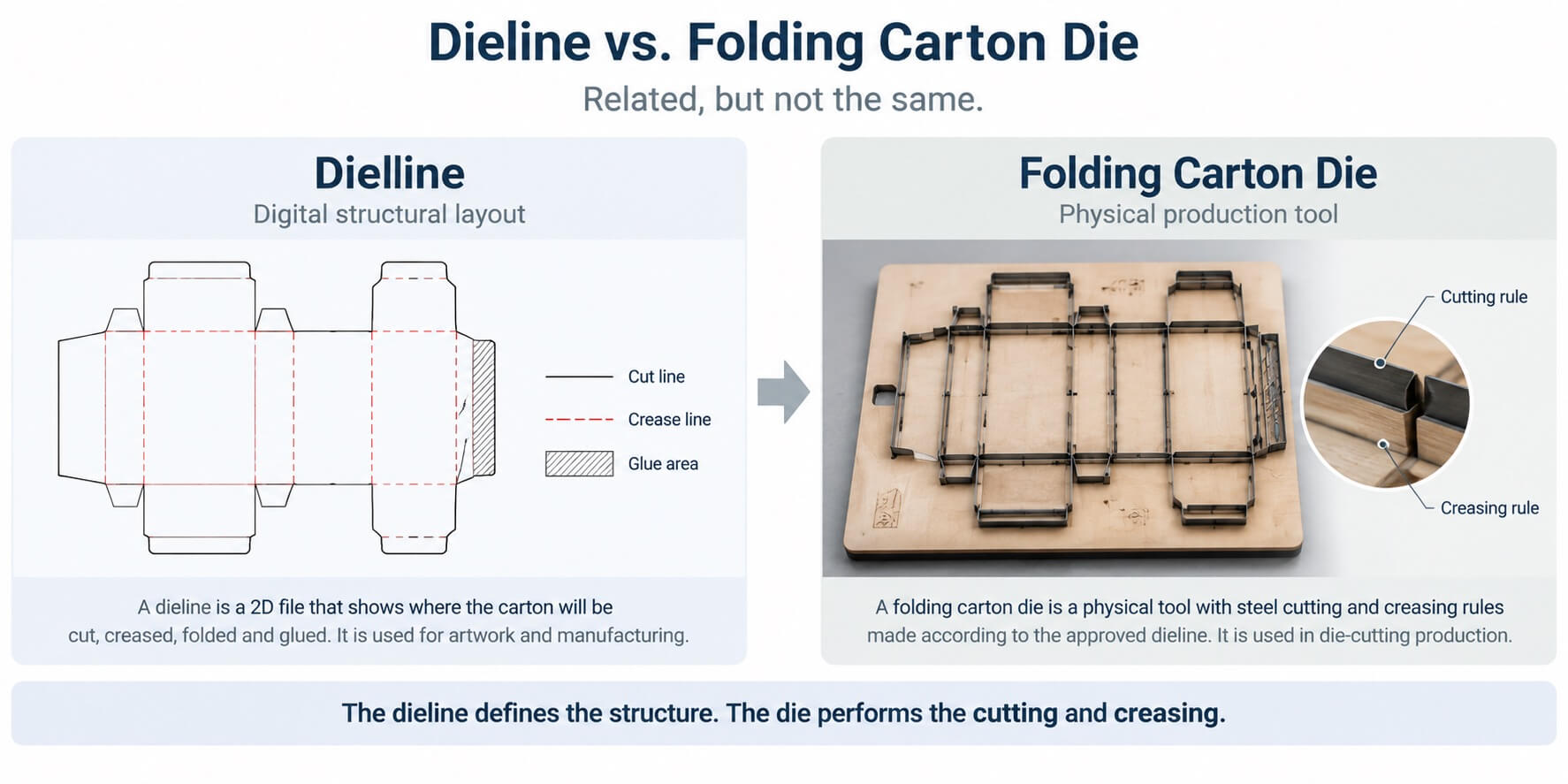
The terms dieline and die are related, but they are not the same thing. A dieline is the technical layout that defines where the carton will be cut, creased, folded and, where required, perforated. It provides the structural framework for both artwork placement and manufacturing.
Folding carton dies, on the other hand, are physical production tools. In conventional die cutting, cutting and creasing rules are formed according to the approved structural layout and used to convert printed paperboard sheets into carton blanks. The dieline tells the production team where those operations belong; the die performs the physical cutting and creasing operation.
This distinction matters because structural changes made after tooling has been prepared may require the die to be modified or remade. That can add cost and time. For this reason, product fit, carton dimensions, closures and major structural details should normally be approved during prototyping before final tooling and mass production.
Artwork should also be prepared on the approved dieline rather than on an approximate box drawing. This helps keep logos, text, barcodes and important graphics away from folds, glue areas and cut edges.
Select Paperboard Before the Structure Is Fully Locked
Paperboard selection affects appearance, strength, printability and folding performance, so material should be considered before the carton structure is completely finalized. Common options for cardboard folding boxes include different grades and calipers of coated and uncoated paperboard, selected according to product weight, print requirements, surface appearance and budget.
A thicker board is not automatically a better board. Increasing caliper can improve stiffness, but it can also change crease behavior, folding resistance and the dimensions required around the product. Likewise, a highly printable coated board may be appropriate for cosmetics or personal care packaging, while another application may prioritize natural surface character or recycled content.
Material decisions therefore need to be coordinated with structure. If the board specification changes significantly after sampling, the carton may need to be tested again rather than assuming that the original fit and folding behavior will remain unchanged.
This is also where sustainable folding cartons should be considered as an engineering decision rather than simply a marketing label. Using responsibly sourced paperboard, reducing unnecessary material, designing for recyclability and avoiding unnecessary mixed-material components can all contribute to a more resource-efficient package.
Prepare the Carton for Printing
After the structure and material direction are sufficiently stable, attention shifts to graphics and folding carton printing. The approved dieline becomes the framework for artwork, showing the designer where front, back and side panels, flaps, folds and glue areas will appear after conversion.
The appropriate printing process depends on factors such as quantity, color requirements, paperboard surface and artwork. Offset printing is widely used for high-quality commercial folding cartons, while digital printing can be useful in certain shorter-run or development situations. What matters is not simply choosing a printing technology, but making sure the artwork, substrate and production process work together.
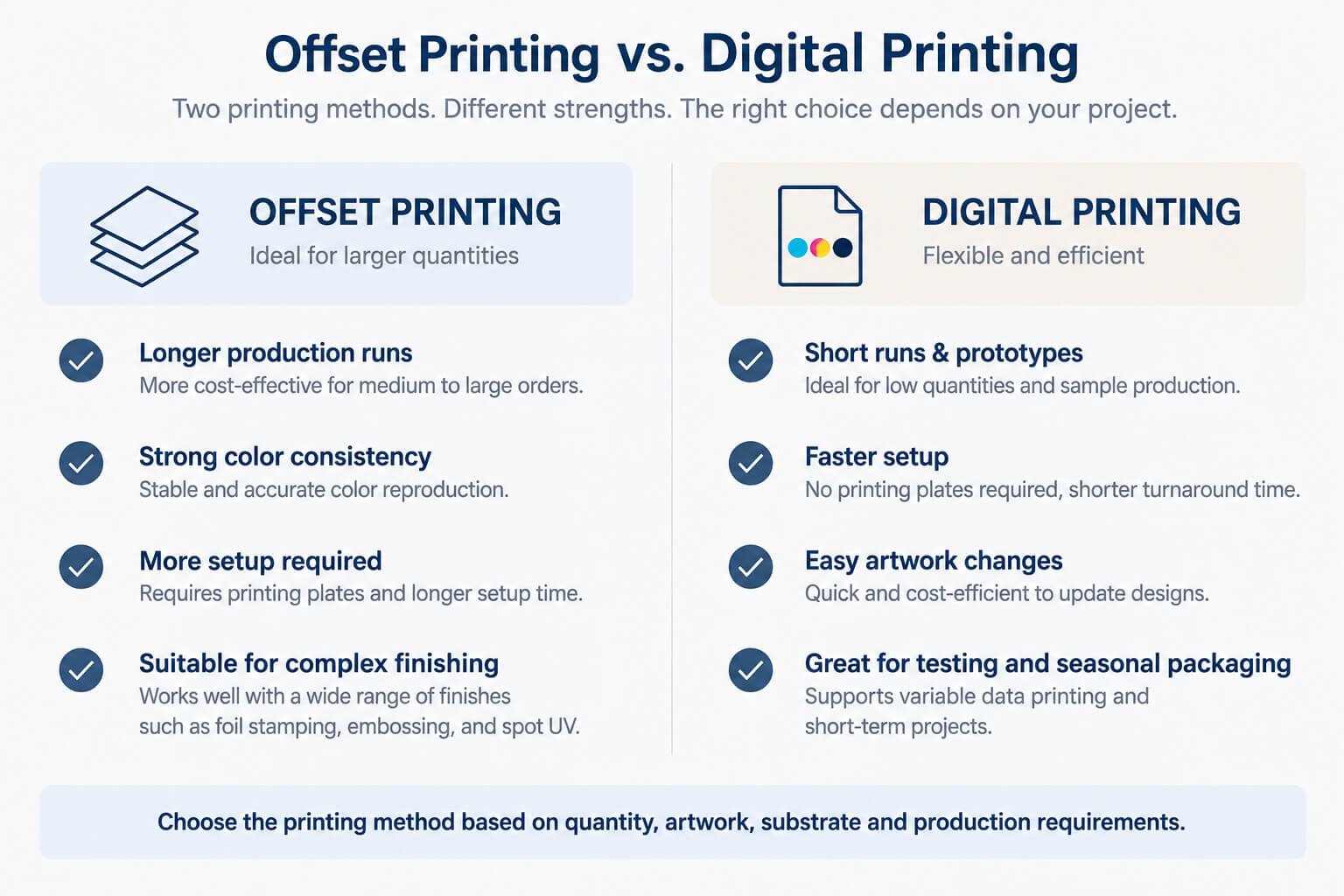
Professional folding carton printers also need to manage issues such as color consistency, registration, solid ink coverage and the relationship between printed graphics and later finishing or die cutting. In carton printing packaging, a design that looks correct on a monitor can behave differently on paperboard because surface whiteness, coating and ink absorption affect the final appearance.
If foil stamping, embossing, debossing, spot coating or lamination is required, these processes should be identified before production planning is finalized. Finishes may require additional tooling or registration tolerances, and they can influence both cost and production sequence.
Prototype Before Mass Production
A prototype is the point where dimensions on a structural file become a physical package. Depending on the project stage, the first sample may be an unprinted white dummy used mainly to evaluate size and structure. Later samples can incorporate printing, paperboard and finishes closer to the intended production specification.
The product should actually be loaded into the sample. Check whether it enters easily, whether there is excessive movement, whether tuck flaps and locks close correctly, whether the carton remains square, and whether the insert—if present—holds the product in the intended position. It is also worth considering how easily the carton can be assembled and packed, particularly for orders that will involve large quantities.
This stage is especially important for a new foldable packaging box or foldable carton box structure. Small adjustments made before tooling and production are usually easier to manage than discovering a fit or assembly problem after thousands of cartons have already been printed and converted.
From Printed Sheet to Finished Folding Carton
Once the sample and production specification are approved, manufacturing moves through a sequence of controlled processes. Paperboard is printed, finishes are applied where required, and printed sheets are die-cut and creased. Waste areas are removed, and the carton blanks then move to folding and gluing according to the structure.
This stage explains why structural decisions made earlier matter so much. A technically sound carton should not only look good when assembled; it should also run consistently through die cutting, folding and gluing equipment. In large production runs, even a small structural or registration problem can be repeated across thousands of units.
Quality checks can include dimensions, cutting and crease position, print color, registration, surface defects, gluing, folding accuracy and functional assembly. The exact inspection points depend on the carton and customer specification. Finished cartons are typically packed flat for transportation, which reduces shipping volume compared with shipping fully erected boxes.
The result is not simply a printed folding box carton. It is the outcome of coordinated structural design, materials, printing, tooling and converting processes.
How Do Requirements Change for Different Consumer Goods?
There is no single specification that works for all folding cartons for consumer goods. Cosmetics and personal care products often place greater emphasis on print quality, surface finishing and shelf presentation. Food products may introduce different material, barrier or regulatory considerations depending on whether the carton contacts the product directly or contains primary packaging. Small electronics may require greater attention to product movement, accessory organization or internal protection.

Product weight can also change the appropriate structure. A lightweight tube may need little more than a well-sized carton, while a heavier glass bottle may require a stronger bottom or an internal support. The packaging development process should therefore start with the actual product rather than applying the same carton specification across different industries.
This product-first approach also helps control cost. Structural complexity, heavy paperboard and additional finishes should be used when they solve a genuine packaging requirement—not simply because they make the specification sound more premium.
Where Does Sustainability Enter the Development Process?
Sustainability should be considered throughout development rather than added as a final feature. For sustainable folding cartons, some of the most meaningful decisions are often structural: selecting an appropriate board weight, reducing unnecessary dimensions, improving sheet utilization, minimizing unnecessary components and choosing materials that fit the intended recycling system.
Paper certification and recycled content can also be relevant depending on the project and market. However, a sustainability claim should not replace performance testing. Reducing material too aggressively can create product damage or increase secondary packaging requirements, which may work against the original objective.
A better approach is to balance material efficiency, product protection, manufacturability and end-of-life considerations. When these decisions are made during folding carton design, sustainability becomes part of the packaging system rather than a decorative claim added after the structure has already been finalized.
Final Thoughts
Developing a custom folding carton is a connected engineering and manufacturing process. Choosing among different types of folding cartons is only the beginning. The selected structure must be adapted to the product, translated into an accurate dieline, matched with the appropriate paperboard, prepared for printing and finishing, tested through physical samples, and converted consistently during production.
For buyers, the most useful question is therefore not simply, “Which carton style should we use?” It is whether the product, structure, material, artwork and production process have been developed as one system. When these decisions are coordinated before mass production, the finished carton is more likely to meet both visual and functional requirements while avoiding preventable changes later in the project.