

Cosmetic packaging may pass final production inspection with consistent printing, clean edges, and an approved surface finish, yet develop visible scratches or scuff marks before reaching retail shelves. The cosmetic product itself may remain intact, but the damaged packaging can fall outside the brand’s agreed appearance requirements.
For brands developing custom printed folding cartons, preventing surface damage requires more than choosing a protective coating. The finished package must withstand contact with adjacent boxes, internal components, handling equipment, and transport materials. A coating that performs well during laboratory abrasion testing may still develop visible marks when exposed to concentrated pressure or repeated movement during distribution.
Effective prevention therefore begins with understanding the relationship between surface durability, packaging geometry, and the actual distribution environment. Brands should evaluate cosmetic packaging as a complete system and establish production specifications that cover not only the finished appearance but also how that appearance will be preserved.
The objective is not to eliminate every possible mark under every conceivable condition. It is to identify foreseeable damage mechanisms, control the variables that contribute to them, and verify that the finished packaging meets defined acceptance criteria after representative handling and transportation.
Distinguish Surface Abrasion From Other Packaging Defects
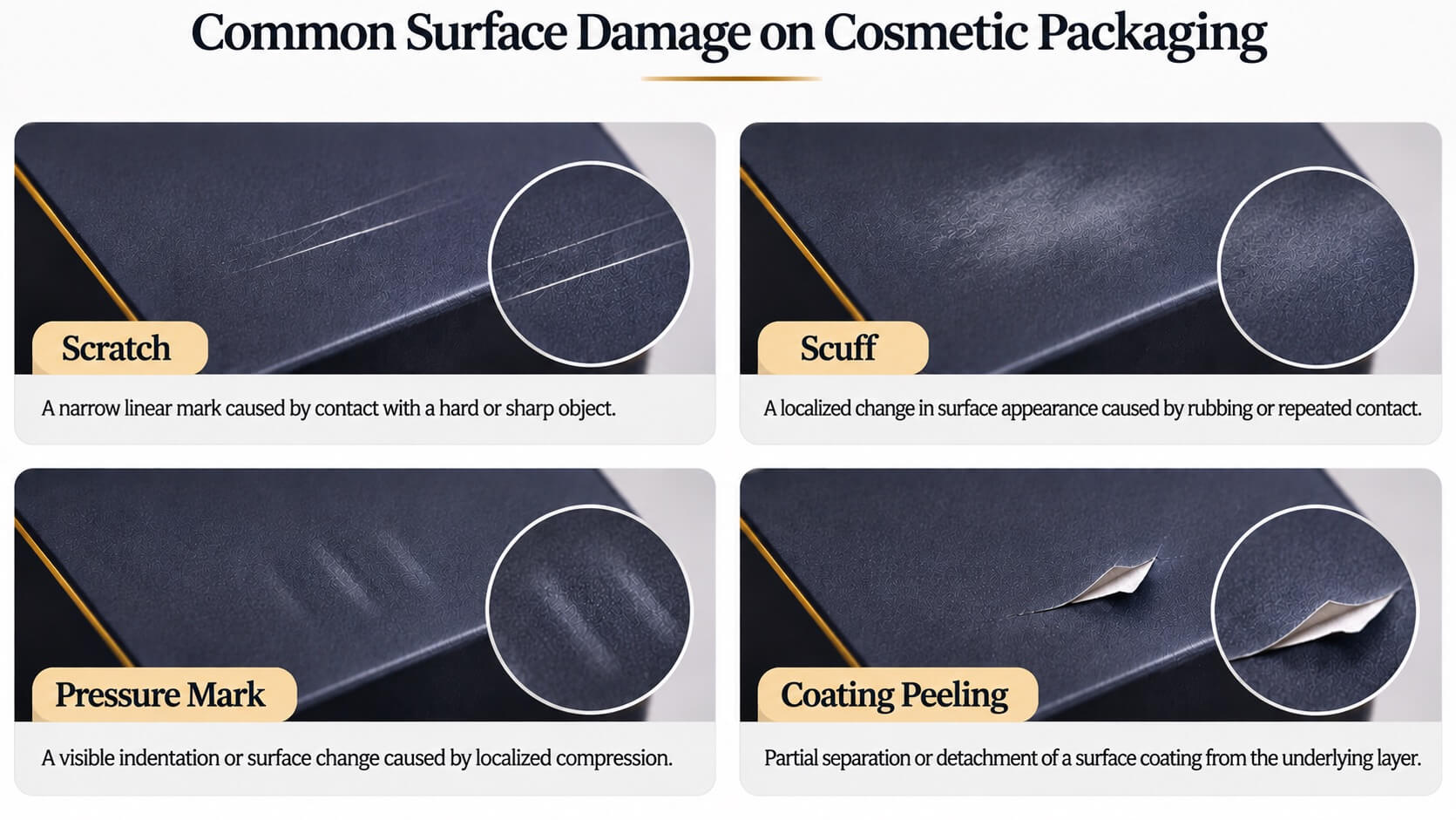
Before selecting a corrective measure, brands need to identify what type of damage has occurred. Surface defects may look similar in photographs, but their underlying mechanisms can be substantially different.
Abrasion generally involves material removal or changes to the surface caused by repeated contact and relative movement. A scuff may appear as a dull or polished patch without a clearly defined groove. Scratching typically involves localized contact that creates a visible line or indentation. Pressure marking can occur when a textured or rigid component presses against a decorated surface, even when little sliding movement takes place.
Ink transfer and coating delamination represent different failure mechanisms. Ink transfer may involve insufficiently stabilized surface material, unsuitable contact conditions, or excessive pressure. Delamination indicates separation within the surface system and may require investigation of substrate preparation, coating compatibility, or processing conditions.
Why can cosmetic packaging show surface damage when the product inside has not moved? Because internal product protection and external appearance protection are separate functions. A well-designed insertroup of premium skincare cartons arranged inside a master shipping carton.
If the retail boxes have excessive freedom to move, vibration may produce repeated sliding contact. If the same boxes are compressed tightly against a rough divider, the dominant risk may shift from sliding abrasion to pressure marking. may immobilize a glass fragrance bottle while the retail box continues to experience friction against neighboring packages inside the shipping carton.
A useful investigation starts by documenting defect location, shape, direction, frequency, and severity. Marks repeated at the same height on multiple boxes may indicate contact with a divider or adjacent package. Damage concentrated around corners may suggest handling or localized compression. Broad surface rubbing across large panels may indicate relative movement during transport.
However, defect appearance alone cannot establish the cause. Observations should be compared with retained production samples, packing records, and, where available, samples collected at different stages of distribution. This helps distinguish damage originating during manufacturing from damage introduced during warehousing or transportation.
Evaluate the Complete Printing and Surface-Finishing System
Surface durability is not determined by the coating alone. It depends on the interaction between the substrate, ink, finishing layer, converting process, and subsequent handling conditions.
For printed folding cartons, the substrate influences ink absorption, surface smoothness, and the mechanical support provided to the printed layer. Different paperboards may respond differently to the same ink and coating combination. Coated and uncoated surfaces can also produce different results because their surface characteristics and printing behavior are not identical.
The ink system introduces additional variables, including adhesion, film formation, drying or curing conditions, and compatibility with subsequent finishing. A coating may provide good abrasion resistance on one printed substrate but perform differently when the ink coverage, substrate, or production conditions change.
This is why abrasion resistance should be evaluated on the complete production-representative construction rather than inferred from a coating supplier’s general material description.
A frequent question is whether matte lamination protects cosmetic packaging better than gloss lamination. There is no universal ranking. Some matte surfaces develop visible burnishing, where repeated contact changes local gloss. Certain glossy finishes make fine scratches more noticeable under directional lighting. Film formulation, surface texture, coating chemistry, and contact material all influence the result.
The same caution applies to anti-scuff coatings. Such treatments are intended to improve resistance to particular contact conditions, but the term does not establish a universal performance level. A meaningful specification should identify the tested construction, evaluation method, and acceptable result.
Decorative finishes introduce further considerations. Foil-stamped elements, raised embossing, and textured coatings may create local high points that contact neighboring surfaces before the surrounding panel does. A design that combines several finishes may therefore require evaluation of individual features as well as the overall surface.
Brands should also recognize that visual sensitivity differs from mechanical resistance. A dark, uniform panel may reveal slight gloss changes more clearly than a patterned surface, even if the underlying material loss is comparable. Appearance acceptance must therefore consider both physical damage and its visibility under agreed inspection conditions.
Understand How Contact Pressure and Movement Produce Damage
Once the surface construction has been evaluated, the next step is to understand the mechanical conditions it experiences during distribution.
Two variables are particularly important: contact pressure and relative movement. When neighboring packages move against each other, frictional forces act at their contact surfaces. Repeated movement can alter the finish, remove surface material, or transfer particles between contacting components.
Contact pressure influences the severity of this interaction, but the relationship is not always straightforward. A larger nominal contact area does not guarantee uniform pressure. Folded edges, raised decorations, warped panels, and protruding components can concentrate loads at relatively small locations.
For paper folding cartons, panel stiffness and box geometry affect how loads are distributed. A large, unsupported panel may deflect under compression and contact an adjacent surface differently from a smaller or more strongly supported panel. The position of folds, seams, and internal supports can also change the load path.
Does reducing the space between boxes always prevent scuffing? No. Restricting excessive movement can reduce repeated rubbing, but overpacking may increase compression and create pressure marks. The appropriate clearance depends on box geometry, surface sensitivity, protective materials, and the loads expected during storage and transport.
Consider a group of premium skincare cartons arranged inside a master shipping carton. If the retail boxes have excessive freedom to move, vibration may produce repeated sliding contact. If the same boxes are compressed tightly against a rough divider, the dominant risk may shift from sliding abrasion to pressure marking.
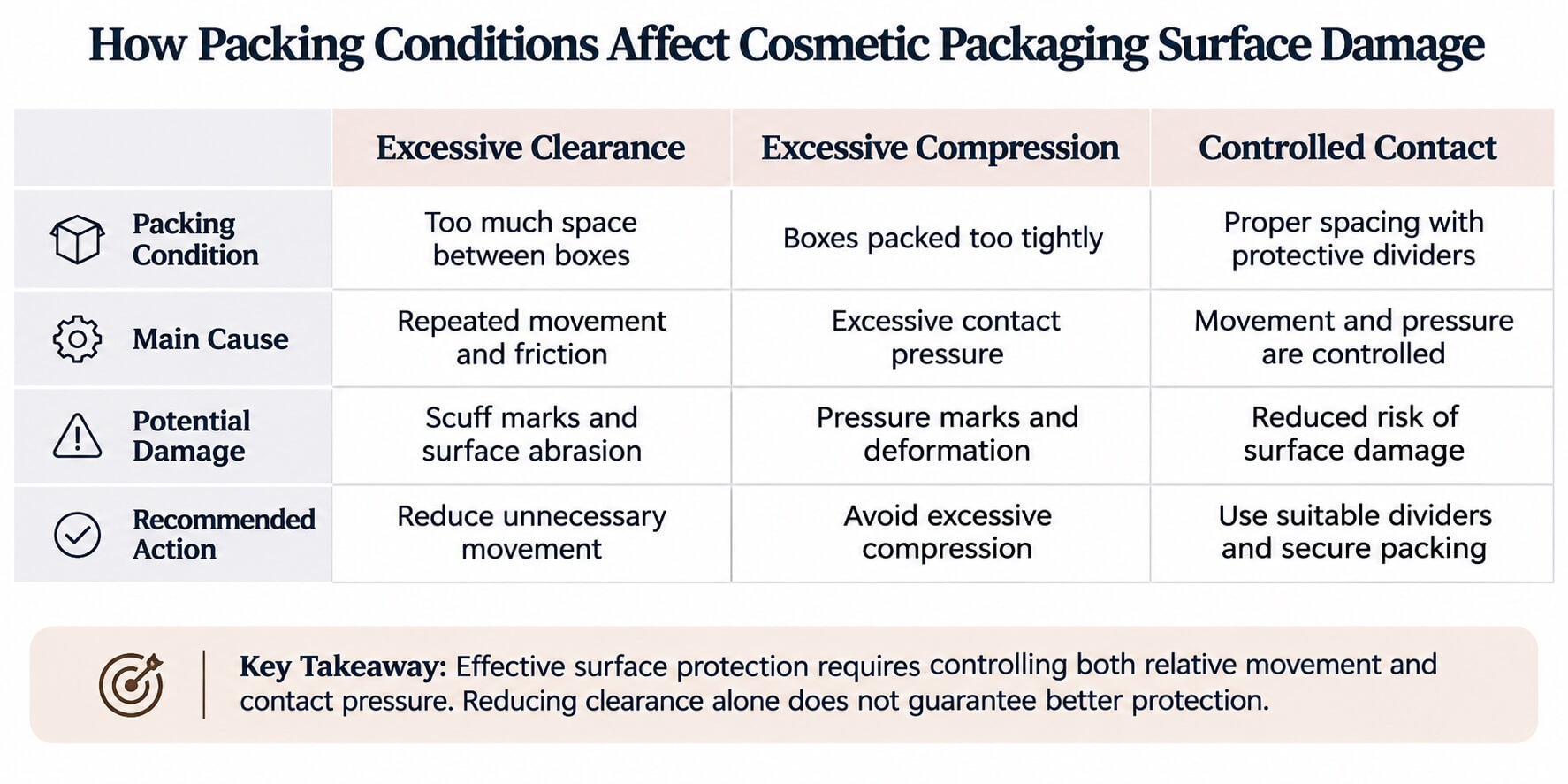
The solution must therefore address the actual mechanism. For movement-related damage, better restraint or compartment design may be appropriate. For pressure-related defects, contact geometry, load distribution, and the separator material may need adjustment.
Increasing paperboard thickness is not automatically the answer. Greater stiffness may reduce some forms of panel deformation, but it can also change how contact loads are transmitted. The complete structure must be assessed rather than treating thickness as an independent measure of protection.
Examine the Relationship Between Product Weight, Inserts, and Outer Panels
Internal inserts are generally designed to position and support the cosmetic product. Their influence on external appearance is less obvious but can be equally important.
A glass fragrance bottle introduces concentrated mass within the package. During vibration or impact, the bottle and insert transfer forces through their contact points into the outer structure. If these loads are directed toward a relatively flexible decorated panel, the panel may deform or press against adjacent packaging.
The relevant question is not simply whether the product fits tightly. It is whether the insert establishes a suitable load path while preventing excessive movement and avoiding unintended pressure on appearance-critical surfaces.
For heavy jars, the insert may need to support the product near structurally appropriate regions rather than relying on a large unsupported panel. For irregularly shaped bottles, contact should be evaluated around protrusions, shoulders, caps, and other features that could concentrate force.
The insert material also matters. Folded paperboard supports, corrugated components, and molded paper structures behave differently under compression and repeated loading. Their suitability depends on geometry, material properties, product weight, and the distribution conditions being addressed.
Can an insert that protects the product still contribute to packaging damage? Yes. An insert may prevent glass breakage while transmitting concentrated pressure to the outer box. It may also allow small but repeated movements that create internal rub marks. These outcomes do not necessarily mean the insert is inadequate for product retention; they indicate that its performance must be evaluated against additional requirements.
For multi-product cosmetic sets, the interaction becomes more complex. Bottles, jars, applicators, and accessories may have different masses and surface sensitivities. Their positions can change how the package responds to vibration and how forces are distributed through the structure.
This is why insert design should be validated with actual products or sufficiently representative substitutes, including realistic mass distribution—not only with empty cavities or simplified visual mockups.
Design Secondary Packaging Around Actual Contact Conditions
Even when the retail package and insert perform correctly, surface damage may occur at the secondary packaging level.
Master cartons, internal dividers, interleaving materials, protective sleeves, and pallet arrangements influence how finished packages contact one another during storage and transportation.
A divider is effective only when its material, geometry, and position suit the surface it protects. A relatively rough divider may prevent direct box-to-box contact while introducing abrasion at its own contact points. Loose protective sheets may shift during handling, while excessively tight wrapping can introduce pressure marks.
The correct design therefore depends on the complete packing arrangement.
For example, a shipping carton containing individually separated cosmetic boxes may reduce broad panel-to-panel rubbing. However, if the divider height or edge geometry concentrates force against a decorated area, the improvement may be incomplete.
Should every premium cosmetic box be individually wrapped? Not necessarily. Individual wrapping may reduce some contact risks, but it adds materials, labor, and handling operations. Its value depends on the surface sensitivity, packing density, transport conditions, and the effectiveness of simpler alternatives.
The objective should be to achieve the required protection with a controlled and repeatable packing process.
For brands considering different folding cartons for consumer goods, this principle extends beyond cosmetics. The same outer packing arrangement may not be suitable for lightweight skincare cartons, heavier fragrance sets, and large retail presentation boxes because their mass distribution and contact behavior differ.
Packaging engineers should evaluate the orientation of each unit, the location of critical decorated panels, the stability of separators, and the consequences of compression during stacking. The resulting packing instructions should be documented and reproduced during volume production.
Account for Structural Differences and Manufacturing Contact
Different box constructions expose finished surfaces to different forms of contact before and during distribution.
In manufacturing folding cartons, printed sheets undergo cutting, creasing, folding, gluing, collection, and packing. Depending on the production process, finished surfaces may contact machine components or neighboring cartons before they leave the factory.
This creates an important distinction between the durability of a flat printed sheet and the appearance of a fully converted box. A surface may pass a laboratory rub comparison yet develop marks during folding, stacking, or packing because the actual contact conditions differ.
Wrapped rigid constructions introduce other variables. Turned edge boxes use covering materials folded around structural board components. Wrapped corners, seams, and edge transitions can create localized contact conditions that are absent from flat sheet samples.
For kraft sleeve boxes, repeated sliding between the sleeve and inner component may affect the finish along the contact path. The problem may occur during assembly, customer opening, or transport-induced movement, depending on the construction.
The same engineering principles apply to luxury apparel boxes, where larger decorated panels may be more susceptible to handling contact or deformation under stacking loads. Meanwhile, recyclable gift boxes with logo require surface protection strategies compatible with their actual material construction and intended end-of-life requirements.
These examples do not imply that one structure is inherently more durable than another. They demonstrate why abrasion performance must be assessed in relation to geometry, assembly sequence, and actual use.
A relevant personal care packaging case study describes the use of an anti-scuff matte varnish alongside structural and insert development. The broader engineering lesson is that surface finishing, component movement, and product support should be considered together.
Control Drying, Curing, Storage, and Handling Conditions
Some defects attributed to transportation may originate earlier in production.
Printed and coated materials require suitable processing conditions before subsequent handling. Depending on the printing and finishing system, incomplete drying or curing can affect resistance to blocking, rubbing, or transfer.
Blocking occurs when contacting surfaces adhere or resist separation under particular conditions. When the components are pulled apart, the surface may become marked or damaged. This mechanism differs from ordinary abrasion and should not be treated with the same corrective measures.
Storage conditions can introduce additional variables. Relative humidity affects the moisture
content and mechanical behavior of paper-based materials. Temperature can influence certain coating and adhesive systems. These changes may affect panel flatness, contact pressure, or the stability of stacked components.
Can cosmetic packaging develop scuff marks without being transported? Yes. Prolonged stacking, repeated internal handling, unsuitable interleaving materials, or contact before the finish has reached its intended processing condition may cause damage during warehouse storage.
However, it would be inaccurate to prescribe one universal curing period, humidity range, or stacking limit for all packaging. Requirements depend on the substrate, coating chemistry, production process, and storage configuration.
Manufacturers should establish process-specific controls and verify their effectiveness on the finished construction.
For brands preparing multiple sales channels, the packaging preparation process should include pack-out conditions, handling sequence, and storage requirements where these affect appearance or performance.
Select Tests That Match the Suspected Failure Mechanism
A reliable validation program should not rely on one test to represent every distribution risk.
For printed packaging, ASTM D5264 describes a laboratory practice using the Sutherland Rub Tester to compare abrasion resistance under defined conditions. It can support comparisons among inks, coatings, laminates, and printed substrates, but its results depend on the selected test configuration and should not be treated as a universal prediction of transport performance.
The test conditions and acceptance criteria must therefore be documented. Comparing two finishes without controlling the substrate, contact material, applied load, and test procedure may produce results that are difficult to interpret.
Other investigations may require different methods. Coating separation can justify an adhesion assessment appropriate to the material system. Pressure marks may require examination of contact geometry and applied loads rather than additional abrasion cycles.
Distribution simulation evaluates a different level of performance.
ISTA Procedure 3A, for example, addresses packaged products moving through parcel delivery systems. It is intended to simulate selected transport hazards affecting the complete packaged product, including relevant handling and vibration conditions.
However, a successful ISTA 3A result does not automatically prove that a surface has a particular abrasion-resistance rating. Nor does a satisfactory laboratory rub result establish that the shipping configuration will protect the retail package.
What is the most useful test for preventing cosmetic packaging scratches? There is no single best test independent of the failure mechanism. A sound program may combine controlled surface testing with representative pack-out evaluation and distribution simulation.
Test samples should use production-representative substrates, inks, finishes, assembled structures, and product weights. The packing configuration should match the intended shipping arrangement as closely as practical.
Acceptance criteria must also be defined before testing. Without an agreed inspection method, two reviewers may reach different conclusions about the same surface mark.
Define Appearance Acceptance Criteria Before Mass Production
A packaging specification that simply requires “no scratches” may sound strict, but it is often difficult to apply consistently without further definition.
Brands should distinguish between critical appearance areas and less visible surfaces. A prominent front panel may have different presentation requirements from an internal flap or concealed underside.
Inspection conditions should be agreed in advance. These may include lighting arrangement, viewing distance, orientation, comparison with an approved physical reference, and the treatment of defects visible only under unusually strong directional light.
The specification should also distinguish cosmetic defects from functional failures. A minor surface gloss variation may affect appearance without reducing package function, while coating loss that compromises required information or exposes an unacceptable underlying layer may have greater significance.
The appropriate classification depends on the product, the affected area, the agreed quality requirements, and any applicable regulatory obligations.
How should brands decide whether a visible mark is acceptable? The decision should follow documented acceptance criteria rather than an inspector’s individual preference. Reference samples and agreed defect descriptions can improve consistency, but they do not eliminate the need for judgment when borderline cases occur.
Sampling plans should reflect the relevant quality risk. A small number of visually acceptable prototypes cannot establish the defect rate of a large production lot. Conversely, an isolated damaged unit does not automatically establish that the entire lot is defective.
Where the commercial agreement uses statistical acceptance sampling, the inspection level, defect classification, and acceptance criteria should be explicitly defined. No universal AQL value should be presented as suitable for every cosmetic packaging project.
The objective is to create a standard that is demanding enough to protect brand presentation and sufficiently precise to be applied consistently by both buyer and manufacturer.
Convert Test Findings Into Repeatable Manufacturing Controls
The final stage is translating observations into production and purchasing requirements.
A folding cartons manufacturer should be able to identify the surface system used, the relevant process controls, the critical appearance areas, and the packing configuration approved for shipment.
When comparing a folding cartons supplier with a manufacturer of folding cartons, buyers should focus on documented capabilities, quality responsibilities, and verification procedures rather than assuming that either business description guarantees better control.
A complete specification should identify the substrate, ink and finish construction, approved reference sample, applicable testing requirements, appearance criteria, protective materials, and shipping configuration.
It should also establish how changes are managed. Replacing a coating, changing the interleaving material, increasing the number of units per shipping carton, or modifying the distribution route may alter the damage risk even when the retail box design remains visually unchanged.
Cost evaluation should follow the same system-based approach.
Is additional surface protection worth the cost? The answer depends on the total consequences of damage, not just the price of protective materials. Brands should consider rejected packaging, repacking labor, replacement shipments, inventory loss, and operational disruption alongside the cost of prevention.
For some projects, a more suitable coating may reduce the need for individual wrapping. In others, a simple change in separator geometry may be more effective than upgrading the surface finish. The best solution is the one that addresses the verified failure mechanism while meeting the required appearance standard at an acceptable total cost.
Packaging decisions also need to remain practical as order quantities change. The relationship between setup costs, material consumption, and unit economics is discussed further in packaging production cost planning.
Ultimately, preventing cosmetic packaging surface damage is not a single-material decision. It is a coordinated process involving surface engineering, structural design, manufacturing controls, secondary packaging, and distribution validation.
Brands achieve more reliable results when they identify the actual damage mechanism, establish measurable acceptance criteria, and verify that the complete packaging system can preserve the approved appearance through the intended distribution process.