
Most packaging starts with a familiar rectangle or square for good reasons: these shapes are efficient to manufacture, pack, stack, store, and ship. But there are situations where the package itself needs to becom e a more distinctive part of the product experience. That is where custom shaped boxes can make sense.
A shaped package might follow a recognizable geometry such as a heart, hexagon, or triangle, or it may be developed around a product silhouette or brand concept. The important question is not simply whether an unusual shape looks more interesting. For a commercial packaging project, the shape must also work with the product, opening structure, insert, materials, manufacturing process, packing method, and logistics.
Choosing a successful shaped box therefore starts with function—not with shape alone.
When Does Custom Shaped Packaging Actually Make Sense?
The strongest reason to move away from a standard box is when the shape contributes something meaningful to the product or brand experience. A fragrance launch, confectionery gift, jewelry collection, seasonal set, or promotional package may benefit from a structure that is recognizable before the customer even reads the graphics.
This does not mean that every premium product needs unusual packaging. Standard rectangular rigid paper boxes can provide excellent presentation while remaining relatively straightforward to manufacture and pack. If a special shape adds little beyond visual novelty, the additional structural work and production complexity may not be justified.
Shaped packaging becomes more useful when the geometry reinforces a product story, creates a distinctive presentation, fits an unusual product, or supports a specific opening experience. The decision should therefore begin with a simple question: what does changing the shape actually improve?
For buyers still comparing basic packaging formats before choosing a custom geometry, Demei’s different packaging structures overview provides a useful starting point.
Shape and Box Structure Are Not the Same Thing
One of the most important distinctions in packaging development is the difference between shape and structure.
A heart, triangle, or hexagon describes the geometry of the package. A two-piece lid-and-base box, drawer box, folding carton, or collapsible rigid box describes how the package is constructed and opened. These two decisions can be combined.
For example, a hexagonal box could be produced as a rigid lid-and-base structure. A specially shaped gift package might use two piece boxes, while another design could incorporate a sliding tray similar to a rigid drawer box. Product visibility can also be incorporated through a die-cut opening when a concept calls for the function associated with window display boxes.
This is why a packaging brief should not stop at “we want a heart-shaped box.” It should also define how the customer opens it, how the product sits inside, how it will be packed, and what level of rigidity or protection is required.
What Shapes Can Be Used for Custom Shaped Boxes?
Geometric shapes are often the most practical starting point because their proportions and panel relationships can be engineered systematically. Heart shape boxes, for example, naturally suit gifting, confectionery, jewelry, and event packaging where the silhouette itself communicates part of the occasion.
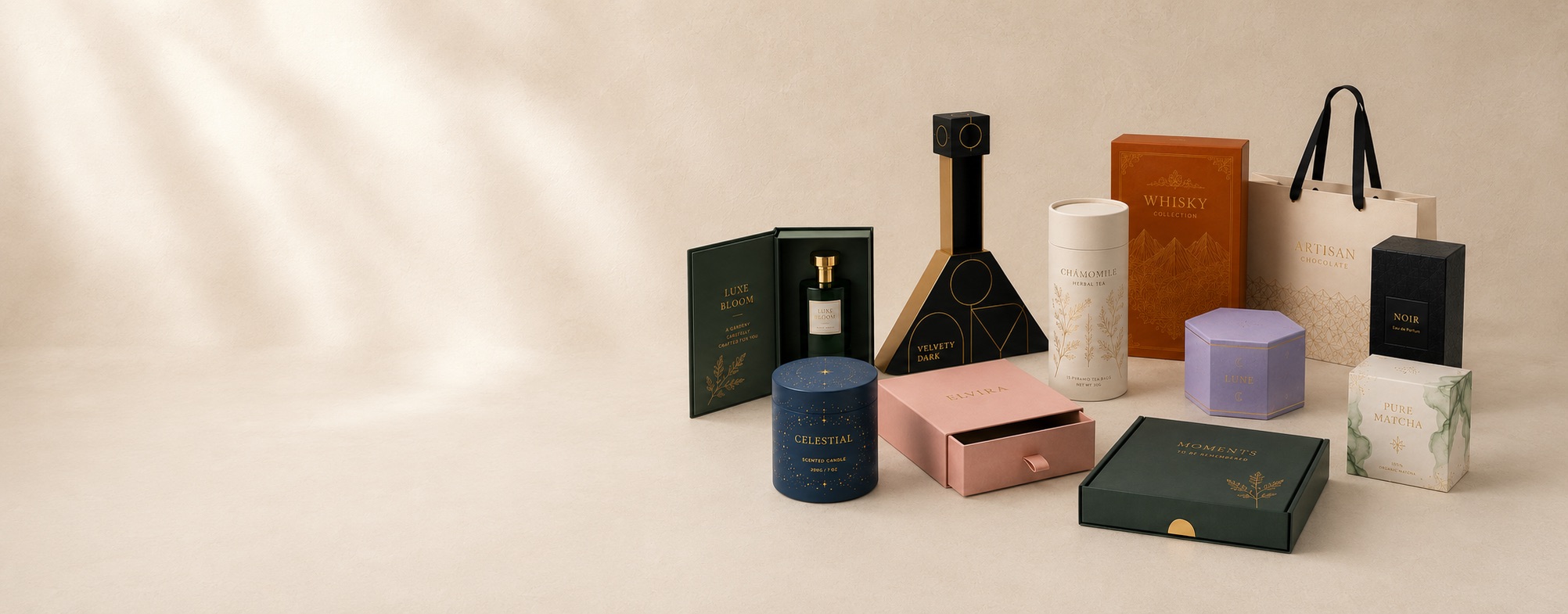
A hexagonal box offers a different effect. Its multiple faces create additional visual surfaces and can make a package stand apart from conventional square packaging without requiring an entirely free-form silhouette. Custom hexagon boxes can be developed around candles, cosmetics, confectionery, gift sets, and other products where the shape supports presentation as well as containment.
A triangular box creates an even more unconventional profile, but the product fit becomes more important because much of the internal volume near the corners may not be useful for a rectangular or cylindrical product. Beyond these geometries, brands can explore oval, polygonal, architectural, product-inspired, or proprietary silhouettes.
The goal, however, should not be to find the most complicated shape possible. Good shaped boxes use geometry deliberately. The exterior form should have a reason to exist and should still provide usable internal space.
Start With the Product, Not the Outer Shape
Before structural engineering begins, the manufacturer needs accurate information about the physical product: dimensions, weight, orientation, fragility, number of components, and how the buyer expects the product to be presented when the package opens.
This becomes particularly important with irregular packaging. A visually impressive outer silhouette may create surprisingly inefficient internal space. A heart-shaped package, for instance, has curved and tapered areas that may not correspond naturally to the shape of the product. A triangle creates similar challenges near its corners.
The insert becomes the bridge between the outer geometry and the actual product. Paperboard platforms, folded supports, dividers, collars, molded pulp, or other inserts can position products within the available space. For bottles, the design may need support at the base and neck; for a multi-product set, each item may need its own controlled position.
The insert should therefore be developed together with the box rather than added after the outer structure has already been finalized. Structural design guidance commonly treats insert position, product clearance, opening direction and dieline development as connected engineering decisions.
How Does Shape Affect Manufacturing?
Every departure from a standard geometry can change the production process. Folding cartons may require a custom cutting die and carefully positioned crease lines. Shaped rigid boxes can require individually cut board components, accurate wrapping pieces, forming aids, and more manual positioning during assembly. Industry manufacturing guides similarly note that changing geometry affects engineering and the precision required to reproduce the structure consistently.
Curves, sharp angles, narrow surfaces, and multiple corners also affect wrapping. A paper that behaves well on a flat rectangular panel may need additional consideration when it has to turn around complex edges. Artwork and finishes need the same attention: foil, embossing, patterns, and logos must remain correctly positioned after cutting, wrapping, folding, and assembly.
This is also where a collapsible rigid box or rigid collapsible box can become relevant to the discussion. A collapsible construction can reduce the volume occupied before assembly, but the structure has to be engineered so it forms accurately and remains stable after setup. It should be selected because the construction works for the project, not simply because “collapsible” sounds more efficient.
For complex custom shape boxes, a physical prototype is especially valuable. It allows the buyer and manufacturer to evaluate fit, lid alignment, opening resistance, insert performance, artwork position, stability, and assembly before committing to mass production.
Do Custom Shaped Boxes Cost More to Produce?
Often they can, but there is no useful universal percentage.
Cost depends on the specific geometry and construction. A relatively simple hexagonal folding carton may be much easier to manufacture than a complex hand-wrapped rigid structure with curved walls, multiple components, a fitted insert, and several finishing processes. Packaging cost is influenced by structure, material use, setup, finishing, inserts, quantity, assembly and logistics rather than shape alone.
Material efficiency matters as well. Non-standard components may not nest on sheets as efficiently as simple rectangular pieces, while complex rigid structures may involve more cutting, wrapping, gluing, positioning, or inspection. Tooling and additional sampling can also affect the project economics.
The better question for a buyer is therefore not “Are shaped boxes expensive?” but:
Does the value created by this shape justify the additional complexity of producing it?
What Should Buyers Check Before Approving a Custom Shaped Box?
Before approving a shaped packaging design, buyers should evaluate the complete packaging system rather than the appearance of the closed box.
Check whether the internal dimensions match the real product and insert; whether the opening method feels natural; whether the box remains stable when filled; whether important graphics stay aligned across edges; and whether the structure can be assembled consistently in production. A sample should also be reviewed in the way the packaging will actually be used—not only photographed on a desk.
Shipping deserves particular attention. An unusual shape may look compact from the front while occupying more volume when packed into master cartons. Pre-assembled rigid structures generally occupy their finished volume, while some folding or collapsible constructions can reduce inbound storage and transport requirements. The right choice depends on quantity, packing location, assembly requirements, and the product itself.
This is ultimately what separates a distinctive package from a merely unusual one. The best custom shaped boxes do not ask manufacturing, product protection, or logistics to compromise for the sake of appearance. They use shape, structure, and product fit as parts of the same design decision.
A successful result should feel distinctive to the customer—and completely intentional to the people who have to manufacture, pack, ship, and sell it.