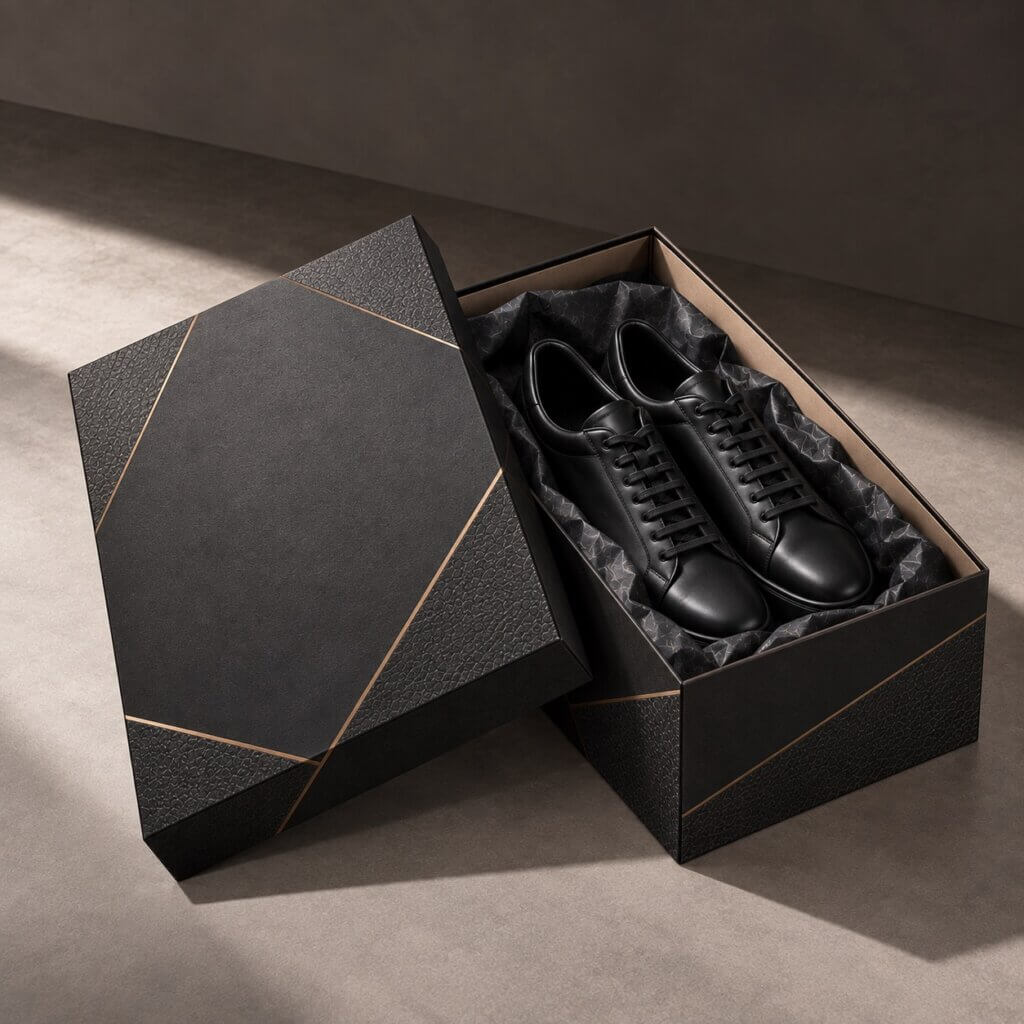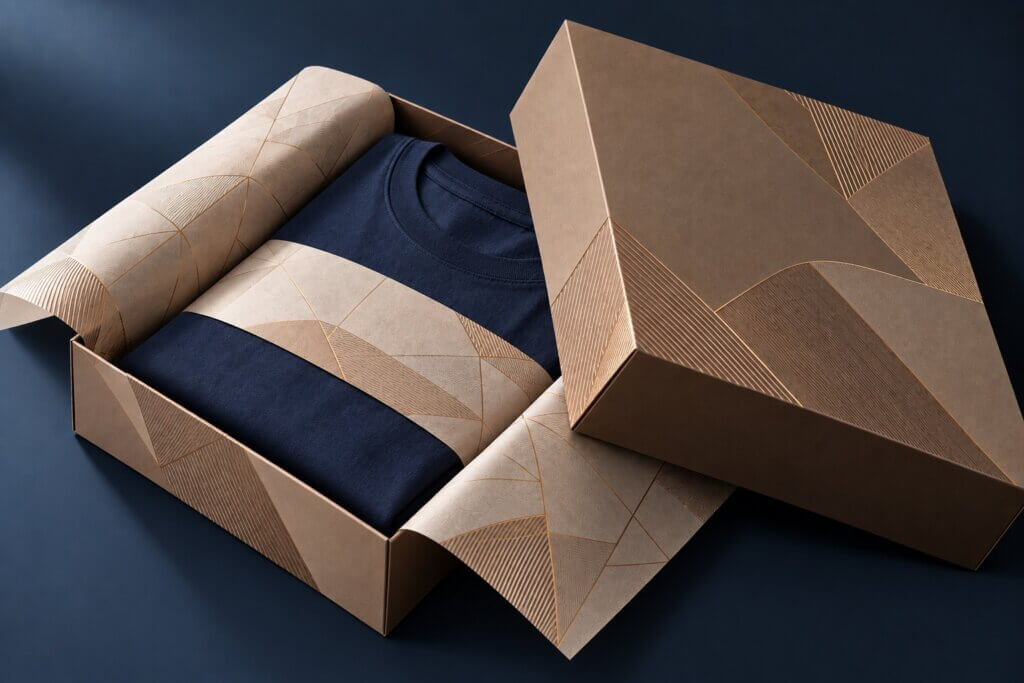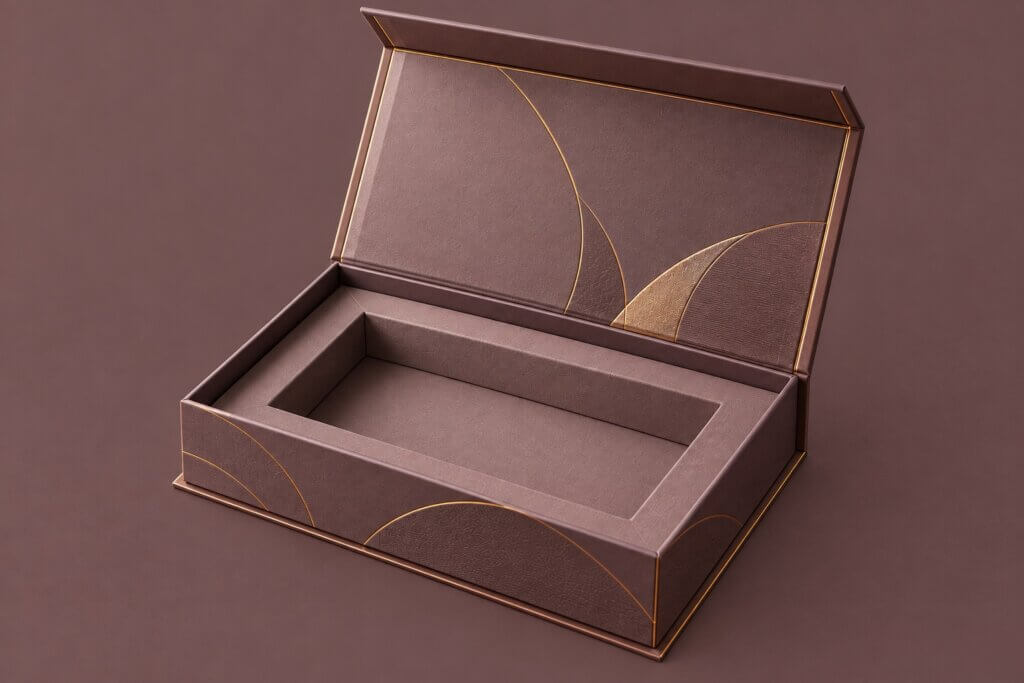

Two book-style boxes can use similar greyboard, similar wrapping paper, and almost identical finished dimensions, yet feel noticeably different when opened. One cover may rotate smoothly and return naturally to a flat, aligned position, while another becomes tight near the spine, shifts slightly as it closes, or needs extra pressure before the front edge sits correctly against the box. The difference is rarely explained by one material or one dimension. It usually comes from how several structural relationships work together as the package moves.
For custom booklet boxes, these relationships begin with the construction rather than the decoration. Unlike custom folding cartons, where scored paperboard forms most of the package, a book-style rigid box combines rigid board components with a flexible opening zone. It also behaves differently from custom drawer boxes, where the primary movement occurs between a sleeve and a sliding tray. More complex custom shaped boxes may introduce different opening mechanisms, but the same principle applies: once part of a package is designed to move, the relationship between components becomes as important as the dimensions of the individual components.
The engineering question is therefore not simply whether the box can open. It is whether the cover can follow a controlled opening path, return to a repeatable closed position, and continue doing so after the insert and product are added. That behavior develops progressively—from board geometry and the flexible hinge region to wrapping construction, component alignment, closure, product loading, physical sampling, and finally production tolerances.
A Booklet Box Is a Moving Structure
A typical book-style rigid box uses several rigid board components positioned within a continuous wrapped construction. An inner tray or rigid box body is mounted onto part of this case, while the cover remains free to rotate around the spine area. This is a more useful way to understand a booklet box than simply describing it as packaging that “looks like a book.” The book-like appearance is the visual result; structurally, the important characteristic is the relationship between rigid and flexible areas. Some components must remain dimensionally stable while another region must repeatedly bend enough to create the opening motion without losing control of the cover position.

This is also why a book-style construction should not be treated exactly like a conventional two-piece rigid box. A separate lid and base depend largely on the dimensional clearance between two independent components. A booklet structure introduces an additional moving relationship between connected rigid panels, so the construction has to satisfy two requirements at the same time: the rigid areas need enough stability to hold their geometry, while the connecting region needs enough flexibility to allow controlled movement.
Once movement becomes part of the structure, the first critical question is where that movement should occur.
The Hinge Gap Creates the Opening Path
The boards forming the cover and spine cannot behave as one continuous rigid panel at the point where rotation is required. A controlled space between adjacent board components allows the wrapping material to flex as the cover moves, creating the working hinge region. If that space is too small for the selected board thickness and wrapping construction, the rigid edges and surrounding material can begin to interfere with one another during rotation. Opening resistance may increase, the covering material may be compressed into an unnecessarily tight fold, and the cover can struggle to reach its intended opening angle naturally.
An excessive gap creates a different problem. The flexible region becomes wider, allowing more movement between the rigid components and potentially making the relationship between the cover and spine less controlled. For this reason, there is no single correct hinge-gap dimension for every booklet box. The required spacing depends on board thickness, wrapping construction, adhesive build-up, spine geometry, intended opening angle, and the position of the inner box. These variables determine how much room the wrapped structure needs to bend without creating unnecessary movement, which is why a hinge dimension copied from another box may be unsuitable even when the two packages appear similar in finished size.
The hinge is therefore not an isolated measurement. It is the first part of a dimensional system, and the next manufacturing step—wrapping the boards—changes that system again.
Wrapping Material Becomes Part of the Moving Structure
Wrapping paper is often considered primarily as a visual material because its color, texture, print response, foil compatibility, and tactile character contribute strongly to presentation. Around the hinge of a book-style box, however, the wrapping material also performs a structural function. It crosses the space between rigid components and bends every time the cover moves, which means its caliper, flexibility, surface treatment, lamination, grain behavior, adhesive application, and edge-wrapping construction can influence the finished movement. Two samples based on the same board layout may therefore behave differently if their wrapping materials have substantially different physical characteristics.
A thicker wrapping material may contribute to opacity, surface character, or a particular tactile effect, but those qualities do not automatically make it more suitable for a booklet structure. Around the hinge, the same material must tolerate repeated bending without creating excessive stiffness, uncontrolled creasing, or unnecessary material build-up. A paper that performs well across a large stationary panel can behave differently when it becomes part of a narrow flexible zone, so material selection should consider both visual performance and the physical behavior required by the structure.
Material build-up also matters outside the hinge. Wrapping paper, adhesive, liners, turned edges, and overlapping areas all occupy physical space, so the effective relationship between components after wrapping is no longer exactly the same as the original bare-board geometry. Once those layers have been introduced, the engineering problem progresses from creating enough freedom for the cover to open to ensuring that the same cover can return accurately to its intended position.
Smooth Opening Is Only Half of the Requirement
A cover can open smoothly and still close poorly. When the booklet closes, the cover needs to return to a repeatable position relative to the inner box, and that position is influenced by spine width, hinge geometry, board squareness, inner-box placement, wrapping build-up, and assembly accuracy. A slight shift in board placement may not create an obvious problem by itself, and neither may a small variation in wrapping or inner-tray mounting. When several of these variations accumulate in the same direction, however, the finished result may appear as an uneven front edge, inconsistent clearance, or a cover that sits slightly out of square.
Opening freedom and closing alignment are two different requirements.
The hinge needs enough freedom to rotate without interference, while the complete structure still needs enough positional control to return consistently. This distinction also helps explain the relationship between book-style construction and magnetic packaging. A book-style structure does not inherently require magnets: “book-style” describes how the rigid components are connected and opened, while magnetic closure describes one possible method of holding the cover in its final position. The two are frequently used together, but they are not the same structural definition.
Once magnets are introduced, however, the closure becomes another dimensional relationship that has to work with the geometry already established.
Magnets Should Maintain Closure, Not Correct the Structure
A concealed magnetic closure can create a clean and controlled closing action, but it should work with an already aligned structure rather than force a poorly aligned cover into position. Its performance depends on more than magnetic strength. Magnet position, polarity, distance between the magnetic components, material covering them, board thickness, cover stiffness, and the final position of the cover all influence how the closure behaves. If corresponding closure points are misaligned, one area may engage before another, or the magnetic attraction may pull the cover slightly sideways as it approaches the box.
Increasing magnetic force does not solve the underlying geometric problem. It may simply increase the force required to reopen the package while leaving the alignment error unchanged. The more reliable development sequence is to establish the cover’s opening path and final closed position first, then specify a closure that maintains that position without creating unnecessary opening resistance. This is also why comparing a “book-style box” directly with a “magnetic box” can be misleading: one term describes the opening structure, while the other describes a closure method.
At this stage, the empty box may already open and close correctly, but the package has not yet been tested under the condition in which it will actually be used.
The Product and Insert Change the Loaded Condition
Once a product and insert are added, the package gains weight and its internal load distribution changes. A heavier product positioned away from the center can affect how the package is held and opened, while an insert that sits too high may interfere with the cover or internal lining. Excessive outward pressure from an insert can also influence the geometry of the assembled inner box. Whether a booklet box requires a custom insert therefore depends on the product rather than the box style alone: product geometry, weight, fragility, presentation position, allowable movement, and removal direction all influence that decision.
Where an insert is required, its role goes beyond filling unused space. It should locate the product, restrict unwanted movement, transfer load into structurally stable areas, and still provide enough clearance for practical removal. These requirements can conflict with one another. Reducing clearance may improve positional control, for example, while making the product unnecessarily difficult to remove. Insert design therefore becomes another balance of controlled relationships rather than a question of making the cavity as tight as possible, especially for fragrance, cosmetics, electronics, accessories, and multi-component gift sets.
The correct condition to evaluate is the loaded package—not only the empty box.
This distinction matters because a structure that behaves correctly without its contents can change once the final product, insert, and closure begin working together. At that point, the relationship can no longer be validated reliably from a digital rendering alone, which makes physical sampling the next stage of the development process.
A Physical Sample Should Test Motion, Not Just Appearance
A digital rendering can communicate proportions, artwork, finish placement, and the intended presentation, but it cannot fully reproduce the physical interaction between board edges, wrapping layers, adhesive, friction, compression, component position, and actual product weight. This is why a booklet box can look correct digitally yet behave differently as a physical sample. Opening and closing are physical outputs produced by the complete material and dimensional system, not by appearance alone.
A useful prototype should therefore be evaluated using the intended board construction, representative wrapping material, insert, closure, and actual product—or a substitute that represents the relevant dimensions and loading conditions closely enough for structural evaluation. The purpose is not only to determine whether the package looks like the approved design. The sample needs to show whether the hinge bends where intended, whether the cover moves through the expected path, whether the closure meets in the correct position, and whether adding the product changes any of those relationships.
Repeated opening is more informative than a single successful movement. During sampling, the hinge should continue bending through the intended flexible zone without developing abnormal creasing or progressive resistance. The cover should return naturally to its designed position, closure points should continue to register correctly, and the loaded product should remain controlled without the insert interfering with the cover. These observations connect material behavior directly to the dimensional decisions made earlier in development.
At this point, sampling has moved beyond asking whether the box looks correct. It is testing whether the complete construction behaves correctly and whether that behavior is stable enough to become the reference for production.
Mass Production Adds a Tolerance Stack
Once an approved structure enters production, normal manufacturing variation is introduced through board cutting, board placement, wrapping registration, adhesive application, edge turning, inner-box mounting, closure positioning, and final assembly. Individually, these variations may be small, but their combined effect matters because several components participate in the same opening and closing motion. If multiple variations accumulate in the same direction, the finished result can appear as a shifted cover, uneven spine relationship, closure mismatch, or different opening resistance from one box to another.
The production objective is therefore not to eliminate every dimensional variation. It is to identify which relationships are functionally sensitive and control those relationships within an appropriate range. Hinge spacing, spine-to-box position, cover alignment, inner-tray placement, and closure registration are examples of relationships that can directly influence how the finished package behaves. A dimension with little influence on movement does not necessarily require the same functional attention as one that determines where the cover bends or where it finally closes.
An approved sample can consequently open correctly while production boxes develop small differences in resistance or alignment if control focuses mainly on appearance. Matching print color, foil position, embossing, and surface finish remains important, but those checks alone do not control the complete opening system. Production consistency also depends on maintaining the functional relationships established during structural sampling, so that normal manufacturing variation stays within a range that does not materially change the user’s opening and closing experience.
For production engineering, consistency means reproducing the behavior of the approved structure—not simply reproducing its appearance.
A Good Booklet Box Is Designed as One Opening System
A well-functioning book-style package is not created by one premium material, a stronger magnet, or an unusually thick board. Its behavior develops progressively through the construction. Board geometry establishes the rigid skeleton; spacing between panels creates the flexible hinge region; wrapping materials change how that region bends while adding thickness to the finished components; and those finished dimensions influence where the cover returns. The closure then maintains that position rather than creating it.
Once the insert and product are added, the same structure must continue to operate under its actual loaded condition. Physical sampling connects those individual decisions into one working package, while mass-production control has a different responsibility: keeping the functionally sensitive dimensions and assembly relationships within a range that reproduces the approved behavior consistently.
For custom booklet boxes, this is ultimately the difference between designing a box that simply looks correct when closed and engineering a package that opens, carries the product, closes, and repeats that experience predictably.
At Demei Packaging, most custom packaging projects start from 500 pieces. For booklet-style structures, we recommend validating the hinge construction, wrapping material, insert, product fit, and closure together in a physical sample before mass production.