
Two corrugated mailer boxes can have identical dimensions, board grades, and structural designs yet respond differently to bending, compression, and folding. One possible reason is the orientation of the corrugated flutes relative to the finished package. Although flute direction is often determined during dieline development, its effects extend beyond material layout into structural performance and manufacturing consistency.
For brands developing custom packaging mailers, this matters because corrugated board does not behave equally in every direction. Rotating a blank relative to the flute orientation can change the mechanical response of individual panels, alter how creases form, and affect the relationship between material utilization and production reliability.
The engineering challenge is not simply deciding whether flutes should run vertically or horizontally. It is understanding how board orientation interacts with panel geometry, load distribution, folding requirements, and manufacturing constraints. These interactions should be considered together before a structural design is approved for production.
Why Corrugated Board Has Direction-Dependent Mechanical Properties
The influence of flute direction begins with the construction of corrugated board. A typical single-wall structure contains two linerboards separated by a fluted medium, with adhesive bonds connecting the components into a composite material. The separation between the liners contributes substantially to bending rigidity, while the corrugated medium helps maintain that separation and transfers shear forces between the facing layers. The mechanical response depends on the geometry and properties of the complete construction rather than on paper thickness alone.

Corrugated board is generally treated as an orthotropic material, meaning its effective mechanical properties differ along its principal directions. This behavior results from both the geometry of the flutes and the directional properties of the constituent papers. Under bending, the liners carry significant tensile and compressive stresses, while the medium and adhesive connections influence shear transfer and local stability. Rotating the board relative to a load therefore changes how these structural components participate in resisting deformation.
Is flute direction the same as paper grain direction? No. Flute direction describes the direction along which the corrugation channels extend. Paper grain direction is associated with the preferential fiber orientation established during papermaking, commonly described using machine direction (MD) and cross direction (CD). Although conventional corrugating processes establish relationships between these directions, rotating a converted blank does not independently change the fiber orientation within its constituent papers.
For a box mailer, the practical implication is that orientation must be evaluated relative to the actual package geometry. A directional material property only becomes meaningful when the relevant loading direction, panel dimensions, and support conditions are identified.
How Flute Direction Changes Panel Bending and Structural Stability
The directional behavior of corrugated board becomes particularly important when the material forms the broad panels of a package. Under external pressure, these panels may bend toward the contents, while under in-plane compression they may eventually lose stability through buckling. Although bending and buckling are different mechanical responses, both are influenced by panel stiffness, geometry, and boundary conditions.
Does flute direction affect bending stiffness? Yes, but the effect depends on the bending axis and the board construction. Because the fluted structure and constituent papers contribute differently along different directions, rotating the board can change the relationship between applied bending moment and resulting curvature. The magnitude of this change depends on flute profile, liner properties, medium properties, bonding, and the specific deformation being evaluated.
Consider a shallow rectangular mailer with a relatively wide top panel. If external pressure is applied near the center, the panel distributes that load toward its supported edges. Its resistance to deflection depends not only on the board’s directional bending stiffness but also on the distance between supports. A long unsupported span may allow substantial deformation even when the nominal board grade appears adequate.
This leads to an important design distinction: increasing material strength does not necessarily solve a panel-stiffness problem. A package may require a different support arrangement, reduced unsupported span, or revised construction rather than simply heavier board.
In custom printed mailers, these structural decisions should precede final artwork approval. A design that requires significant changes to panel dimensions or crease positions after printing approval can introduce avoidable revisions to both the structural dieline and printed layout.
Why Flute Orientation Does Not Determine Box Compression Strength Alone
Once panels are connected through folds, corners, and closure features, the package becomes a three-dimensional load-bearing system. Under compression, external forces are transferred through the lid, sidewalls, corners, and supporting surfaces. The resulting deformation depends on how these elements interact rather than on the strength of any single panel.
For conventional shipping cartons under top-to-bottom compression, vertical flute orientation is widely used because it aligns the board’s directional properties with an important load path. However, shallow self-locking packages may behave differently. Their lid engagement, folded edges, sidewall proportions, and product support can alter how external loads are transmitted through the structure.
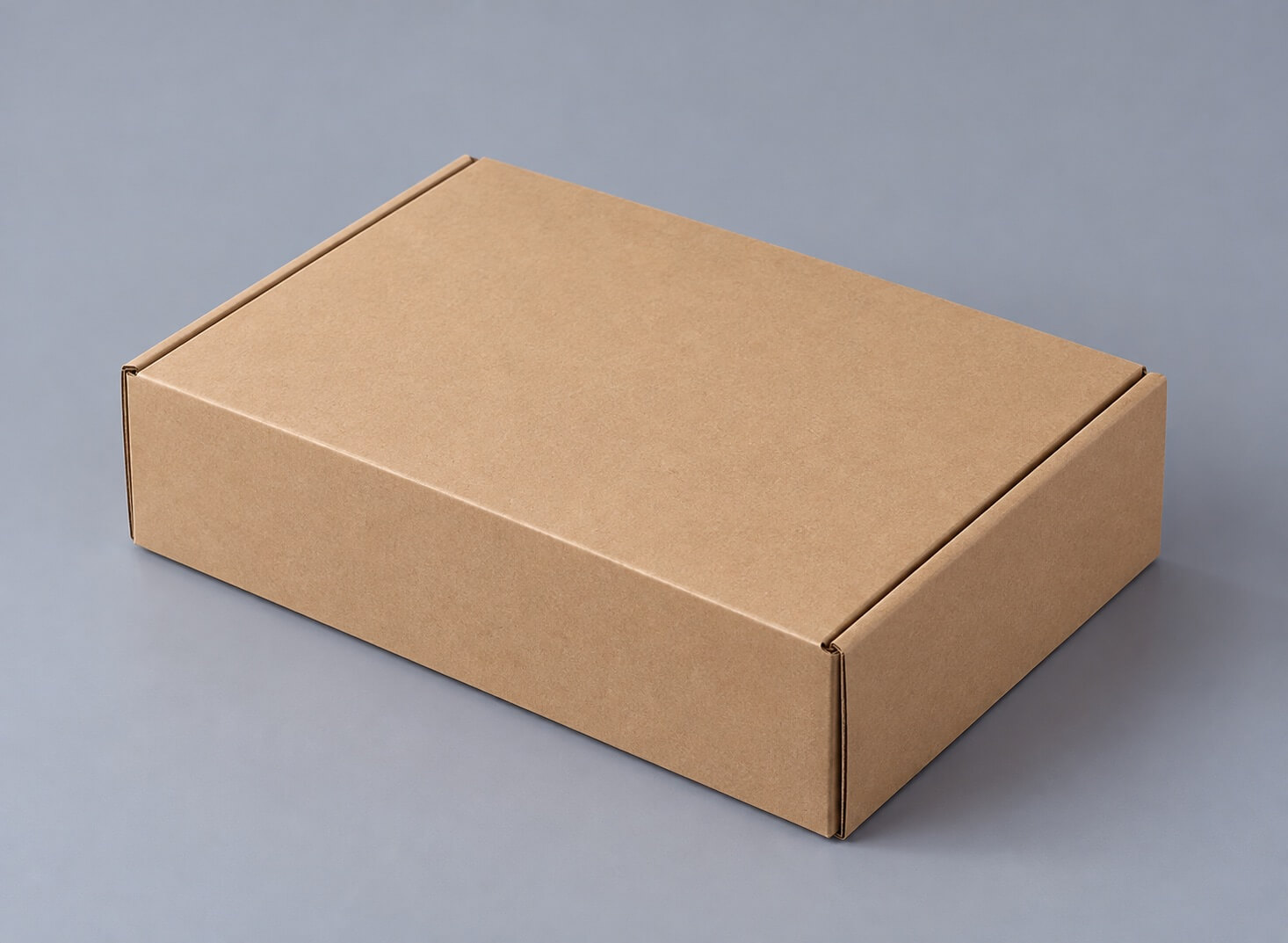
Should corrugated flutes always run vertically to maximize compression strength? Not necessarily. The appropriate orientation depends on the package configuration and the loading conditions. Research on conventional corrugated cartons has demonstrated that changes in flute angle do not always produce proportional changes in maximum box compression load. These findings illustrate the importance of structural interaction, although results from conventional cartons should not be applied directly to every mailer design.
A critical distinction is the difference between edgewise material resistance and complete-box compression. The Edge Crush Test (ECT) evaluates the edgewise compression resistance of a board specimen under prescribed conditions. A Box Compression Test (BCT) measures the assembled package’s response to a specified compressive loading procedure. Both measurements are useful, but they describe different levels of structural behavior.
Can a box with adequate ECT performance still deform excessively? Yes. A board may satisfy a specified edgewise compression requirement while the finished package experiences substantial panel deflection, premature local buckling, or closure displacement. These outcomes can arise from panel proportions, bending stiffness, connection details, or loading conditions that are not fully represented by the ECT result.
For personalized boxes for shipping, structural suitability therefore cannot be established from a board-strength designation alone. It must be evaluated in relation to the assembled design, packed product, and intended distribution environment.
This is also why selecting the best custom mailer boxes for a particular application requires more than comparing material ratings. The preferred construction is the one that satisfies the relevant performance requirements while remaining practical to manufacture and assemble.
How Flute Orientation Influences Creasing and Folding Accuracy
Structural strength is only useful when the selected board can be converted into the intended package consistently. This makes crease formation the next important consideration.
During converting, creasing introduces controlled local deformation so the board can fold along predetermined lines. The process changes the geometry and mechanical behavior of the affected area. Depending on the tooling and board construction, portions of the corrugated medium may be compressed or locally crushed, while the liners undergo bending and tensile or compressive deformation.
Does folding parallel to the flutes behave differently from folding across them? It can. A crease running parallel to the flute channels interacts with the corrugated structure differently from one crossing successive flute peaks and valleys. This can influence the distribution of local deformation, folding resistance, and the consistency of the resulting hinge.
However, flute orientation alone does not determine crease quality. Creasing-tool geometry, channel width, compression depth, liner properties, board moisture, and folding angle also affect the result. Excessive local crushing may reduce stiffness around the fold, while insufficient crease formation can increase folding resistance or spring-back. The objective is to develop a fold that operates reliably without introducing unacceptable material damage.
This becomes particularly important in self-locking structures. Sidewalls, lid hinges, dust flaps, and locking tabs must move through compatible folding sequences. If one crease develops excessive resistance or uneven recovery, the resulting force can influence adjacent panels, potentially affecting wall alignment or closure engagement.
Can flute orientation affect assembly accuracy even when the dieline dimensions are correct? Yes. A dimensionally correct blank can still assemble inconsistently if its crease behavior produces excessive resistance, uneven folding, or local distortion. The problem may become more apparent during repeated production or rapid manual packing than during assembly of a single carefully prepared sample.
For custom colored mailers, these effects may also influence surface appearance. Highly printed regions that cross folding lines can make local cracking, coating damage, or irregular crease formation more visible. Representative printed samples should therefore be assessed in their assembled condition rather than judged only while flat.
How Flute Direction Affects Dieline Layout and Production Yield
Once the required mechanical and folding characteristics have been established, the design must be translated into an efficient manufacturing layout.
Corrugated blanks are cut from sheets with defined dimensions and flute orientation. Changing how the dieline is positioned relative to the sheet can alter the direction of the flutes through each panel and across its crease lines. Although the finished package dimensions may remain unchanged, the manufacturing consequences can be significant.
Can manufacturers rotate a dieline to improve material utilization without changing box dimensions? Sometimes, but the result depends on the blank geometry, sheet size, equipment constraints, and required flute orientation. Rotating a blank can change how many units fit on a sheet, the arrangement of waste areas, and the relationship between creases and corrugation channels.
For example, one layout may provide a higher theoretical cutting yield but introduce less favorable folding behavior. Another may use more material while producing a structure that assembles more consistently. Neither outcome should be assumed without examining the actual board specification and converting process.
This distinction is especially relevant to wholesale mailer boxes, where small changes in material utilization or rejection rates can become commercially meaningful across repeated production runs.
A useful manufacturing comparison should therefore consider more than the number of blanks obtained from each sheet. It should also evaluate acceptable finished-unit yield, conversion stability, tooling requirements, and the consequences of structural variation. A layout that reduces sheet waste but increases rejected packages may not provide the lowest effective manufacturing cost.
The relationship between design and production is why structural design and material selection should be coordinated rather than treated as independent decisions. An efficient layout must preserve the mechanical and assembly characteristics required by the approved structure.
How Manufacturers Should Validate Flute Orientation Before Mass Production
The preceding analysis establishes why flute orientation must be evaluated at multiple levels. Material testing identifies directional properties, component testing examines localized behavior, and finished-package testing determines whether those properties produce acceptable performance in the assembled structure.
Is an Edge Crush Test sufficient to validate a corrugated mailer for shipping? No. ECT measures a defined material characteristic and does not independently evaluate lid retention, panel deflection, assembly consistency, impact resistance, or vibration-related damage. The relevant tests should be selected according to the risks associated with the intended application.
A disciplined validation process begins by defining those risks. Product weight, internal support, panel dimensions, packing method, stacking conditions, and distribution requirements determine which structural responses matter. If a package is expected to support stacking loads, assembled compression performance may be important. If the primary concern is deformation of a broad panel, directional bending measurements may provide more relevant supporting evidence.
The next step is to compare candidate orientations under controlled conditions. Wherever possible, equivalent board constructions should be used so that differences caused by flute orientation are not confused with changes in material composition. Tests should be conducted on conditioned specimens using appropriate methods, with enough samples to evaluate variation rather than relying on one favorable result.
Should flute orientation be reconsidered when changing board grade or flute profile? Yes, where the change may affect performance. Different flute geometries, liner combinations, or medium properties can alter directional stiffness, crease behavior, and structural stability. Earlier validation may not remain representative after a material substitution.
For brands sourcing custom mailers boxes, a nonstandard phrase sometimes found in purchasing searches, the more important requirement is a controlled production specification. That specification should identify the approved board construction, flute orientation relative to the dieline, relevant tooling revision, and agreed acceptance criteria. Search terminology should not become a substitute for technically meaningful documentation.
The validation plan should also distinguish structural compression from transport performance. Compression testing cannot reproduce every shock, vibration, or handling event. Where parcel-distribution damage is a concern, an appropriate distribution-testing procedure may be required in addition to material and structural evaluations.
Manufacturers can also use repeated assembly trials to assess folding resistance, locking consistency, and dimensional variation. Results should be recorded against defined criteria so that material orientation can be compared objectively rather than accepted through visual inspection alone.
These decisions belong within a broader development process. Reviewing packaging development case studies can help illustrate how material choices, structural features, and product-support requirements are coordinated. For projects approaching production, the company’s sampling and production guidance also explains the role of physical prototypes and preproduction approval.
For international distribution, the evaluation should reflect actual operating conditions rather than relying on geographic assumptions. Parcel handling in North America, consolidated retail shipments in Europe, and storage in humid environments can present different combinations of mechanical and environmental exposure. These differences matter because corrugated board is moisture-sensitive and its performance can change with conditioning and storage conditions.
A technically defensible approval therefore combines defined specifications, representative samples, appropriate testing, and documented acceptance limits. It does not depend on a universal rule about flute direction.
Selecting Flute Direction as Part of the Complete Packaging System
Flute direction influences corrugated mailer performance through a sequence of connected mechanisms. It begins with direction-dependent material properties, affects panel bending and structural stability, interacts with crease formation, and ultimately influences the manufacturing layout and consistency of the finished package.
The appropriate orientation is therefore determined by the package’s functional requirements rather than by a preference for horizontal or vertical flutes. For some designs, compression performance may be the primary concern. For others, broad-panel rigidity, folding reliability, or assembly consistency may be equally important.
A sound engineering decision considers these requirements together and verifies the selected construction under representative conditions. By evaluating material behavior, structural geometry, converting performance, and production repeatability as one system, brands can develop corrugated packaging that is both technically reliable and practical to manufacture.
For projects requiring structural assessment before tooling approval, early packaging engineering consultation can help identify which material and orientation variables should be tested before the design moves into production.