
Reverse tuck folding cartons are one of the most established structures used for lightweight retail packaging. They can be supplied flat, erected quickly, printed across almost every visible panel, and adapted to products ranging from skincare tubes and cosmetics to supplements, pharmaceuticals, and small consumer goods.
Among the different types of folding cartons, however, reverse tuck is only one option. Product weight, dimensions, board stiffness, packing method, shelf presentation, and the way consumers open the package all influence whether it is the right structure. For buyers comparing folding carton types, these questions should come before choosing paperboard, printing, or finishing.
For brands developing custom folding cartons, the process should therefore start with the actual product and packing requirements rather than with an existing dieline that is simply resized. The carton structure, paperboard, internal fit, printing, and finishing should work together as one packaging system.
What Makes a Reverse Tuck Carton Different?
A reverse tuck end carton, commonly abbreviated as RTE, is normally made from a single sheet of paperboard that has been printed, die-cut, creased, folded, and glued along one side seam. The finished cartons can remain flat until they are needed for packing, which helps reduce storage and transport volume before use.
Its defining feature is the relationship between the top and bottom closures. The two main tuck flaps close in opposite directions. A straight tuck end carton uses a very similar basic construction, but its top and bottom main tuck flaps close in the same general direction.
A typical RTE carton contains four main body panels, a manufacturer’s glue flap, top and bottom tuck flaps, smaller dust flaps, and the score lines required to form the box. Depending on the product, the dieline can also incorporate thumb notches, locking cuts, windows, hang tabs, or other functional details.
What is the difference between reverse tuck and straight tuck folding cartons?
The main difference is flap direction, but that small structural change affects the flat blank, panel arrangement, and how the carton is packed. Once erected, the two styles can look surprisingly similar, which is why comparing the dielines is usually more useful than looking only at the finished boxes.
The main difference is the direction of the top and bottom tuck flaps. In a reverse tuck end carton, these flaps close in opposite directions, while in a straight tuck end carton they close in the same direction. Both structures are normally supplied flat and can usually be opened and reclosed without damaging the carton.
The difference becomes more obvious when the cartons are viewed as flat dielines rather than finished boxes. Reverse tuck cartons have an opposing flap arrangement, while straight tuck cartons have a more aligned closure layout. Reverse tuck is widely used for general retail packaging, whereas straight tuck may be preferred when panel orientation, front-and-back presentation, or a particular packing arrangement makes the aligned closure more practical.
Neither structure is inherently better. The choice should be based on the product dimensions, weight, packing method, sheet layout, and presentation requirements rather than flap direction alone.
The important point is that neither structure is automatically better. Folding carton styles should be selected according to the product and production requirements rather than by appearance alone.
Is Reverse Tuck Always Cheaper Than Straight Tuck?
Not necessarily.
Reverse tuck structures can create efficient blank layouts for certain carton proportions because the flaps face opposite directions. In some projects, that can allow tighter nesting on the production sheet and reduce board waste. But this advantage depends heavily on the actual dimensions.
Folding carton dimensions, paper grain direction, press sheet size, die layout, spacing between blanks, order quantity, and converting equipment all affect material efficiency. A dieline that looks economical as an individual box may not produce the best sheet utilization when dozens of blanks are imposed together.
This is especially relevant for folding carton converters. They need to evaluate printing setup, die-cutting, stripping, folding, gluing, finishing, and packing speed—not just the area occupied by one blank.
Are reverse tuck cartons cheaper than straight tuck cartons?
Sometimes, but not as a rule. Reverse tuck can be more material-efficient for certain dimensions, while straight tuck can be equally efficient or even preferable in other layouts. The final unit cost depends on board usage, printing setup, finishing, die-cutting complexity, gluing speed, and order quantity.
So reverse tuck should not be selected simply because it is assumed to be the lowest-cost folding carton structure.
Can a Reverse Tuck Carton Hold a Heavy Product?
For lightweight products, a standard reverse tuck closure can work very well. A skincare tube, small pharmaceutical bottle, soap, or compact accessory creates relatively little pressure on the bottom closure.
A dense glass bottle creates a different structural load. As product weight increases, especially when concentrated over a small bottom area, the tuck flap is subjected to more force during packing, lifting, transport, and retail handling. Increasing board thickness may help, but it does not automatically solve the problem because the closure geometry itself can become the limiting factor.
Can reverse tuck folding cartons hold heavy products?
They can handle some moderate loads, but a standard tuck bottom is not the best choice for every heavy product. When weight is high or concentrated, a snap-lock bottom, auto-bottom, glued bottom, or another reinforced structure may provide more reliable support.
If the product also requires cushioning or controlled positioning, the carton may need to work together with an insert rather than relying on the outer shell alone.
This is where comparing different packaging structures becomes useful. The goal is not to force every product into a familiar carton, but to choose the structure according to product weight, shape, protection requirements, packing method, and distribution conditions.
Choosing the Right Paperboard
The reverse tuck dieline determines how the carton closes, but it does not determine which board should be used. The same structure can be produced from different paperboard grades depending on product weight, graphics, stiffness requirements, finishing, sustainability goals, and budget.
SBS and other coated white paperboards are common when a clean printing surface and accurate graphics are important. The search term white coated board for folding cartons often represents a broader requirement: buyers may actually be looking for brightness, smoothness, print consistency, stiffness, and compatibility with foil, embossing, or coatings.
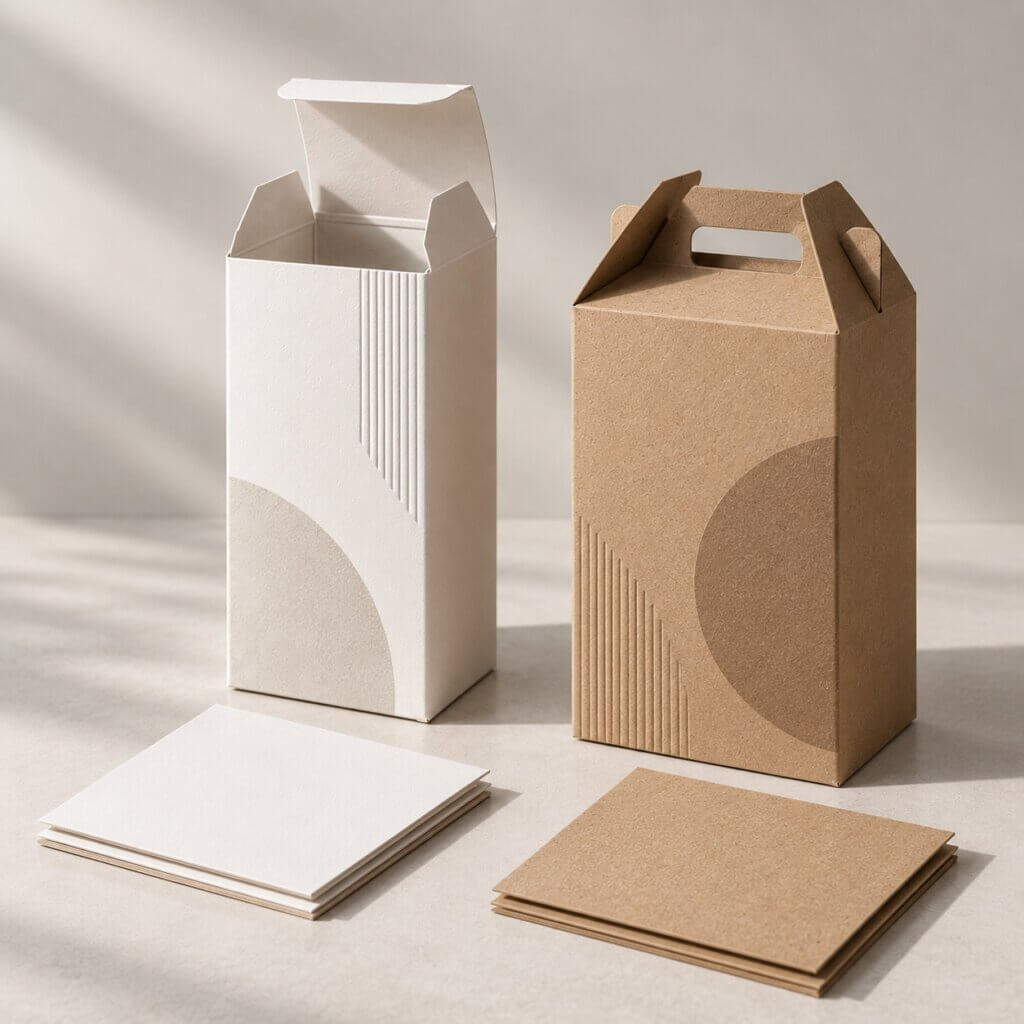
Kraft is another practical option. Kraft reverse tuck folding cartons work particularly well when a brand wants the natural substrate itself to remain visible as part of the packaging identity. Natural brown board can create a more material-led appearance without changing the basic RTE construction.
What paperboard is best for reverse tuck folding cartons?
There is no single paperboard that is best for every reverse tuck carton. SBS and other coated white boards are commonly selected when the package needs a smooth printing surface, clean color reproduction, and compatibility with finishes such as foil stamping, embossing, or coatings. They are particularly useful for cosmetics, healthcare products, and other retail packaging where printed appearance is important.
FBB is another option when a good stiffness-to-weight balance is required, although its characteristics can vary between grades and suppliers. Natural kraft takes the design in a different direction: its visible fibers and brown substrate become part of the packaging appearance, making it useful for brands that want a more natural or material-led presentation. Because the substrate is not white, lighter inks and certain colors need to be evaluated differently during artwork development.
White kraft can provide a cleaner appearance while retaining some of the character associated with kraft-based packaging, while specialty papers can introduce distinctive textures and surfaces for more design-led applications. With these materials, printing, scoring, folding, and finishing compatibility should be tested before production, particularly when the paper has an unusual texture or coating.
The material name alone is therefore not enough to make the decision. Caliper, stiffness, grain direction, surface properties, product weight, printing requirements, finishing, and cost all need to be considered together.
Board should also be evaluated by more than GSM. Caliper influences physical thickness, stiffness affects panel flatness, grain direction influences scoring and folding, and surface characteristics affect ink and finishing performance.
The best board is therefore not automatically the thickest or most expensive one. It is the material that provides enough structural performance and the intended visual result without adding unnecessary weight or cost.
Why Folding Carton Dimensions Need More Attention
One of the easiest mistakes in folding carton development is designing directly from nominal product measurements. If a bottle measures 40 × 40 × 120 mm, for example, that does not automatically mean that an internal carton measuring 42 × 42 × 122 mm will provide the correct fit.
Folding carton dimensions need to account for actual product tolerances, paperboard thickness, fold geometry, product orientation, loading direction, closures, and any internal components. Too little clearance can make packing difficult, create panel bulging, or place excessive pressure on the tuck flaps. Too much clearance allows movement, makes the package feel oversized, and wastes material.

Board caliper also reduces usable internal space once the blank is folded, particularly around tight folds and inserts.
How do you determine the correct folding carton dimensions?
The most reliable approach is to start with the actual product rather than only a specification sheet. Product length, width, height, weight, orientation, production tolerance, fragile areas, and loading method should all be considered.
Packaging engineers for custom folding carton design also need to understand whether the product requires an insert, how much movement is acceptable, and whether the carton will be packed manually or automatically. A good dieline is not simply a drawing that fits around an object; it balances fit, board behavior, production tolerance, and packing efficiency.
Printing Should Be Planned Around the Structure
Reverse tuck describes the box construction, not the printing method. The same carton can use simple one- or two-color graphics or a more developed retail design involving full-color printing, foil stamping, embossing, debossing, coatings, or other finishes.
Offset printing remains widely used for commercial folding carton production, particularly where consistent repeat production and larger quantities are important. Digital printing for folding cartons can be more useful for shorter runs, multiple SKUs, regional versions, promotional packaging, or projects with frequent artwork changes.
Artwork must also respect the physical structure. A logo that appears perfectly centered on a flat artwork file can shift visually once the carton is folded. Fine graphics near score lines may distort, while foil or other finishing crossing a deep crease can behave differently from the same treatment on a flat panel.
This becomes particularly important with folding cartons for beauty and personal care, where a relatively small carton may need to accommodate branding, product claims, ingredient information, regulatory text, barcodes, and decorative finishing within limited printable space.
What Products Are Reverse Tuck Folding Cartons Best For?
Reverse tuck cartons generally make the most sense for products that are compact, light to moderate in weight, and benefit from a printable secondary package. Common applications include skincare products, cosmetics, soaps, supplements, pharmaceuticals, small accessories, and other lightweight consumer goods.

Are reverse tuck folding cartons suitable for cosmetics?
Reverse tuck cartons are particularly well suited to lightweight, compact products such as skincare tubes, lipsticks, small cosmetics, soaps, supplements, and many pharmaceutical products. These applications generally do not place excessive pressure on the tuck closure, while the carton provides enough printable area for branding, product information, ingredients, instructions, and regulatory content.
Some products require a more careful assessment. Small electronics accessories, for example, may fit an RTE carton but often benefit from a paperboard or corrugated insert to prevent movement. Glass serum bottles can also use this structure, but the bottle weight, bottom area, clearance, and internal support need to be considered rather than treating them in the same way as a lightweight skincare tube.
Heavy fragrance bottles are closer to the structural limit of a standard reverse tuck carton. Depending on the bottle weight and distribution conditions, they may require a stronger paperboard, an internal insert, or a reinforced bottom structure. For products that are both heavy and fragile, another folding carton style—or a different packaging structure entirely—may provide more reliable protection.
This is why product category alone should never determine the carton style. Two beauty products can have completely different packaging requirements: a lipstick may be an excellent candidate for a simple reverse tuck carton, while a heavy glass perfume bottle may need a substantially different structural solution.
What Should a Buyer Check Before Production?
Before approving mass production, the carton should be tested with the real product whenever possible. Start with fit: the product should load easily without excessive movement. Then test the closures. The bottom needs to remain secure during normal handling, the top flap should open naturally, and the dust flaps should not interfere with filling.
Board behavior should also be checked on the formed carton. Panels should remain reasonably flat, score lines should fold cleanly, and the material should not crack unnecessarily. At the same time, an excessively thick board should not be used simply to create a sense of security if the real problem is structural.
Printing and finishing should also be judged after the carton has been erected. Foil registration, embossing position, color alignment, artwork continuity, and the relationship between graphics and folds can all look different from a flat proof.
A successful handmade prototype is only the first step. The real question is whether the structure can be reproduced consistently when thousands of cartons are printed, die-cut, stripped, folded, glued, packed, and transported.
How do you choose a folding carton manufacturer?
For buyers researching how to choose a folding carton manufacturer, price and printing quality are only part of the decision. A strong supplier should also be able to identify an unsuitable structure, recommend the right board or closure, anticipate die-cutting and gluing issues, provide realistic sampling, and reproduce the approved specification consistently at production scale.
This is where manufacturing experience becomes more valuable than simply offering a long list of materials and finishes. The manufacturer should be able to explain why a structure works, when it may fail, and what should change before mass production begins.
Reverse tuck folding cartons are relatively simple structures, but a good RTE package still depends on several connected decisions. The structure must suit the product, the dimensions must account for real fit and production tolerances, the board needs enough stiffness without unnecessary weight, and the artwork has to work with the physical dieline rather than against it.
When those decisions are made together, a reverse tuck carton can do exactly what this structure is designed to do: provide an uncomplicated, efficient, printable package that is easy to produce, pack, open, and use.