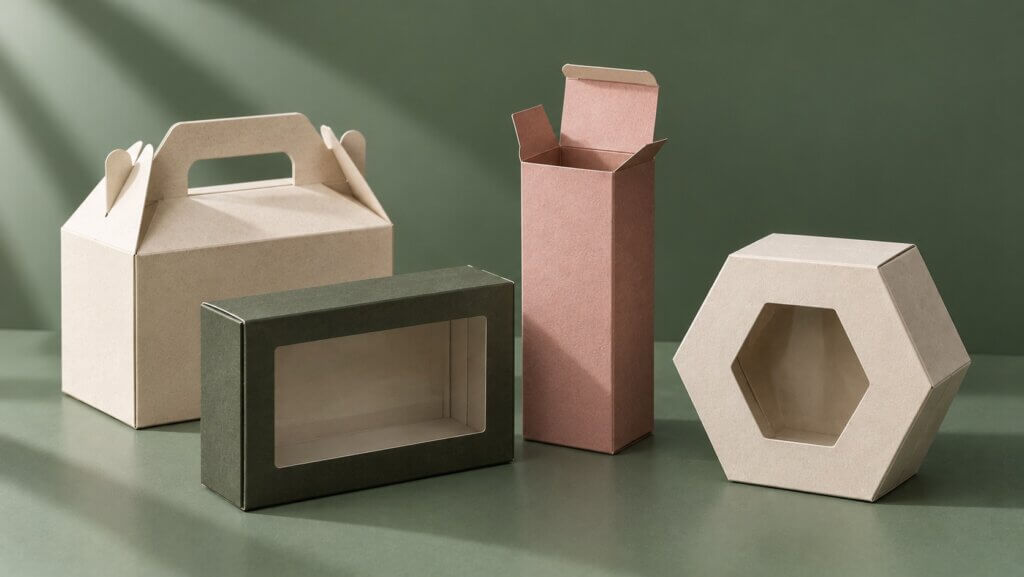

Two rigid boxes can have the same finished dimensions, use the same basic opening style, and appear almost identical in a product photograph, yet feel surprisingly different once they are picked up and opened. One may feel firm and balanced, with clean edges and a lid that moves evenly. The other may flex slightly across a large panel, feel less stable after the product is loaded, or develop uneven resistance as the lid moves over the base. The difference is rarely created by one obvious specification. It develops through the way materials, dimensions, components, and production tolerances interact.
For luxury rigid boxes, this distinction is important because external size describes only the final boundary of the package. It does not describe how the structure behaves. Greyboard establishes the structural skeleton, wrapping changes both the surface and the effective dimensions, those dimensions determine how components interact, and the insert changes how the product load is supported inside the finished box. This is different from custom folding cartons, where scored paperboard is converted and folded into shape, and from custom drawer boxes, where the movement between the sleeve and inner tray becomes part of the structural experience. A useful comparison therefore begins inside the construction rather than with decorative finishing.
The Finished Size Tells Only Part of the Story
When two boxes are specified as 200 × 150 × 60 mm, it is tempting to assume that the structural difference between them will be small. In reality, those numbers say very little about panel stiffness, edge compression, component alignment, or opening resistance. Two boxes can reach the same external dimensions through different combinations of board, wrapping material, adhesive, turn-ins, and internal construction. Those differences may remain almost invisible when the boxes are sitting on a table, but they become much easier to detect when the package is pressed, lifted, opened, closed, or loaded with the actual product.
This is also why the familiar question of what makes a rigid box feel premium cannot be answered only with foil, embossing, textured paper, or other visible finishes. Those processes can improve presentation, but the physical experience begins earlier. If a large lid flexes too easily, one corner sits slightly higher than another, or the lid releases unevenly, additional decoration does not correct the underlying relationship. The first layer of perceived quality is therefore structural: does the completed box behave as one controlled object?
That leads naturally to the material at the center of most conventional rigid constructions—the board itself.
Board Thickness Matters, but Not in Isolation
Greyboard thickness is one of the easiest specifications to compare, which is why buyers often use it as a shortcut for quality. But two boards with similar caliper do not necessarily behave identically. Their density, stiffness, compression response, moisture condition, and consistency can differ, and the geometry of the finished box determines how strongly those differences become visible. A compact jewelry box has relatively short unsupported panels, while a wide gift-set lid may have a much larger unsupported area. The same nominal board specification can therefore feel sufficiently rigid in one structure and noticeably more flexible in another.
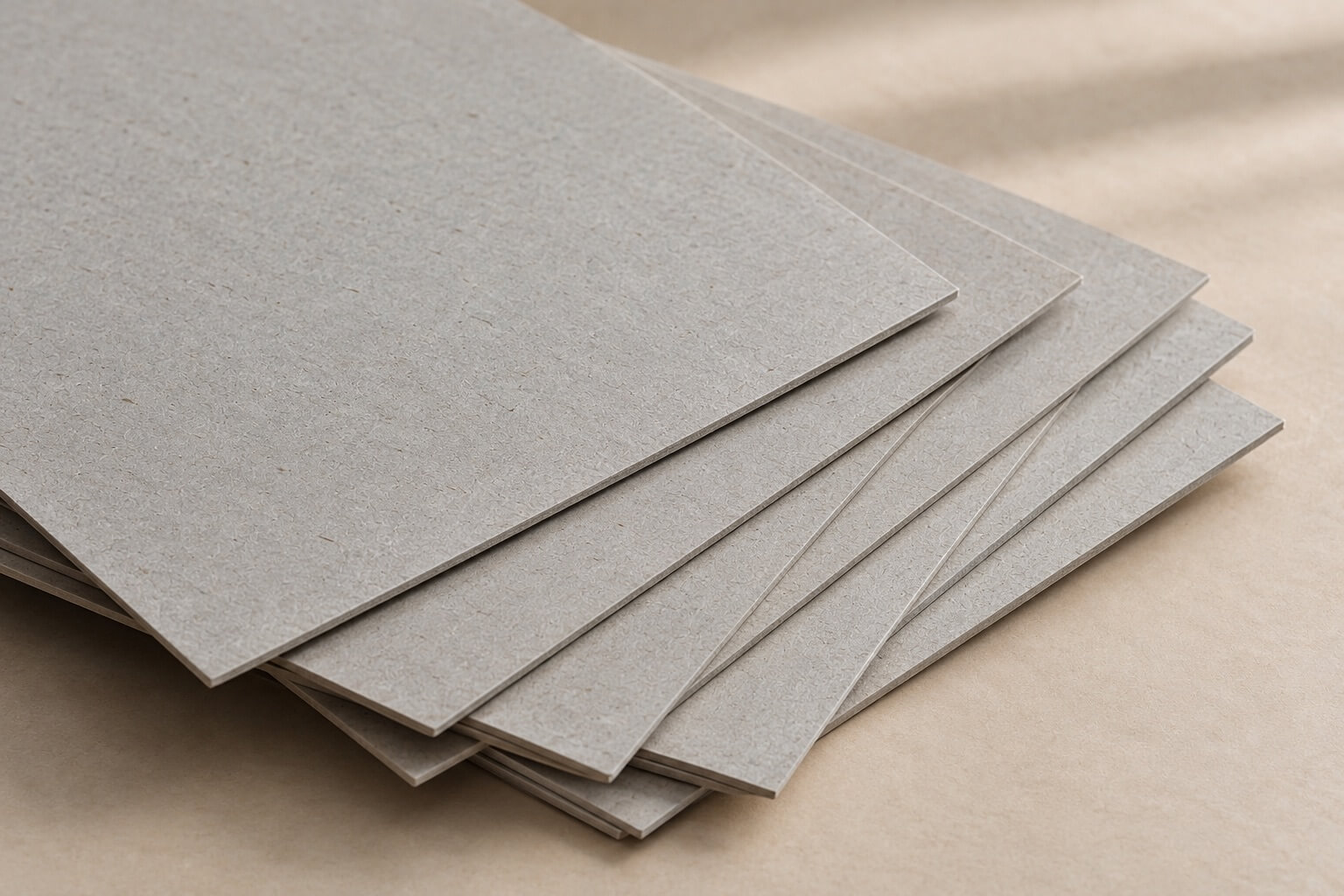
This is why asking how thick the board “should” be has no useful universal answer. The required construction depends on what the board has to do. A heavier product may increase the need for support in the base, while a large lid may be more sensitive to panel deflection. Increasing board caliper can improve stiffness in some situations, but it also changes the rest of the package. If the external dimensions remain fixed, usable internal space changes; wrapped edges become thicker; lid and base dimensions may need adjustment; and an insert developed around the previous construction may no longer fit as intended.
The important manufacturing question is therefore not whether thicker greyboard is automatically better. It is whether the selected board provides appropriate stiffness and dimensional stability for the size, geometry, product load, and assembly method of the finished package. Once the board changes, the consequences continue into the next layer of construction.
Wrapping Turns a Board Dimension Into a Finished Dimension
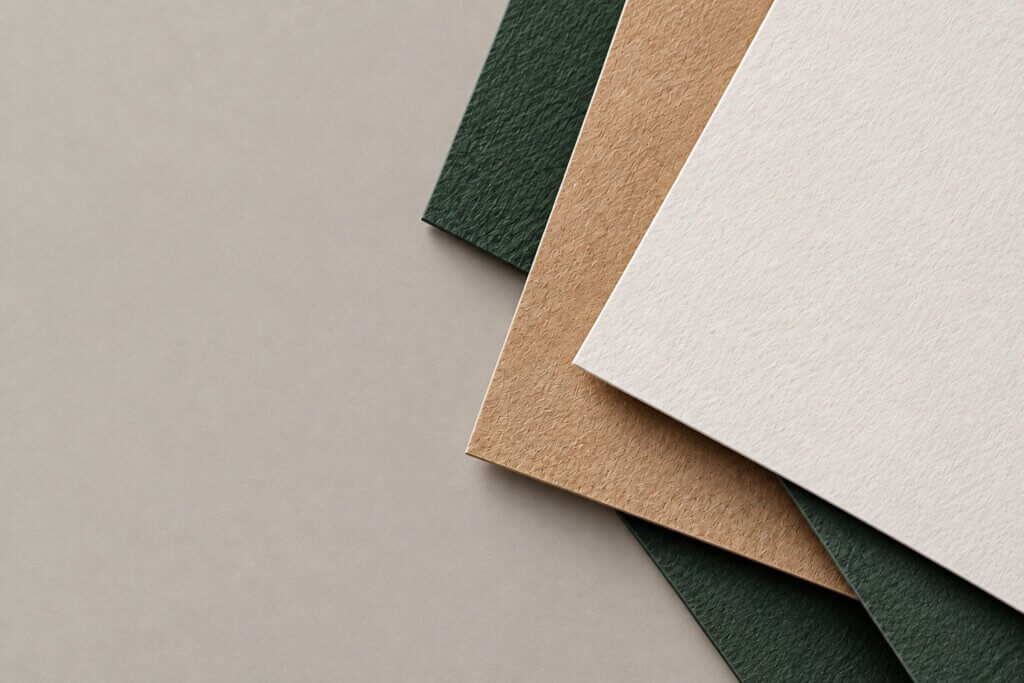
A rigid-box drawing may begin with board dimensions, but the customer never handles bare greyboard. The customer handles the completed wrapped component. This distinction matters because wrapping paper is not merely a decorative skin. Paper caliper, lamination or coating, adhesive, corner treatment, overlaps, and turn-ins all contribute to the physical build-up around the board.
The effect is not necessarily uniform across the entire component. Across the center of a broad panel, the construction may consist of board, adhesive, and one outer layer. Around an edge or turned-in area, additional layers can overlap. Corners introduce another concentration of material and forming operations. As a result, a small material change that appears insignificant when comparing paper samples can become more important after the material is wrapped around a three-dimensional structure.
This is one reason changing the outer paper after a structural sample has been approved should not always be treated as a purely visual substitution. A different paper can change surface friction and tactile character, but it can also change local build-up. If two wrapped components already operate with relatively limited clearance, that change can continue downstream into the way the finished box opens and closes.
Material Build-Up Eventually Becomes a Fit Question
Consider a conventional lid-and-base rigid box. The inside of the lid has to move over the outside of the base. Neither surface is bare board at this stage; both are completed components containing board, adhesive, wrapping material, folds, and formed corners. The relevant clearance is therefore the space between two finished structures rather than the difference between two theoretical board dimensions.
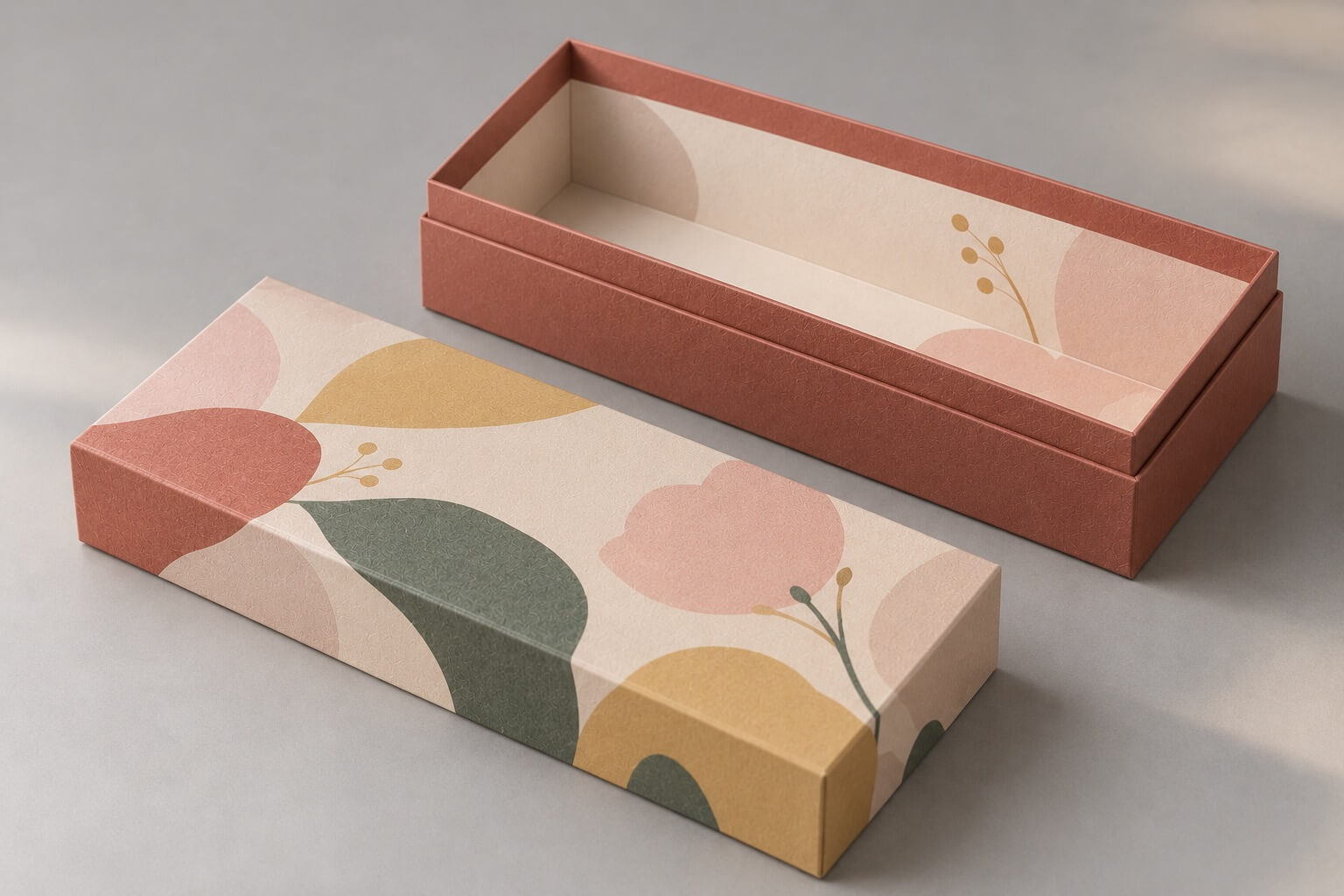
If that clearance becomes too small, friction increases. The lid may drag more heavily on one side, the base may begin to lift as the lid is removed, or the opening force may change from unit to unit. If the clearance becomes unnecessarily large, the opposite problem appears: lateral movement increases and the lid may feel less controlled when the box is handled. This explains why a lid that feels too tight does not automatically mean the dieline is wrong. The original dimensions may be reasonable while material build-up, corner formation, component squareness, or assembly variation changes the effective space available after production.
The important distinction is between nominal dimensions and effective fit. A drawing controls the intended geometry; manufacturing creates the physical components that have to work together. Good structural development connects those two stages instead of assuming that a mathematically correct dimension will automatically produce the intended movement.
A Premium Fit Is Not Simply a Tight Fit
Once fit is considered as a relationship, another common assumption becomes easier to challenge: a high-end box does not need to be as tight as possible. It needs to move in a deliberate and repeatable way. A lid with very little clearance may initially feel substantial, but if small production variations cause one corner to bind, that tightness quickly becomes a functional problem. A slightly more forgiving relationship can sometimes create a more consistent result across production.
Lid depth also changes this behavior. A deeper lid creates a longer area of interaction between the two components, so the same nominal clearance can produce a different opening feel from a shallower lid. Surface characteristics matter as well: two papers with different textures can produce different friction even when the structural dimensions have not changed. This is why the question of whether a premium box should open slowly is slightly misleading. Controlled resistance can be desirable; unnecessary friction is not. The target is not “slow” or “tight,” but a movement appropriate to the structure that remains sufficiently consistent from box to box.
A similar principle applies to custom round boxes, although the geometry changes. Instead of relying on four straight walls and corners, a cylindrical structure depends heavily on diameter, roundness, wrapped thickness, and the relationship between the lid and body. Different geometry changes the variables, but not the basic manufacturing principle: the finished components must be evaluated as a working pair.
The Box Changes Again When the Product Goes Inside
An empty rigid box can feel excellent and still perform poorly as a finished package. Once the product is loaded, weight distribution, internal movement, and the way the product contacts the insert begin to influence what the customer feels. A heavy bottle that is poorly located can make the package feel unbalanced when lifted. Several small components can move independently and make an otherwise rigid outer shell feel less resolved. An insert that compresses too easily can allow the product to settle lower than intended, changing both presentation and support.
This is where the question of whether every rigid box needs an insert should be answered by the product rather than by the box category. A simple product with suitable geometry may not require a complex internal structure. A fragile, heavy, irregular, or multi-component product may require much more deliberate support. Where an insert is needed, its purpose is not simply to occupy empty space. It should establish product position, restrict unwanted movement, transfer loads into suitable areas of the package, and still leave enough access for comfortable removal.
Fit inside the box also has its own tolerance relationship. An insert designed exactly around one measured product can become problematic if the actual products vary slightly in size. Conversely, excessive clearance can allow movement. For this reason, insert development should consider the real product, the direction in which it is loaded and removed, material compression, and expected product variation—not only the CAD dimension of a single ideal sample.
Once the product, insert, and outer shell work together, the package begins to behave as one system. That system, rather than the empty box alone, is what ultimately determines much of the tactile experience associated with luxury rigid boxes.
Opening Feel Is the Output of the Structure, Not a Separate Finish
By this stage, it becomes clear why “premium opening experience” is too vague to function as a production specification on its own. The way a box opens is the result of relationships already established earlier: board stiffness affects structural stability; wrapping changes effective dimensions and friction; lid depth changes contact distance; component alignment determines whether resistance is even; and the loaded product affects how stable the base remains while the lid is removed.
Other rigid constructions add their own variables. A magnetic closure introduces magnet position, polarity, spacing, board thickness between the magnets, and flap alignment. A drawer structure introduces sleeve-to-tray clearance and a much longer sliding path. In each case, the closing or opening mechanism cannot be separated from the structure surrounding it. Increasing magnetic force, for example, cannot correct a lid that is geometrically misaligned, just as reducing drawer clearance cannot correct an inner tray that is slightly out of square.
For customized rigid boxes, the intended movement should therefore be validated on a physical sample built as closely as practical to the proposed production construction. If the board, outer paper, insert, or another fit-sensitive component changes after approval, the effect on movement should be reconsidered rather than assuming that the previous structural relationship remains unchanged.
The Most Difficult Part Is Repeating the Approved Feel
A successful prototype answers one question: can this particular combination of materials and dimensions work? Mass production asks a more demanding question: can the relationship remain acceptable when materials and processes introduce normal variation across the order?
This is where several individually small variables can accumulate. Board caliper may move slightly within the accepted material range. Wrapping position can shift by a small amount. Adhesive application and compression during forming can change local build-up. Corners and assembled components can introduce small dimensional differences. None of these variations necessarily creates a defect by itself, but when several move in the same unfavorable direction, the resulting box can behave differently from the approved sample. This accumulated effect is why tolerance-sensitive packaging should be controlled as a system rather than by inspecting one dimension in isolation.
The objective in production is not zero variation; paper-based packaging cannot realistically be manufactured that way. The objective is to identify which variations matter to the customer experience and control them tightly enough that the package continues to behave within an acceptable range. For one structure, that may mean lid-to-base fit and squareness. For another, it may be drawer movement, magnetic alignment, insert position, or the height at which the product sits.
This also explains why a mass-produced rigid box can occasionally feel different from an approved sample even when no single dramatic error is visible. The useful response is not simply to tighten every tolerance. It is to identify the relationships that are functionally sensitive and control those relationships during materials approval, sampling, assembly, and QC.
The Difference Is Created Through the Whole Construction
Two same-size rigid boxes ultimately feel different because their external dimensions are only the final outline of a much longer manufacturing sequence. Board properties establish the structural response. Geometry determines how much work the board has to do. Wrapping converts raw board dimensions into finished component dimensions. Those dimensions establish clearance and fit. The insert determines how the loaded product behaves. Opening and closing translate those hidden relationships into something the customer can immediately feel, and production control determines whether that experience remains stable across the order.
This is why the physical quality of luxury rigid boxes should not be reduced to heavier board, more foil, thicker paper, or a slower-opening lid. Those features can contribute to a package, but they cannot substitute for a structure in which materials, dimensions, and moving components have been developed together. For brands comparing Demei Packaging’s Packaging Types, the more reliable sequence is to define the product and expected use first, establish the structure and material behavior next, validate fit with a physical sample, and then finalize decorative finishing around a construction that already works. Demei’s own packaging workflow similarly moves from requirements into structure, materials, finishes, inserts, prototyping, and production rather than treating appearance as the only development step.
At Demei Packaging, most custom packaging projects start from 500 pieces. For rigid packaging, the value of a physical sample is not only that it shows what the finished box will look like. It creates a reference for how the complete package should behave—how firm it feels, how the components align, how the product is supported, and how the box opens and closes. The production challenge is then to reproduce those relationships consistently enough that the experience approved in sampling remains recognizable in mass production.