
Finding a rigid box packaging supplier is relatively straightforward. Determining whether that supplier can turn a packaging concept into a repeatable production specification is much more important. A finished sample may show good wrapping, clean corners, accurate foil, and an attractive presentation, but it only represents one result. A production order requires the same structural relationships, materials, finishing, and product fit to remain within an acceptable range across hundreds or thousands of boxes.
For brands developing custom drawer boxes or other premium paper packaging, supplier evaluation should therefore begin with manufacturing capability rather than price alone. This becomes particularly important for fragrance, cosmetics, skincare, jewelry, electronics, and gift products, where inserts, wrapped components, opening resistance, finishing position, and product fit can interact with one another. The real question is not simply whether a supplier has made a similar box before, but whether it can define what matters in the structure and control those relationships through production.
Start With the Manufacturing Requirements of the Structure
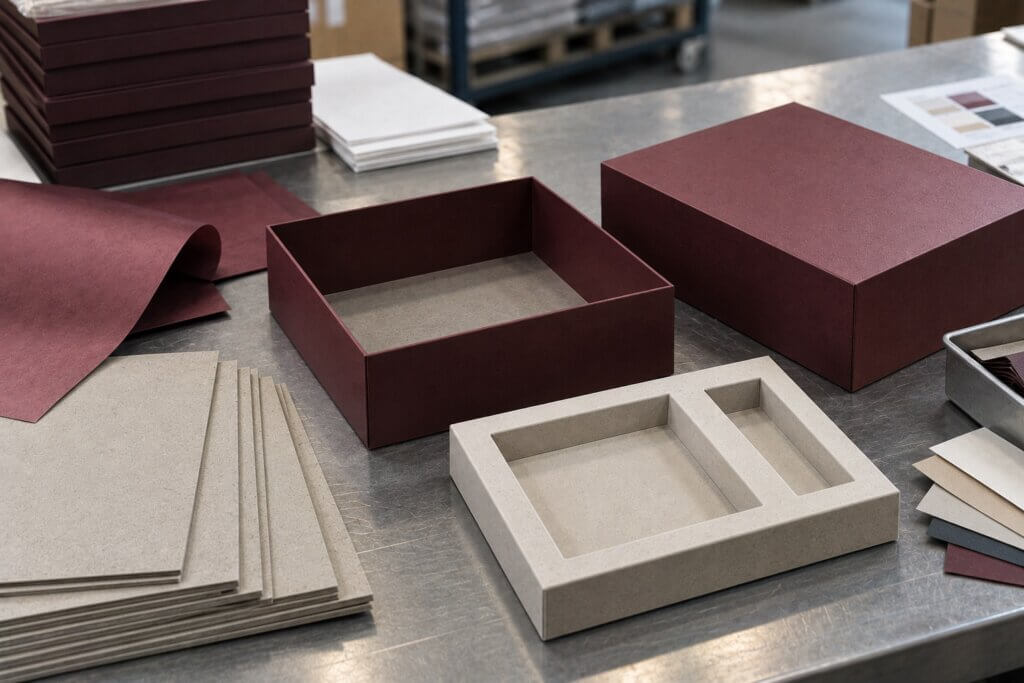
Rigid boxes may share similar materials, but they do not necessarily share the same manufacturing risks. A two-piece lid-and-base box depends heavily on the dimensional relationship between two independently formed components. A drawer box introduces the interaction between tray and sleeve. A magnetic closure structure adds magnet positioning and closure alignment, while a fitted insert introduces another interface between the product and the box.
This is why evaluating a rigid box manufacturer from a product gallery alone provides limited information. A more useful assessment looks at whether the supplier understands how the structure is actually built. Which dimensions affect opening and closing? Where can wrapping paper change the finished fit? Which components are sensitive to assembly variation? How is the insert positioned relative to the product and outer structure?
These questions also help distinguish the ability to reproduce an existing box from the ability to develop a new one. A supplier may manufacture a familiar structure efficiently but still need engineering work when a project introduces an unusual product shape, multiple accessories, a new insert system, or a different opening experience. Demei’s About page describes this development process as a combination of packaging design, structural engineering, and production rather than treating manufacturing as an isolated final step.
Once that manufacturing boundary is understood, the evaluation can move to the actual product.
Product Information Has to Become a Packaging Specification
Product dimensions and order quantity are enough to begin a conversation, but they are not always enough to define a custom rigid box. Product weight, orientation, fragility, surface sensitivity, accessories, intended opening direction, insert requirements, and packing method can all influence the final structure.
This explains why an accurate quotation often requires more than length × width × height. Current rigid-box RFQ guidance also commonly asks buyers to provide the box style, quantity, materials, printing, finishing, insert requirements, packing method, and delivery information before the final specification is established.
The engineering sequence should move outward from the product:
Product → Restraint → Insert → Box Structure → Materials → Finished Specification
Consider a fragrance bottle. Its maximum dimensions define the minimum space it occupies, but they do not define how it should be supported. A heavy glass base, narrow neck, decorative cap, or sensitive printed surface can change where an insert should contact the bottle. Once the insert geometry changes, the usable internal space may change as well, which can eventually affect the dimensions of the outer rigid box.
A capable packaging supplier should therefore identify missing technical information before freezing the structure. Asking the right questions at this stage is often more valuable than producing an immediate quotation from incomplete specifications.
Material Decisions Should Follow Structural Decisions
Once the basic structure is established, materials can be evaluated in context. In rigid box packaging, board thickness, wrapping paper, insert construction, and surface finishing are not completely independent decisions.
Increasing greyboard thickness, for example, can improve stiffness in some structures, but it also changes physical geometry. Finished wall thickness, wrapped edges, internal space, lid-to-base fit, and insert dimensions may all be affected. Similarly, wrapping paper has both a visual and manufacturing role. Its thickness, texture, grain behavior, print response, and interaction with foil or embossing can influence the finished result.
For that reason, asking which material is “best” for a rigid box is less useful than defining what the material needs to achieve. A large presentation box carrying a heavy product may require a different board specification from a small jewelry box. A heavily textured paper may create the desired tactile character but require different consideration for fine foil details than a smoother coated stock.
Finishing should be treated in the same way. Foil stamping, embossing, debossing, lamination, or specialty papers add value only when they can be integrated into the structure and reproduced consistently. A technically resolved package is not the one with the greatest number of processes; it is the one in which the selected processes remain compatible with the structure and production method.
At this point, the specification has moved beyond a visual concept. The next stage is to test whether those decisions work together physically.
A Prototype Should Validate the Packaging System
A physical sample is valuable because it brings structure, material, finishing, insert, and product together for the first time. This is why sampling remains an important step in custom rigid packaging development. Demei’s current FAQ confirms that physical prototypes can be produced before mass production so structure, materials, artwork, and finishing can be reviewed.
The sample should ideally be tested with the actual product. Instead of looking only at color and surface appearance, the review should include product insertion and removal, opening resistance, drawer movement where applicable, lid closure, insert retention, wrapped corners, finishing registration, and the way the complete package behaves when loaded.
This provides a more practical answer to the common question of whether a sample is necessary before bulk production: its purpose is not simply to show what the packaging will look like. It is a physical validation of the relationships established during development.
But an approved sample establishes only one successful result.
The next question is whether that result can be reproduced.
Mass Production Changes the Problem From Fit to Repeatability
During sampling, considerable attention can be given to an individual unit. During mass production, the same specification has to operate within normal manufacturing variation.
Rigid packaging is particularly sensitive to this because several converted components often interact. Board cutting, paper wrapping, adhesive application, component forming, insert conversion, foil registration, and final assembly each introduce their own process variation. Even when individual components remain within acceptable limits, their variations can accumulate in the finished package.
A drawer structure provides a simple example. If the inner tray becomes slightly larger while the wrapped sleeve becomes slightly smaller, each component may still appear acceptable when measured independently. Once assembled, however, the combined variation can make the drawer noticeably tighter. The important issue is therefore not whether manufacturing variation exists—it inevitably does—but whether the specification has enough tolerance for the package to continue functioning correctly.
This is where the evaluation of a rigid box packaging supplier becomes more meaningful. The supplier should be able to identify which relationships need tighter control and which dimensions have greater flexibility. A successful prototype demonstrates that the design can work; production capability determines whether it can continue working repeatedly.
Quality Control Should Follow the Critical Interfaces
Once these relationships are defined, quality control becomes more targeted. Inspecting only overall dimensions and surface appearance may miss the parts of the package that actually determine performance.
For a two-piece box, the critical interface may be lid ↔ base. For a drawer structure, it may be tray ↔ sleeve. For a bottle or cosmetics set, product ↔ insert may matter more than a small variation in an unrelated external dimension. Magnetic structures introduce another relationship between magnet position ↔ closure alignment.
The inspection method should therefore follow the function of the approved package. Product fit, opening resistance, insert position, wrapped edges, artwork alignment, foil registration, color consistency, and assembly quality may require different checkpoints rather than one generic final inspection.
This approach also makes supplier evaluation more objective. Instead of asking whether a factory “has good QC,” the buyer can determine whether the supplier understands what must be controlled for this particular structure and where those controls should occur during production.
Only after those requirements are defined does a commercial comparison become fully meaningful.
Compare Price, MOQ, and Lead Time on the Same Specification
Two quotations can describe boxes that look nearly identical while representing different production specifications. Board grade, wrapping paper, insert material, finishing coverage, assembly requirements, packing method, acceptable tolerances, and inspection requirements can all affect cost.
The same principle applies to MOQ. There is no universal minimum quantity for every custom rigid box because setup requirements vary by structure and finishing. Current supplier pages, for example, publish substantially different minimum quantities, reinforcing that MOQ is supplier- and project-specific rather than an industry-wide fixed number.
At Demei Packaging, most custom packaging projects start from 500 pieces, but the final MOQ depends on the box type, structure, materials, and finishing requirements. Demei’s FAQ currently lists quotations within 24 hours after complete specifications, structural development where required, physical sampling, and mass-production timelines as separate stages of the project.
Lead time should therefore be considered against the same technical specification. A simple rigid box using established materials and a complex multi-component structure requiring new inserts and several finishing processes should not automatically be expected to follow the same development schedule.
Supplier Evaluation Should Become More Specific as the Project Develops
A useful supplier assessment becomes progressively narrower. At the beginning, the brand needs to establish whether the manufacturer regularly works with the required type of packaging. The next stage is determining whether the product can be translated into a workable structure. Materials and finishing then need to be integrated into that structure, followed by prototype validation, production planning, and control of the critical interfaces.
The progression can be summarized as:
Manufacturing Capability → Product Understanding → Engineering Specification → Prototype Validation → Production Repeatability → Quality Control → Commercial Comparison
This sequence matters because the manufacturing risk of a rigid box is determined by the project itself. A simple lid-and-base presentation box and a multi-component fragrance or jewelry package with fitted inserts, specialty wrapping paper, foil, and precise opening relationships may both belong to the same broad packaging category, but they require very different levels of engineering and process control.
Evaluating a rigid box packaging supplier is therefore not about finding a factory that claims to do everything. It is about determining whether its manufacturing system can control the specific relationships that matter to the product being developed.