
Ordering a few packaging samples and ordering thousands of finished boxes are two different purchasing tasks. A sample can be judged largely by what is visible: the proportions look right, the paper feels appropriate, the color is close to the artwork, and the product fits. A volume order requires something more precise. The approved result has to be translated into specifications that purchasing, production, quality control, and the supplier can interpret in the same way.
This becomes particularly important when sourcing rigid boxes wholesale for cosmetics, footwear, gift sets, electronics, or other premium products. Buyers comparing different Packaging Types should therefore standardize more than the finished dimensions. Board construction, wrapping paper, color references, finishing positions, insert fit, acceptable appearance, and final packing method all affect whether the next 2,000 boxes are effectively the same product as the box that was originally approved.
For luxury custom packaging, standardization does not mean removing customization. It means turning the approved customization into something that can be manufactured and inspected repeatedly. This is also why reviewing actual Case Studies can be more useful than choosing a supplier from a material list alone: the important question is not only what a factory can make, but how a project moves from a reference into controlled production.
Start With the Product, Not the Finished Box
What information does a supplier need before quoting rigid boxes? The most useful starting point is the product itself: its actual dimensions, packed weight, orientation, number of components, fragile or protruding areas, and the way it will be removed from the package. A bottle with a pump, for example, cannot be reduced to length × width × height if the pump is the point most likely to contact the insert. A cosmetic set containing several components creates a different loading condition from a single product of the same total weight.
This matters because internal dimensions are not simply product dimensions with an arbitrary amount added. Clearance has to account for the insert, wrapping construction, removal space and realistic product variation. Too little clearance can make packing difficult or place pressure on the product; too much can allow movement and make the presentation inconsistent. In cosmetic custom packaging, the physical product or an accurate production-equivalent sample is therefore especially valuable before the packaging dimensions are finally locked.
The same principle applies to empty shoe boxes intended to become branded retail packaging. Specifying only a nominal shoe size does not fully describe the packed condition. Shoe style, pair orientation, tissue, accessories and the intended presentation can change the usable internal volume. The box should be standardized around the actual pack-out, not a category name.
Dimensions Need a Reference Point Before They Need a Tolerance
Once the packed product is understood, the next question is deceptively simple: should a rigid box be specified by its internal or external dimensions? In procurement documents, the answer should not be left implicit. The buyer and manufacturer should identify exactly what each dimension refers to and which dimensions are function-critical.
An internal cavity dimension controls product and insert fit. An external dimension may affect sleeves, shipping cartons, retail shelving or other components. Lid and base relationships introduce another set of dimensions that influence alignment and opening behavior. If all of these are summarized as “box size,” two suppliers can receive the same request and still calculate different constructions.
Tolerance comes after this distinction. Not every dimension deserves the same level of control. A dimension affecting product retention, lid engagement or alignment with another component may be critical; a non-functional external dimension may permit greater variation. Good standardization therefore identifies what the dimension controls before deciding how tightly it should be controlled.
Board and Wrapping Paper Should Be Separate Specifications
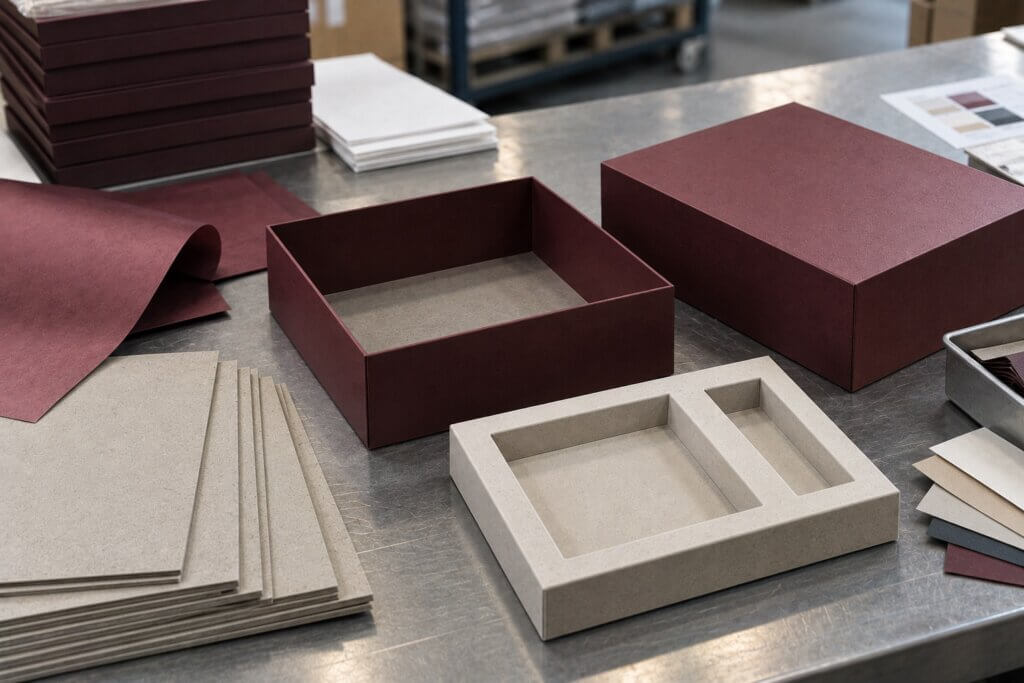
A common purchasing question is: does thicker board always make a rigid box better? No. Board thickness is only one part of the construction. It changes stiffness, weight, edge geometry and the relationship between the board and the wrapping material. Increasing it without considering box size, product load and converting behavior can simply create a heavier package rather than a more appropriate one.
This distinction is particularly important when buyers compare rigid packaging with paperboard boxes. “Paperboard,” “greyboard,” “specialty paper,” and “printed paper” should not be treated as interchangeable descriptions. In a wrapped rigid construction, the structural board and the outer wrapping paper perform different jobs and should be recorded separately. The production specification should identify the approved structural material and thickness together with the approved wrapping material, surface and relevant print or finish requirements.
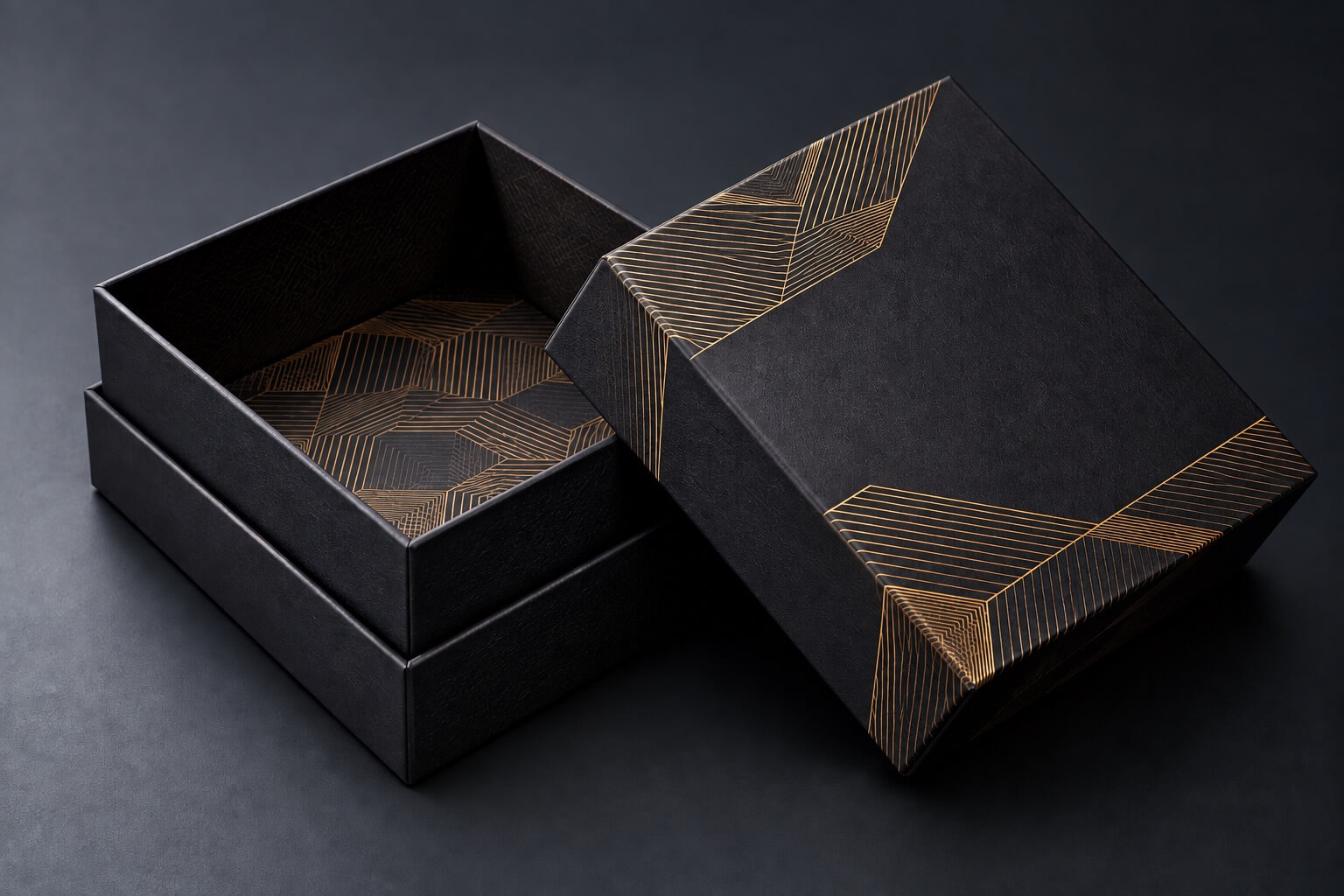
For luxury custom packaging boxes, this separation also helps prevent a common sourcing problem: two quotations may describe a visually similar box while using materially different constructions. Standardizing the material system first makes later comparisons more meaningful.
Color and Finishing Need Production References, Not Descriptive Words
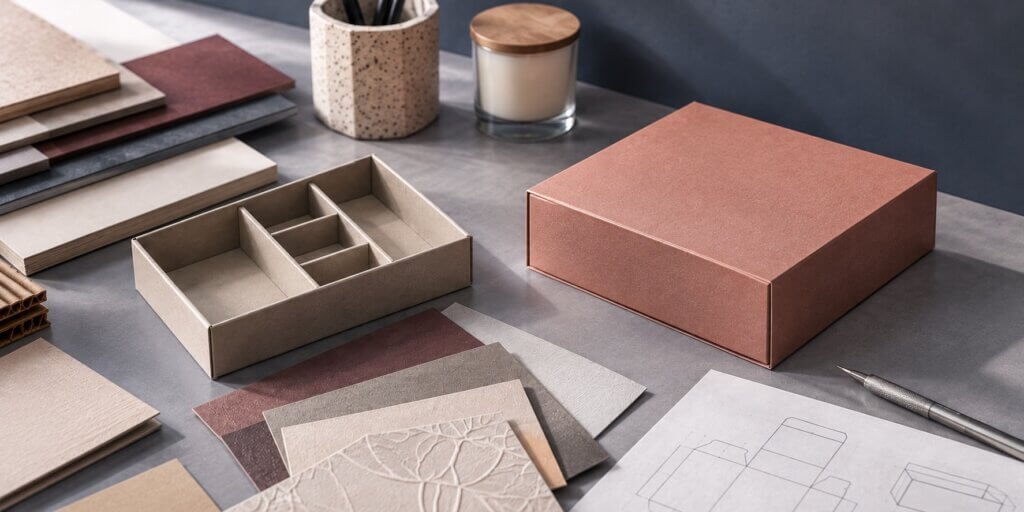
“Black,” “champagne gold,” “matte,” or “deep burgundy” can communicate a creative direction, but they are weak production specifications. Once artwork is approved, critical colors should be tied to an agreed reference appropriate to the printing process and substrate. The same applies to foil, embossing, debossing or other finishing: artwork position alone does not fully describe how the finished effect should appear.

How can buyers keep colors and finishes consistent in a bulk order? A useful approach is to define the substrate, color reference, finishing material and approved physical result together. This matters because the same nominal color can appear different across coated, uncoated or textured surfaces, while foil and embossed details can respond differently to changes in paper texture and production conditions.
The goal is not to demand that every box be microscopically identical. Paper-based packaging involves materials and processes with normal manufacturing variation. The more useful objective is to identify which differences affect brand appearance or function and establish an agreed standard against which production can actually be inspected.
The Insert Must Be Standardized With the Box
For customized boxes for gifts, cosmetics and multi-component sets, the insert is often treated as an accessory after the outer box has been confirmed. In production, it should be considered part of the packaging system. Its material, cavity dimensions, support points, removal clearance and relationship with the outer box all affect the final pack-out.
Do rigid boxes need custom inserts? Not always. An insert is justified when the product needs positioning, separation, presentation or additional support. What matters is that its purpose is clear. A cavity that grips too tightly may slow packing or make the product difficult to remove, while excessive clearance can allow movement. The approved insert should therefore be tested with the actual product rather than assessed only as an empty component.
This becomes especially important in custom boxes for business when one packaging format is expected to accommodate several SKUs. Instead of automatically creating a different outer box for every product, the buyer can determine whether the outer dimensions can remain standardized while selected inserts change. When feasible, this can simplify purchasing and inventory—but only if every product/insert combination is physically validated.
A Physical Sample Should Become a Measurable Reference
Should buyers approve a sample before mass production? For a customized rigid-box project, a physical sample provides information that artwork and renderings cannot fully show: product fit, opening resistance, edge appearance, wrapped corners, insert access and the interaction between materials and finishes. Demei’s current FAQ similarly states that physical prototypes can be reviewed for structure, materials, artwork and finishing before mass production.
But sample approval should not end with “approved.” The important step is translating that approval into controlled information. Which paper was used? Which board construction? Which color reference? Which foil or surface finish? Which insert version? Which dimensions are critical? Which physical sample becomes the retained reference?
This is where a beautiful prototype becomes useful to production. The sample establishes the physical target; the specification explains what created that target.
Packing Method Is Part of the Product Specification
The packaging specification should not stop when the rigid box itself is finished. How should rigid boxes be packed for bulk shipping? The answer depends partly on the surface and structure that need protection. Abrasion-sensitive finishes, projecting decorative details and exposed corners may require a different packing arrangement from simpler wrapped surfaces.
The buyer should therefore confirm how finished boxes are protected, how many are packed into a master carton, whether any separation is required between units, and whether carton dimensions create storage or logistics constraints. These decisions can affect both appearance on arrival and total shipping volume.
This is particularly relevant to rigid boxes wholesale, because a small change in unit packing becomes a repeated change across hundreds or thousands of pieces. Packing is therefore not merely a logistics instruction added after manufacturing; it is the final stage of preserving the approved packaging condition until the product reaches the packing line.
Standardization Also Makes Supplier Quotations More Comparable
Why can two suppliers quote very different prices for apparently the same rigid box? One reason is that the boxes may not actually be specified the same way. If a request contains only dimensions, artwork and a reference photograph, each supplier may make different assumptions about board, wrapping paper, inserts, finishes, assembly and export packing.
That makes price comparison less useful. Before evaluating quotations, buyers should determine which variables must remain fixed and which variables suppliers are allowed to optimize. A supplier might propose a different material or construction for a valid manufacturing reason, but that change should be visible rather than hidden inside the quotation.
For buyers sourcing luxury custom packaging, this approach changes the conversation from “Which supplier gave the lowest unit price?” to “What exactly is included in each unit price?” That is a much stronger basis for procurement.
What Should Be Locked Before a Volume Order Is Released?
By the time a project reaches volume production, the specification should tell the same story as the approved physical package. Product and pack-out conditions establish the internal requirement; critical dimensions define fit; structural board and wrapping paper define the material system; color and finishing references define the visible result; the insert controls product positioning; the approved sample provides a physical benchmark; and the packing method protects that benchmark through delivery.
What is the minimum order quantity for custom rigid packaging? There is no useful universal number because structure, materials and finishing affect the practical production threshold. At Demei Packaging, most custom packaging projects start from 500 pieces, with the final MOQ confirmed according to the project requirements. The company’s current FAQ also lists physical sampling before mass production and a typical mass-production range of 10–25 working days, depending on the project.
The more important lesson for buyers is that higher volume increases the value of clear specifications. A vague instruction repeated 5,000 times does not become more accurate because the order is larger. It becomes a larger source of variation.
For brands working with a manufacturer over multiple orders, this documentation becomes even more valuable. About Demei Packaging describes production control in terms of material inspection, color matching, finishing alignment and repeatability across production. Those controls work best when the approved result has already been converted into specifications that can be checked.
Ultimately, standardizing a rigid box does not mean reducing it to a generic product. It means defining the customized result clearly enough that it can be quoted, manufactured, inspected and reordered without repeatedly interpreting the original idea.