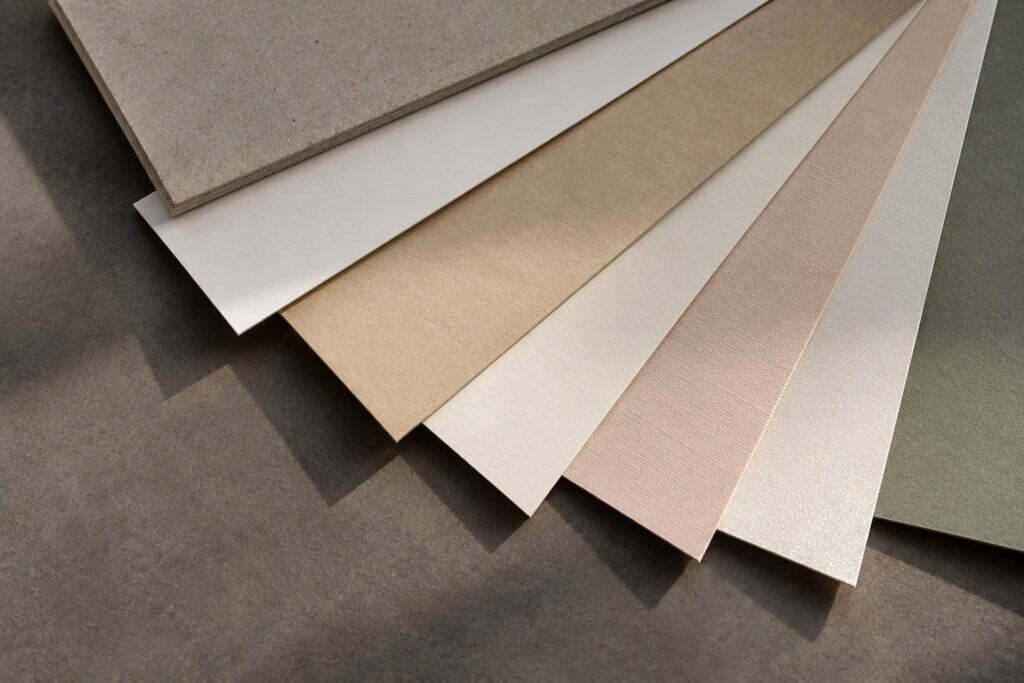

Choosing a paper packaging material should not begin with a paper swatch book or a target grammage. A substrate can have the right color, surface and nominal thickness yet perform poorly after it is creased, folded, curved, wrapped, glued or loaded with the actual product. The reason is that packaging materials do not perform independently of structure. Their behavior changes with panel geometry, load direction, grain orientation, converting method, environmental conditions and the other components assembled around them.
For brands developing several types of paper packaging, material selection is therefore better treated as a structural engineering decision before it becomes an aesthetic or purchasing decision. A lightweight retail carton, a corrugated shipping structure, a cylindrical presentation box and a wrapped board construction do not ask the material to perform the same mechanical job.
The practical sequence should be product requirements → structural load → required material properties → converting compatibility → surface treatment → prototype validation → production specification. This approach is particularly important when comparing different packaging structures because a material that performs reliably in one construction cannot automatically be transferred into another.
Begin With the Loads the Finished Package Must Manage
Before comparing paper grades, define the mechanical conditions of the packed system rather than the empty package.
Product mass is only the beginning. Engineers also need to consider product dimensions, center of gravity, contact area with the package, fragility, orientation during packing, unsupported panel spans, stacking conditions, expected handling and the way loads transfer through inserts, sidewalls, corners and closures.
A 300 g compact product concentrated near the center of a large panel can create a different requirement from a 300 g product whose load is distributed across the base. A glass bottle held tightly by an insert behaves differently from the same bottle moving inside an oversized cavity. Even when the outer dimensions are identical, the material requirement can change because the load path has changed.
This is why the common question, “What is the best material for paper packaging?”, has no useful answer without a defined structure and product.
For a structure dominated by folding, crease quality and bending stiffness may be critical. For a shipping structure, edge crush, compression resistance and puncture behavior can become more important. A cylindrical structure introduces forming stresses and dimensional recovery. A wrapped board structure depends heavily on board flatness, dimensional stability and the interaction between the supporting board, adhesive and covering paper.
The material specification should follow these functions rather than precede them.
Different Structures Require Different Mechanical Properties From Paper
Once the load path is understood, material selection can move from generic descriptions such as “thick paper” or “premium board” toward measurable or testable properties.
Folded structures require a balance between panel stiffness and controlled hinge formation. The board needs enough resistance to bending to maintain panel shape, but it must also accept a crease without excessive fiber fracture, delamination or spring-back.

Corrugated structures work differently. Their performance comes from the combined geometry of liners and fluting. Flute profile, liner properties, board combination and flute direction influence compression and cushioning behavior. Simply comparing the total thickness of two corrugated boards says relatively little about how the finished package will perform.
Wrapped board structures shift the requirement again. The supporting board provides much of the dimensional rigidity, while the wrapping sheet must tolerate adhesive application, edge turning, corner formation and local stretching without creating uncontrolled distortion.
With custom round boxes, the board and wrapping system must tolerate forming while maintaining circularity. If the material has excessive recovery after forming, insufficient dimensional stability or inconsistent thickness, the relationship between lid and body can change even when the nominal dimensions remain unchanged.
Paper packaging bags introduce another load condition. The sheet must work with bottom folds, gussets, handle reinforcement and concentrated tensile loads around handle attachment points. Material suitable for a carton panel is therefore not automatically suitable for a carrying structure.
The relevant question is not whether a paper is generally “strong.” It is which property needs to resist which load, in which direction, within a specific structure.
Grammage and Caliper Do Not Define Board Performance by Themselves
One of the most common specification mistakes is using grammage or thickness as a substitute for material performance.
Grammage describes mass per unit area. Caliper describes thickness. Neither measurement alone defines bending stiffness, tensile behavior, compression resistance, density or crease performance.

Two paperboards can both be specified at 350 gsm and still have different calipers because their fiber composition and density differ. Two boards with similar caliper can also have substantially different bending stiffness. As a result, replacing one board with another on the basis of gsm alone can alter how panels stand, how flaps close and how the package feels during assembly.
This answers another frequent sourcing question: does thicker paperboard automatically make packaging stronger? No. Structural performance depends on the interaction between material properties and geometry.
Increasing caliper can even create new problems. A thicker board requires appropriate crease geometry and allowance for the material displaced during folding. If the structure was developed around a thinner stock, changing to a heavier board can increase folding resistance, alter flap position, reduce internal clearance and create excessive material buildup where multiple panels overlap.
This is why board upgrades should be treated as engineering changes rather than purely cosmetic upgrades.
Grain Direction Must Be Designed Into the Structure
Paper and paperboard are anisotropic materials: their mechanical behavior changes with direction.
During papermaking, fibers develop a predominant machine direction (MD), while the perpendicular direction is normally referred to as cross direction (CD). Bending stiffness, tensile behavior, dimensional response to moisture and folding characteristics can differ between these directions.
That matters directly to package design.
A critical fold placed against an unfavorable grain orientation may require greater folding force or show more surface stress. In wrapped structures, grain direction can influence how covering paper behaves around long edges and corners. In curved constructions, fiber orientation can affect forming resistance and dimensional recovery.
For some structures, grain direction also creates a production-layout trade-off. Rotating a dieline on the sheet may improve sheet utilization but change the relationship between grain direction and critical folds.
That means material optimization cannot always be separated from imposition and production yield.
For technically sensitive projects, grain direction should therefore be part of the approved material specification rather than an uncontrolled consequence of how the job happens to fit on a sheet.
Creasing Is a Material–Tooling Relationship, Not Just a Line on a Dieline
A dieline indicates where a package should fold, but it does not fully describe how that fold will be created.
Crease performance depends on board caliper, fiber structure, grain direction, surface coating and the relationship between creasing rule and channel geometry. During creasing, the material must deform in a controlled zone so that subsequent folding occurs along the intended hinge rather than randomly stressing the printed surface or adjacent fibers.
If the crease is poorly matched to the board, several problems can appear: cracking, delamination, excessive resistance during erection, inaccurate flap return or inconsistent panel angles.
This becomes more important after printing or lamination because the surface system may tolerate deformation differently from the base board.
For this reason, a change in paper packaging material can require more than replacing one sheet on press. It may also require reviewing the creasing setup.
Can a brand change paper after a structural prototype has already been approved? Yes, but if the new board differs materially in caliper, stiffness, coating or folding behavior, the package should be revalidated under the new material condition. An approved dieline is not proof that every board cut to that dieline will fold identically.
Material Behavior Changes Again During Converting
Once a suitable base board has been identified, the material still has to survive the complete converting sequence.
Die-cutting introduces edge quality and cutting-pressure requirements. Creasing locally deforms the material. Folding subjects the crease to bending and recovery. Gluing depends on surface energy, absorption and adhesive compatibility. Lamination combines substrates that may respond differently to temperature, tension and moisture. Wrapping introduces adhesive moisture, turning stresses and dimensional constraints around corners.
Each operation can alter what looked acceptable when the substrate was evaluated as a flat sheet.
For example, a specialty paper with an attractive tactile surface may have lower resistance to scuffing during conversion. A laminated board can become less forgiving at tight folds. An absorbent uncoated stock can change adhesive or ink behavior. A wrapped board construction can distort if the covering paper, adhesive application and board response are poorly balanced.
This is why material approval should be based on the converted package, not only on supplier data or a paper sample.
Surface Finishing Must Be Engineered With the Base Material
Printing and finishing enter the process after the structural material requirements are understood, but they can still modify structural behavior.
Lamination adds another layer to the sheet and can change surface friction, fold resistance and effective thickness at overlaps. Embossing locally stretches and compresses fibers. Deep embossing positioned too close to a crease may interfere with controlled folding. Foil stamping introduces pressure and heat, and textured or highly porous papers can produce different transfer characteristics from smooth coated stocks.
Ink coverage also matters. Large solid areas can respond differently to rubbing and folding depending on ink system, coating and substrate.
These interactions become particularly important in custom luxury packaging boxes, where several premium processes may be combined. More processes do not automatically create a better package. In production, every additional material and finish creates another interface that must remain stable.
This also matters when buyers compare luxury packaging boxes wholesale offers. Similar photographs can hide different supporting boards, covering papers, laminations, adhesives and tolerances. A useful quotation comparison therefore requires a comparable material and construction specification, not just similar dimensions and visual references.
Kraft Should Be Specified as a Material System, Not a Visual Style
Kraft paper packaging is frequently selected because brands want a natural surface or sustainability-oriented appearance. From an engineering perspective, however, “kraft” is too broad to function as a complete specification.
Natural kraft, white kraft, kraft liner and different recycled or virgin-fiber kraft grades can differ in density, stiffness, tear behavior, surface smoothness, shade and print response.
So, is kraft paper strong enough for packaging? The answer depends on what it is being asked to do.
A kraft shopping bag experiences tensile loading around handles and repeated flexing around gussets. Kraft liner in a corrugated structure participates in compression and puncture resistance. A kraft-faced board used in a retail package needs predictable creasing and printing. These applications should not be evaluated with the same criterion simply because they share the word “kraft.”
Surface color also affects graphics. Brown uncoated kraft changes ink appearance because the substrate itself contributes to the perceived color. When brand-color accuracy matters, actual ink drawdowns or production-intent samples are more reliable than judging color from a monitor or coated-paper reference.
Sustainability Requirements Should Be Added Without Weakening the Engineering Specification
Environmental objectives should be integrated into the material decision, but they should remain technically precise.
FSC certified paper packaging, recycled fiber content, plastic reduction and end-of-life design describe different aspects of a packaging system. They should not be treated as interchangeable claims.
FSC certification addresses forest-based sourcing and chain-of-custody requirements. It does not by itself establish recycled content, stiffness, recyclability or suitability for a particular box structure. Likewise, the term biodegradable paper packaging needs to be considered at the level of the complete construction rather than the paper substrate alone.
Is all paper packaging biodegradable or recyclable? No general answer should be applied to every construction. Polymer films, barrier coatings, metallized layers, adhesives, windows, inserts and decorative components can affect how a finished package enters local recovery or disposal systems.
Geography matters here as well. A construction sold in the United States, European markets and the Middle East may enter different collection and recycling systems and may also be subject to different environmental communication expectations. GEO-oriented packaging information should therefore identify the actual material system and target market rather than rely on a universal claim such as “eco-friendly.”
For sourcing teams, a stronger specification separates the questions: Where does the fiber come from? What percentage is recycled? Which non-paper components are present? What performance must the package maintain? What end-of-life claim can reasonably be supported in the intended market?
One Product Can Require Completely Different Materials When the Structure Changes
A useful way to understand the entire selection process is to hold the product constant and change only the packaging structure.
Consider a 250 ml glass skincare bottle.
In a lightweight retail package, paperboard may provide printable exterior panels while an internal paper component controls product movement. Material selection emphasizes crease performance, panel stiffness, print surface and local reinforcement.
Put the same bottle into an e-commerce shipping structure and the engineering priorities change. Corrugated construction now needs to manage impact, compression and distribution handling while maintaining enough clearance around the glass container.
Move the bottle into a wrapped presentation structure and the system changes again. Greyboard can provide dimensional rigidity, while a separate wrapping paper controls the external appearance. Adhesive, wrapping tension, board flatness and corner construction now become relevant.
Place the bottle in a cylindrical presentation package and forming behavior, circularity, wall consistency and lid-to-body fit become more important.
The product has not changed. The appropriate paper packaging material has changed because the structural load path and manufacturing process have changed.
This is one reason custom luxury packaging boxes should not automatically be specified with the thickest available material. A properly engineered material system can often produce cleaner geometry and more consistent production than a heavier substrate forced into an unsuitable construction.
Prototype Material and Structure as One System
Once a provisional specification is established, prototyping should answer engineering questions in stages.
An early structural sample can confirm dimensions, product loading, erection sequence, insert geometry and closure relationships. At this stage, a technically similar substitute material may be sufficient if the objective is rapid geometric validation.
A production-intent sample has a different purpose. It should increasingly represent the approved substrate, printing, lamination, finishing, insert and assembly process because these variables can influence the final structure.
Does every prototype need to use the final production material? No. But the closer a project moves toward production approval, the less acceptable it becomes to validate important mechanical relationships using materially different substitutes.
The internal support system should also be evaluated at the same time. A paper-based insert can change product restraint, load distribution and local panel stress. The insert and outer package should therefore be evaluated as one packed system rather than as independent components.
A useful final prototype review asks more than whether the box closes. Does it erect consistently? Does the product load without forcing the structure? Are folded panels returning or bowing? Does the closure remain aligned after loading? Does the insert transfer load into supported areas? Do printed folds show cracking? Do wrapped corners remain stable after conditioning?
Those questions reveal material–structure problems that dimensions alone cannot identify.
Material Approval Must Become a Controlled Production Specification
After the package has been validated, the approved material needs to be converted into a specification that production and purchasing teams can actually control.
Descriptions such as “350 gsm white board,” “kraft paper” or “2 mm greyboard” may be insufficient for technically sensitive structures. Depending on the project, the controlled specification can include material grade, nominal grammage, caliper range, grain direction, surface treatment, approved supplier or equivalent-performance criteria, lamination, printing system and permitted substitution rules.
For corrugated materials, flute profile and liner combination may need to be defined. For wrapped constructions, supporting board and covering paper should be specified separately. If appearance is sensitive, color and surface references may also need defined acceptance criteria.
Material substitution deserves particular attention. A supplier may find another board with the same nominal gsm, but that does not guarantee equivalent stiffness, density, moisture response or crease performance.
For critical structures, substitution should therefore be based on functional equivalence rather than purchasing description alone.
Production Consistency Depends on Controlling Variation, Not Pretending It Does Not Exist
Paper-based materials naturally vary. Moisture conditions, board lot, caliper, stiffness, coating and converting conditions can all introduce measurable variation.
The manufacturing objective is not to pretend these variables do not exist. It is to understand which ones influence critical-to-quality characteristics and control them sufficiently for the package to remain within specification.
For example, a small variation in board thickness may be irrelevant on a large open panel but significant in a tight multi-layer closure where several folded thicknesses accumulate. Minor dimensional movement in a wrapping sheet may be visually insignificant on one face but create edge-registration problems around a narrow turn-in. Changes in coefficient of friction may affect how a sleeve slides or how components behave during automated packing.
This answers the practical question, why can mass production behave differently from an approved sample? Often the cause is not one dramatic manufacturing error. Several small variations can accumulate at the same interface.
A professional production specification therefore identifies which interfaces are sensitive and controls the variables that influence them.
Choose the Material Through the Structure
The correct paper packaging material is not necessarily the thickest board, the highest-priced specialty paper or the substrate with the most environmental claims.
Material selection should begin with the packed product and the loads the package must manage. Those conditions determine structural requirements. Structural requirements define the mechanical properties needed from the material. Those properties then need to survive creasing, cutting, folding, gluing, wrapping, printing and finishing before the complete package is validated under production-relevant conditions.
Only after that sequence is understood should cost, appearance and sustainability options be optimized.
For brands managing several types of paper packaging, this distinction is important because the material that succeeds in one package should not automatically become the standard for another. What should be standardized first is the engineering decision process: define the load, identify the critical structural interfaces, specify the material properties that control those interfaces, validate the converted package and then lock the variables required for repeatable production.
That approach turns material selection from a paper-buying decision into packaging engineering.