
A request for custom packaging often starts with a short message: “We need 5,000 mailer boxes. Please quote.” That is enough to start a conversation, but usually not enough to produce an accurate quotation. The cost of custom mailer boxes depends on much more than quantity. Box dimensions, corrugated material, printing coverage, inserts, finishing, product weight, packing method, and shipping requirements can all change the final price. Two suppliers may therefore quote boxes that appear similar while actually pricing different specifications.
For a smaller buyer, providing the right information reduces back-and-forth and makes the quotation easier to understand. For larger brands, importers, and procurement teams, a clear RFQ is even more important because it allows different suppliers to quote against the same requirements. The purpose is not to prepare a complete engineering specification before contacting a supplier, but to provide enough information for the supplier to understand what needs to be manufactured, how the packaging needs to perform, and which costs should be included.
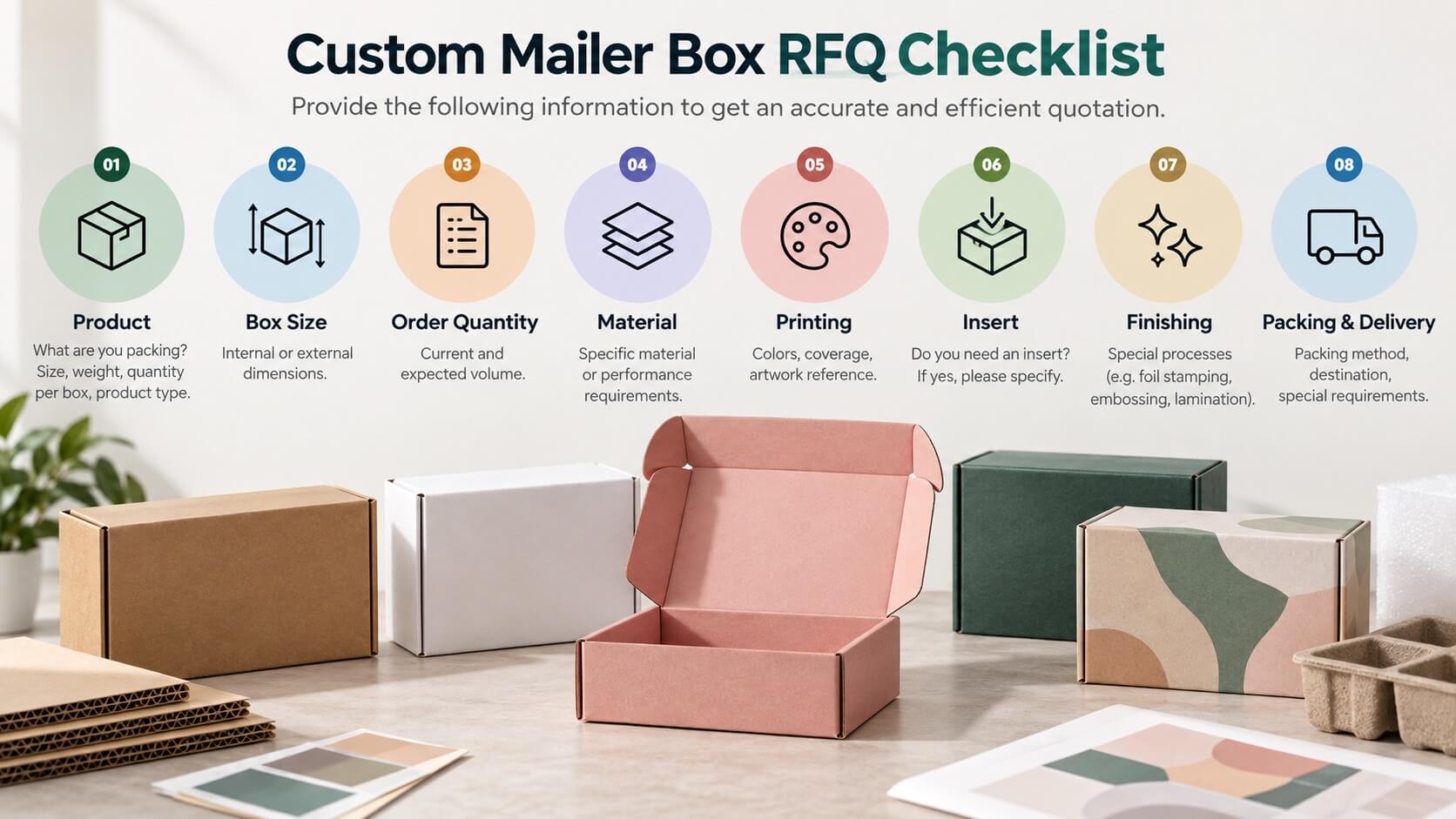
So, what information should you prepare before requesting a quote?
Start With the Product, Not Just the Box
One of the most useful things you can provide is information about the product going inside the package. Tell the supplier what you are packing, its dimensions, approximate weight, how many units go into each box, and whether the product is fragile, rigid, soft, or easily scratched. If several components are packed together, explain how you want them arranged. This information helps determine whether a standard Custom Mailer Box is sufficient or whether the packaging requires additional structural strength or internal protection.
For example, apparel and other soft products may work well in relatively simple folding mailer boxes, while glass skincare bottles, electronic devices, ceramics, or multi-component sets usually require more attention to product movement and protection. Product weight also matters because a box that performs well with a lightweight garment may not be appropriate for a heavier device of the same dimensions. For products with unusual shapes or tight dimensional tolerances, sending an actual product sample or accurate 3D data during packaging development can reduce fitting problems that are difficult to identify from a basic size specification alone.
Provide Dimensions—and Say Whether They Are Internal or External
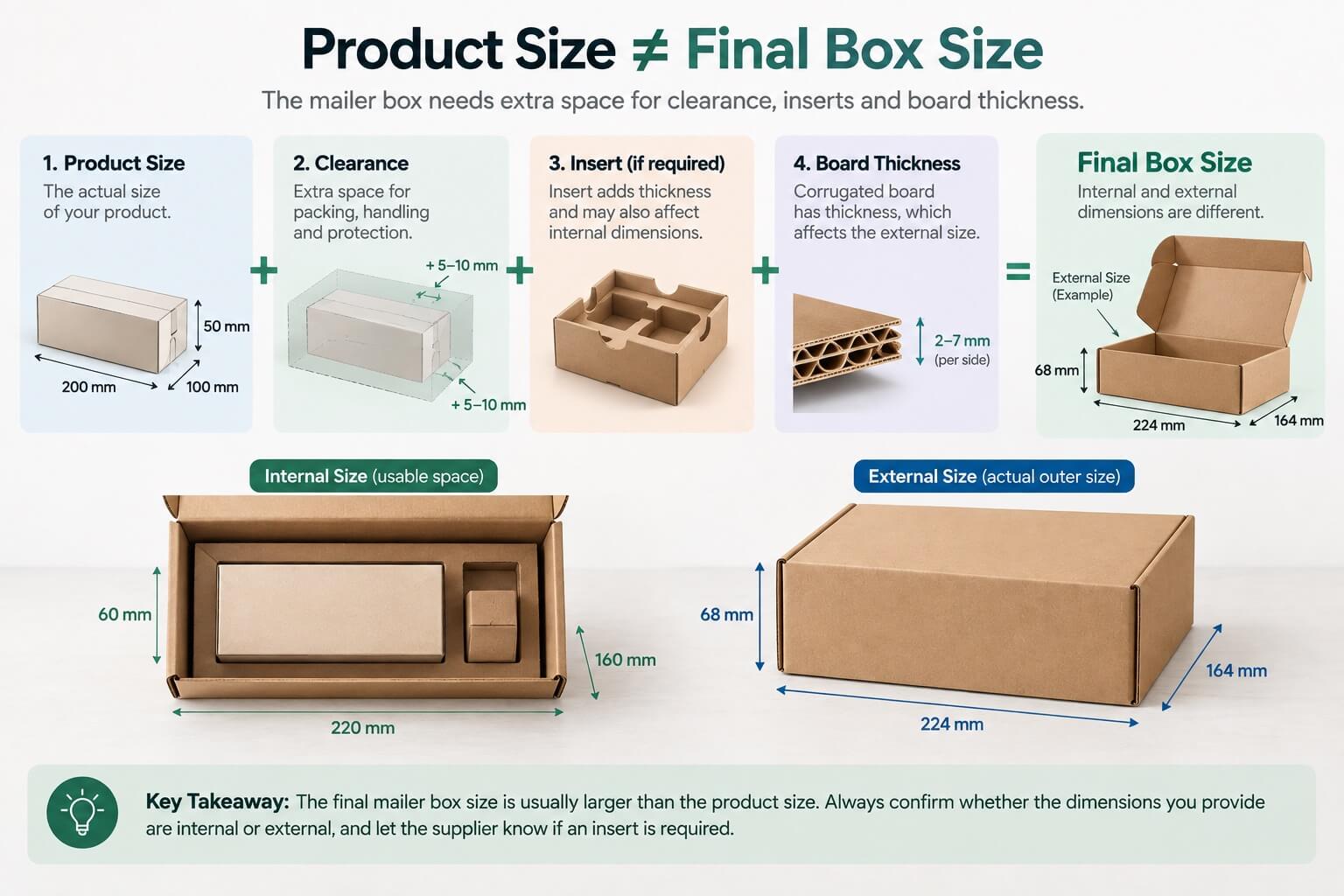
Dimensions are one of the most important quotation inputs, but simply writing “300 × 200 × 80 mm” can still create ambiguity. Always indicate whether those measurements are internal or external. Internal dimensions are generally more useful when packaging is being developed around a product because they define the usable space inside the box, while external dimensions become important when master-carton size, warehouse storage, palletization, or shipping restrictions need to be evaluated.
The box dimensions should not automatically equal the product dimensions. Space may be required for protective wrapping, loading clearance, an insert, or multiple components, and corrugated board thickness must also be considered when translating internal dimensions into the final external size. This becomes particularly noticeable with a mini mailer box, where a difference of only a few millimeters can noticeably affect product fit. If you already have packaging that works well, provide its dimensions and ideally a physical sample. If the correct size has not yet been established, provide the product dimensions and allow the packaging supplier to recommend an appropriate internal size.
Give the Order Quantity—and Expected Future Volume
Quantity directly affects unit price because tooling, setup, printing, and production costs are distributed across the number of boxes being manufactured. A quotation for 500 pieces can therefore look very different from one for 5,000 or 50,000 pieces. If you are still deciding the order volume, request several quantity breaks—for example, 1,000, 3,000 and 5,000 pieces. This makes it easier to see how the unit cost changes as volume increases and is particularly useful for buyers sourcing tuck top mailer boxes wholesale.
Large buyers should also consider providing estimated annual demand. A one-time order for 10,000 pieces is different from a packaging program that requires 10,000 pieces every month. Forecast volume can affect material purchasing, production planning, inventory arrangements, and the overall commercial structure of the project. For recurring orders, buyers may also want to discuss whether packaging specifications will remain stable across future runs, because changes in artwork, material, or dimensions can affect the economics of repeat production.
Specify the Material—or Explain the Performance You Need
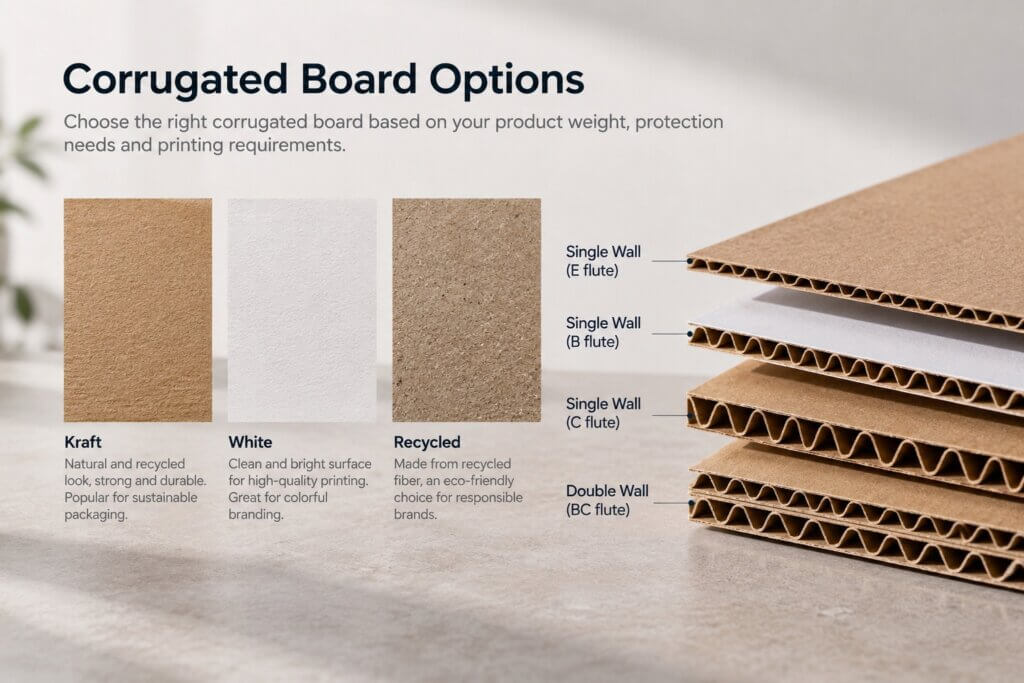
If you already know the required corrugated board grade, flute, liner, or other material specification, include it in the RFQ. If you do not know these technical details, provide the performance information that allows the supplier to make a recommendation instead. Product weight, fragility, box dimensions, stacking conditions, and distribution environment all influence material selection, and these factors are often more useful than simply asking for a “strong box.”
For buyers considering kraft mailer boxes, it is also important to explain what “kraft” means in the project. A Kraft Mailer Box may be selected for its natural brown appearance, but appearance alone does not define the complete corrugated specification. Paper composition, flute, board construction, and printing requirements may still differ between projects. Similarly, choosing the thickest material available does not automatically produce the best package: over-specification can increase material use and cost, while under-specification may reduce protection or stacking performance. The material should therefore match both the desired appearance and the actual performance expected from the packaging.
Define Printing and Color Requirements Clearly
Descriptions such as “full-color printing” or “black box with logo” are not complete printing specifications. The supplier needs to know whether printing is required outside only or on both the inside and outside, how much surface area is printed, whether specific Pantone colors are required, and whether the design contains large areas of solid color. A Printed Mailer Box can range from a simple one-color logo printed on kraft corrugated board to graphics covering nearly every visible surface. Even when the box dimensions and board construction are identical, these two designs may involve different production processes and costs.
The same applies to color-based requests. Terms such as black mailer box, white mailer boxes, pink mailer boxes, red mailer box, or blue mailer box communicate the intended appearance, but they do not explain exactly how that appearance should be produced. A black appearance, for example, may be achieved through printing on a white or kraft liner or through another specified paper solution, and those options can produce different visual results and costs. If final artwork is available, provide it when confirming the quotation. If the artwork is still being developed, a PDF, rendering, or design reference can normally provide enough information for an initial estimate.
Does the Mailer Box Need an Insert?
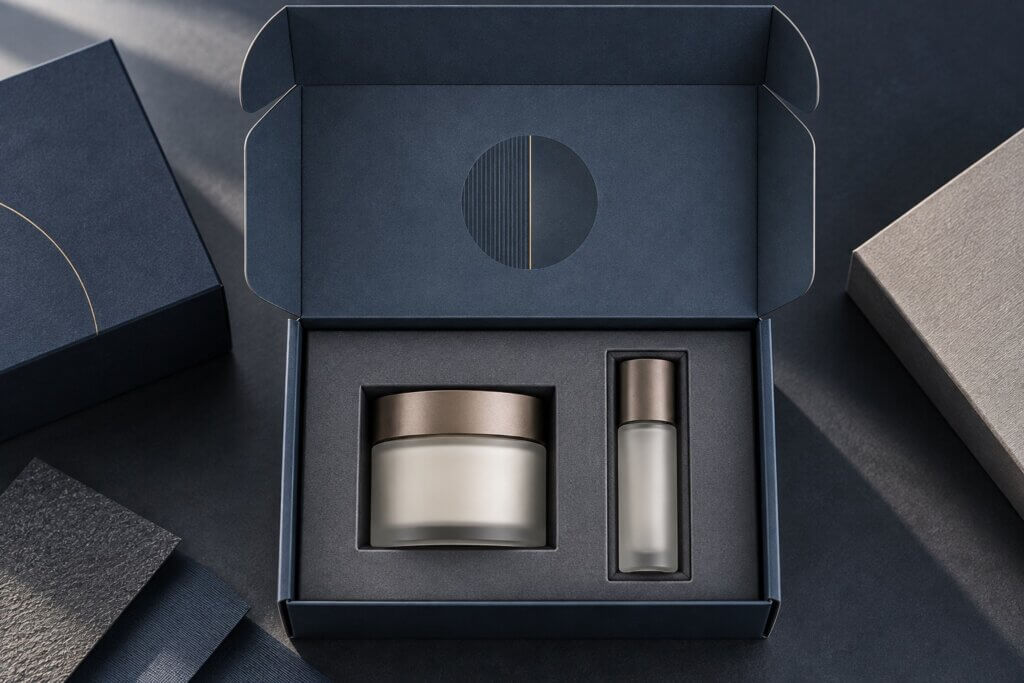
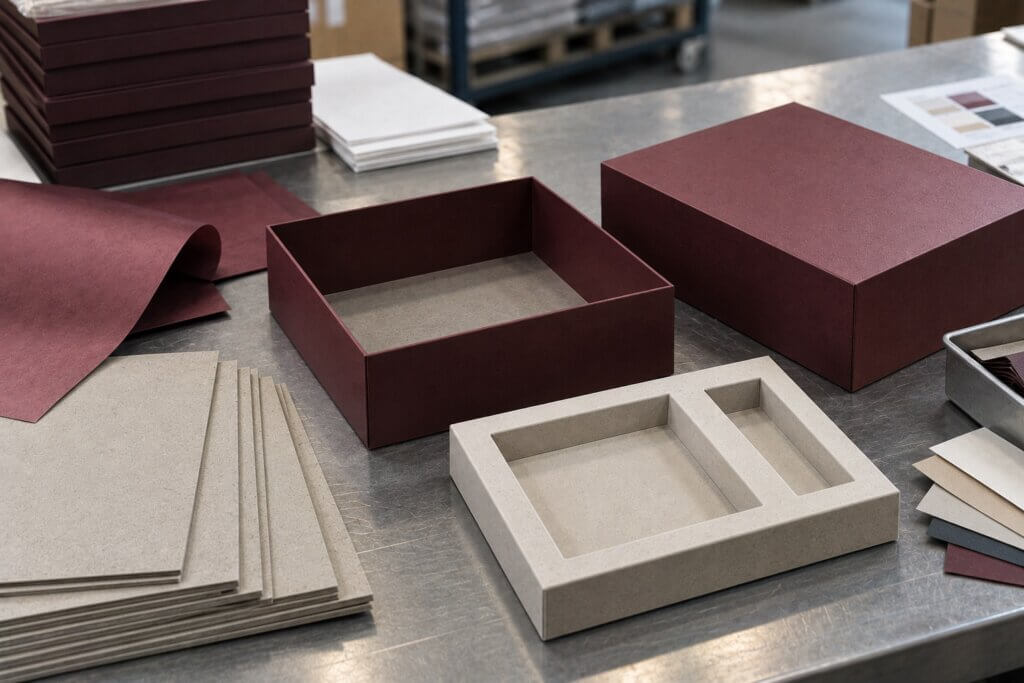
An insert can significantly affect both the box structure and the quotation, so it should be discussed early rather than added after the outer box has already been priced. A mailer box with insert may be appropriate when the product needs to remain in a fixed position, when several components must be separated, or when presentation after opening is important. Depending on the product and protection requirements, possible solutions can include corrugated inserts, paperboard dividers, molded pulp, EVA, or EPE foam.
For custom mailer boxes with inserts, the supplier needs more than the outer box dimensions. Provide the dimensions, weight, quantity, shape, and preferred arrangement of the products that the insert must hold. The insert and the outer box should be treated as one packaging system: changing the orientation of one component can change the insert layout, which may then change the internal box dimensions and total material consumption. Not every product needs an insert, either. Soft products such as apparel may require little internal positioning, while fragile, rigid, or multi-component products often benefit more from controlled movement and separation.
Finishing Requirements Should Be Identified Separately
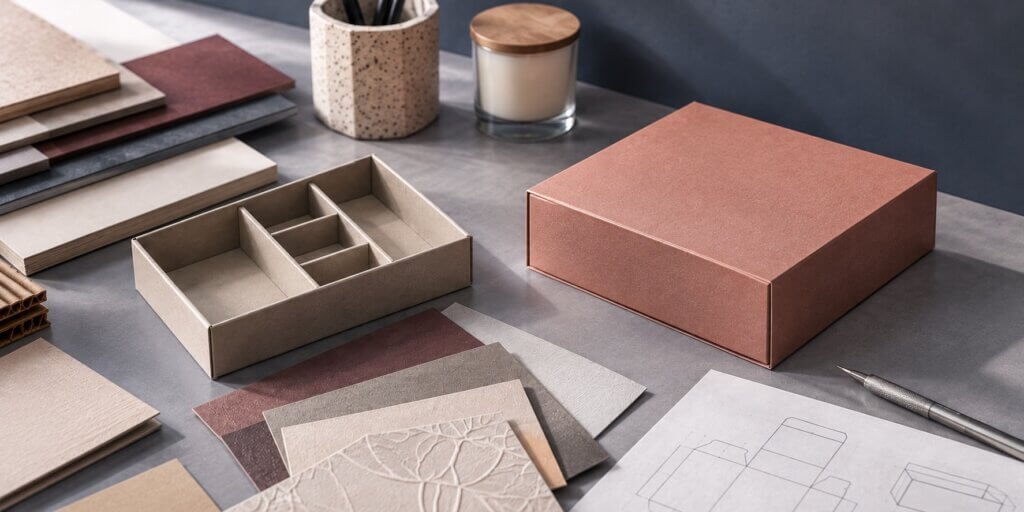
Printing and finishing are related, but they should not be treated as the same specification. If the packaging requires foil stamping, embossing, debossing, lamination, spot gloss, soft-touch treatment, or another special finish, identify it separately in the RFQ. This is particularly relevant to luxury mailer boxes, where two packages may have similar dimensions and structural materials but very different converting and finishing costs.
Finishing should also have a clear purpose rather than simply being added because a process is available. A premium retail, gifting, or product-launch package may justify additional visual or tactile effects, while a high-volume e-commerce mailer may benefit more from efficient printing, reliable structural performance, and controlled production cost. Providing a physical reference or clear finish sample is often more useful than simply asking for the packaging to look “premium,” because the same description can mean very different things to different buyers and suppliers.
Explain How the Boxes Will Be Packed and Delivered
The quotation should not stop at the finished box. Many folding mailer boxes can be supplied flat, reducing storage and transportation volume before assembly, but master-carton quantity, carton dimensions, pallet requirements, labeling, and delivery destination can still affect the total project cost. This becomes increasingly important as volume grows: a packing difference that seems insignificant for 500 boxes can become meaningful when tens of thousands of boxes need to be transported, stored, assembled, and distributed.
Large buyers should therefore provide warehouse receiving requirements, pallet specifications, carton labels, barcode requirements, or maximum carton weights before production if these conditions apply. For smaller orders, the information can be simpler—delivery destination and any unusual packing requirements are usually enough to begin calculating the logistics portion of the quotation. The important point is to identify these requirements before production rather than adding them after the packaging and master-carton configuration have already been confirmed.
What Is Enough Information for an Initial Quote?
You do not need a complete technical packaging specification before contacting a supplier. For an initial quotation, the most useful information is the product dimensions and weight, approximate box dimensions if known, order quantity, material or protection requirements, printing requirements, insert requirements, special finishes, and delivery destination. Together, these details give the supplier enough context to establish the basic packaging specification and identify any information that still needs to be confirmed.
If something is unknown, say so rather than guessing. For example, a buyer may know the product size and weight but not know which corrugated flute is appropriate. In that situation, stating “supplier recommendation required” is more useful than selecting a material specification without understanding whether it is suitable. A packaging supplier can recommend technical details, but it needs enough information to understand the product, distribution environment, desired appearance, and expected level of protection.
How Should Larger Buyers Compare Mailer Box Quotations?
For professional procurement, the lowest unit price does not necessarily mean the lowest price for the same packaging. One supplier may quote a lighter corrugated board, another may include an insert, and a third may assume outside-only printing while your intended design requires printing on both sides. Tooling charges, packing methods, sample costs, delivery terms, and even the interpretation of the box dimensions may also differ. Unless those specifications are aligned, the prices are not directly comparable.
Before comparing quotations, check that suppliers are pricing the same dimensions, material construction, printing, finishing, insert, quantity, packing method, and delivery terms. For repeat orders and larger packaging programs, maintaining a standardized RFQ specification is particularly useful because it creates a consistent basis for supplier comparison and reduces the risk of specifications changing between quotation, sampling, and mass production. Smaller buyers do not need a complicated procurement document, but the principle is exactly the same: understand what is included in each quotation before deciding which price is actually lower.
Final Thoughts
An accurate quotation for custom mailer boxes starts with a clear description of what actually needs to be manufactured. Dimensions and quantity establish the basic project, but product characteristics, corrugated material, printing, inserts, finishing, packing, and logistics determine the real specification and cost. Leaving these details unclear may produce a fast quotation, but it may not produce a price that remains valid once the packaging is fully developed.
For first-time buyers, providing the right information reduces unnecessary back-and-forth and helps the supplier recommend a more appropriate packaging solution. For larger brands and procurement teams, the same information creates a consistent specification that makes quotations from different suppliers much easier to compare. You do not need to know every technical packaging term before sending an inquiry; what matters is giving the supplier enough information to understand what needs to be made, how the packaging needs to perform, and exactly what should be included in the quoted price.