
A product launch can be delayed even when the product itself is ready. The formula may be finalized, inventory may be available, and marketing campaigns may already be scheduled, yet a missing packaging component can prevent finished goods from entering the intended sales channel. The difficulty becomes greater when one launch requires retail cartons, shopping bags, e-commerce shipping boxes, and promotional packaging, each with different production requirements and delivery destinations.
For brands coordinating several packaging types, the central challenge is not simply finding a manufacturer with a short production lead time. It is determining when each packaging component must become available for its next operation. Understanding a supplier’s manufacturing capabilities, reviewing relevant project examples, and clarifying production and shipping requirements can help establish realistic expectations before the launch schedule becomes difficult to change.
A reliable packaging procurement plan therefore begins with the product launch date but does not use that date as the packaging delivery deadline. Instead, it works backward through distribution, product assembly, packaging availability, manufacturing, and order approval. This approach helps brands identify which activities determine the launch schedule, which can proceed independently, and where delays require intervention.
Why Should Packaging Planning Begin with the Product Launch Date?
The public launch date is the point at which a product becomes available to customers, but several operational milestones must occur beforehand. Finished products may need to reach retail distribution centers, e-commerce fulfillment warehouses, or individual stores before sales begin. Packaging must be available even earlier if products require filling, labeling, assembly, or final packing. Consequently, the date when packaging is needed at the packing facility may be substantially earlier than the date shown on the marketing calendar.
How far in advance should a brand order custom packaging? There is no universally reliable number of weeks. The necessary advance period depends on the date the packaging will actually be consumed, the development status of the design, production capacity, transport arrangements, and the uncertainty associated with each stage. A repeat order using approved specifications may require a different schedule from a new product that still needs structural development and physical validation.
Brands should therefore establish three dates before requesting a final production commitment: the customer-facing launch date, the date finished goods must be available for distribution, and the date each packaging component must be ready for use. The third date becomes the operational deadline for packaging procurement. Once it is defined, the purchasing schedule can be calculated rather than estimated from a general supplier lead-time statement.

How Can Brands Calculate the Latest Safe Packaging Order Date?
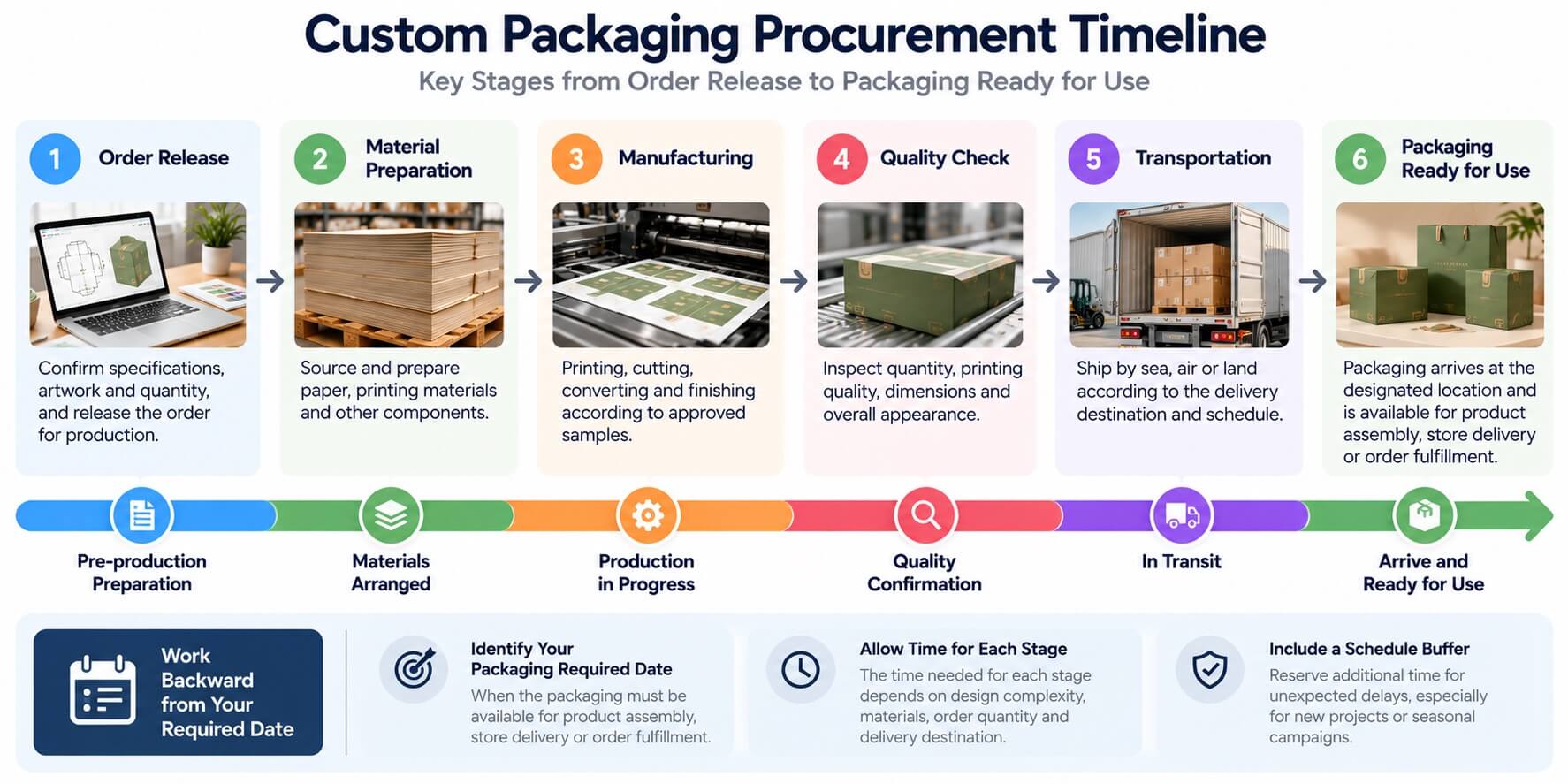
The next step is to work backward from the packaging-required date. The calculation must include the activities that remain incomplete when the order is being planned, rather than assuming that every project begins at the same stage. Artwork approval, production preparation, manufacturing, freight, customs clearance where applicable, and receiving inspection may all influence the date on which packaging becomes usable.
A practical planning relationship is:
Latest safe order-release date = Packaging-required date − Remaining critical-path duration − Schedule buffer
Here, order release means the point at which the manufacturer has received the approvals and commercial authorization required to proceed. An initial inquiry or quotation request should not automatically be treated as a confirmed production order.
Consider an illustrative project in which packaging must be available on November 10. Suppose the remaining sequential activities require three days for final order release, five days of production-queue waiting, twenty days of manufacturing, fourteen days of transport, and two days for receiving. Adding a seven-day planning buffer produces a total allowance of fifty-one calendar days, assuming all durations are expressed on that basis. The planning process would therefore need to begin no later than fifty-one days before the required date.
Does packaging production lead time include shipping? Not necessarily. Manufacturers may quote production time separately from transport, and production schedules may be expressed in working days while freight estimates use calendar days or weeks. These differences must be normalized before dates are calculated. Activities that genuinely overlap should not be counted twice, while approvals or material deliveries that block subsequent work must remain on the critical path.
This distinction is particularly important for international procurement. A technically achievable factory completion date does not establish that packaging will arrive at the correct facility, clear any necessary import procedures, and become available for packing on time.
How Should Brands Coordinate Different Packaging Components for the Same Launch?
Once the latest order-release dates are understood, the brand can separate packaging components according to when they are needed. Retail cartons may be required at a filling or assembly facility, shopping bags may be delivered directly to stores, and shipping boxes may be needed only when an e-commerce fulfillment operation begins. These components belong to the same commercial launch, but they do not necessarily share the same operational deadline.
For example, reverse tuck folding cartons used as primary retail packaging may need to arrive before the first packing run. Chipboard folding cartons, where that material description is appropriate to the specified board grade, may follow a different manufacturing route or preparation schedule. Their release dates should reflect confirmed production requirements rather than an assumption that all folding-carton products have identical lead times.
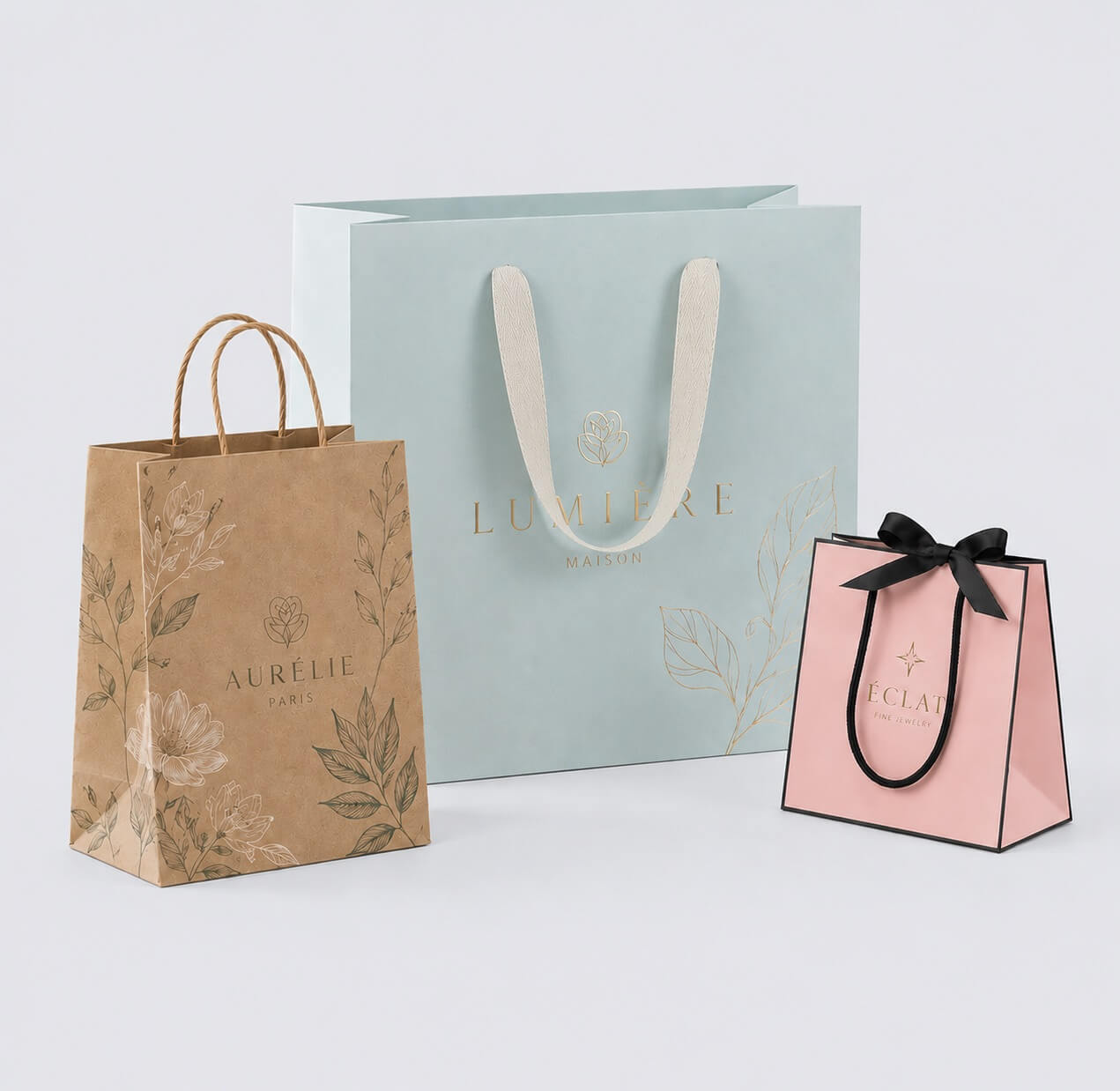
Retail shopping bags introduce another delivery stream. Die cut handle paper bags may be needed for a store opening, while twist handle paper bags or twisted handle paper bags may support a different retail program. The latter two expressions generally refer to a similar handle category and should not automatically be treated as separate technical specifications. Likewise, custom printed white paper bags and custom kraft paper bags may require different material sourcing or printing arrangements, but those differences matter to the launch schedule only when they affect confirmed preparation, production, or delivery dates.
The same principle applies to e-commerce packaging. Kraft mailer boxes and tuck top mailer boxes may be required at fulfillment centers rather than product assembly facilities. The important planning question is therefore not whether every packaging component can arrive together, but whether each component reaches its actual point of use before it becomes necessary.
Which Packaging Decisions Must Be Locked Before Production Capacity Is Committed?
After delivery priorities are established, brands must identify which decisions control the manufacturer’s ability to reserve and execute production. The purpose is not to repeat a complete packaging specification checklist. It is to distinguish unresolved details that prevent a dependable schedule from those that can be completed without affecting the production path.
Structural dimensions, board specifications, approved artwork, printing requirements, order quantities, and required delivery arrangements can influence material purchasing, tooling preparation, press scheduling, and converting operations. For a previously manufactured product, some of these elements may already be established. For a new structure, the supplier may need additional validation before confirming when production can begin.
Can a manufacturer reserve a production slot before final artwork approval? Sometimes a supplier may provisionally discuss capacity or make conditional arrangements, but this should not be confused with an unconditional production commitment. Whether a slot can be held, what approvals are required, and what happens if those approvals are late must be agreed explicitly. A brand should not assume that submitting a purchase order automatically secures the originally discussed completion date.
A useful planning practice is to assign each critical approval a deadline and an accountable decision-maker. When an approval is delayed, the team should immediately establish whether the delay consumes available schedule float or moves the forecast completion date. This turns approval tracking into a launch-control activity rather than a general administrative task.
How Should Brands Schedule Color Variants and Seasonal Packaging?
Once the core packaging schedule is protected, attention can shift to versions whose demand or artwork may be less stable. A brand may require black mailer boxes for its standard e-commerce program, custom black mailer boxes for a particular promotional configuration, and pink mailer boxes for a limited product collection. These are commercially distinct versions, but their production timing should depend on the confirmed manufacturing plan, not simply on the fact that they share a general packaging category.
Seasonal orders require particular care because their useful selling period is limited. Christmas mailer boxes may have a fixed promotional window, while holiday mailer boxes can refer to a broader range of campaigns with different start and end dates. The brand should distinguish the final date for receiving packaging from the earlier date when finished promotional products must be available for dispatch.
Should seasonal packaging be ordered earlier than everyday packaging? It often warrants an earlier planning decision because a late arrival may leave little opportunity to recover sales during a short campaign. However, ordering excessively early can create inventory exposure if artwork, promotional quantities, or launch plans change. The appropriate response is to confirm the campaign’s critical dates, establish a realistic production and logistics schedule, and release quantities according to the level of demand certainty.
Where multiple seasonal versions are involved, the purchasing plan should identify which versions are essential for the initial campaign and which can support later replenishment. This allows brands to protect the launch without automatically committing every forecast unit at the earliest possible date.
When Should Brands Split Deliveries or Prioritize Critical Packaging?
Even with careful planning, some packaging components may be completed earlier than others. The next decision is whether all items should wait for consolidated shipment or whether selected components should move independently. This is a schedule-and-cost decision, not a rule that split deliveries are always faster or more economical.
Consider a launch requiring 20,000 retail cartons, 10,000 shopping bags, and 15,000 shipping boxes. If the first production run needs only 5,000 retail cartons, shipping an initial usable quantity separately may allow assembly to begin while the remaining packaging is completed. However, the feasibility depends on whether the manufacturer can release an independently inspected quantity, whether transport arrangements support partial shipments, and whether the receiving facility can handle separate deliveries.
Can partial packaging shipments prevent a product launch delay? They can when the delayed activity lies on the launch’s critical path and the early shipment arrives in time to remove that constraint. They may provide little benefit when another component, product, or approval remains unavailable. The relevant comparison is the additional cost of splitting or accelerating delivery against the operational value of the time actually recovered.
Brands should also avoid treating air freight as a universal solution. Faster transport does not compensate for unfinished manufacturing, incomplete inspections, or missing approvals. An expedited shipment is useful only when the remaining timeline and receiving arrangements support the intended recovery.
How Can Brands Keep Packaging Orders Aligned When Launch Plans Change?
The final stage is continuous schedule control. A packaging order may have been planned correctly when released, but product launches can move, demand forecasts can change, and artwork revisions can be introduced after manufacturing preparations begin. The procurement plan therefore needs a method for evaluating changes against the remaining launch schedule.
What happens if packaging artwork changes after an order has been placed? The impact depends on the production stage and the nature of the revision. Before materials or tooling are committed, the change may be relatively manageable. After printing or converting has begun, it may require replacement materials, additional preparation, rework, or a revised delivery commitment. The correct response is to request a documented assessment of schedule, cost, usable work in progress, and the latest feasible approval date before authorizing the change.
For ongoing control, each packaging component should have one current status record showing its approved version, required-at-site date, forecast delivery date, outstanding approvals, and responsible contact. A forecast date that moves beyond the required date should trigger a specific recovery decision: adjust the production sequence, reduce the initial required quantity, change the shipping plan, or revise the launch operation if no feasible recovery remains.
How much schedule buffer should a packaging order include? The buffer should reflect actual uncertainty rather than a fixed allowance applied to every project. New structures, untested production processes, long international transit routes, and short seasonal selling windows may justify different levels of contingency. Where historical performance data exists, it provides a stronger basis for setting buffers than a generic percentage.
Ultimately, organizing packaging orders around product launch dates is a matter of coordinating operational dependencies. Brands that identify the true packaging-required date, calculate the remaining critical path, release essential components in the correct sequence, and respond promptly to schedule changes are better positioned to launch products without unnecessary emergency freight, excess inventory, or avoidable production interruptions.