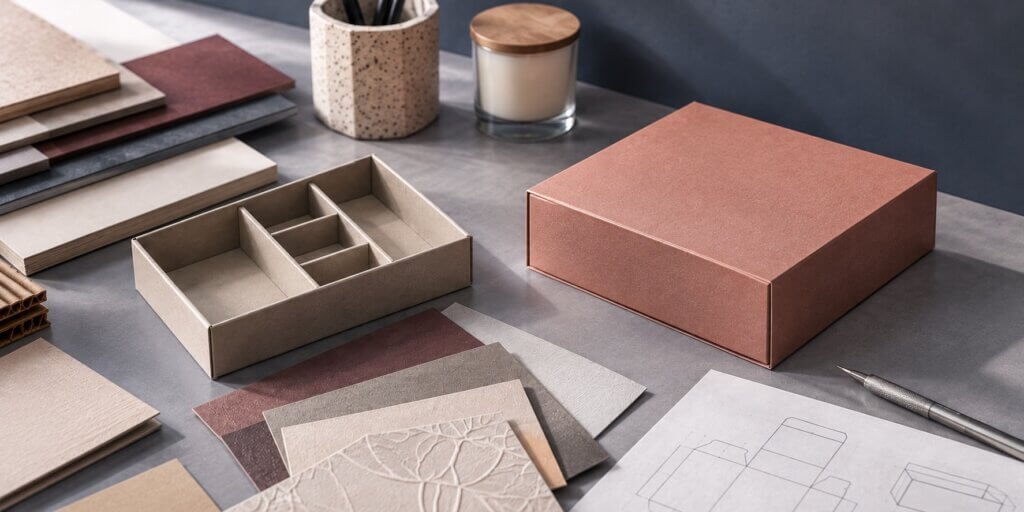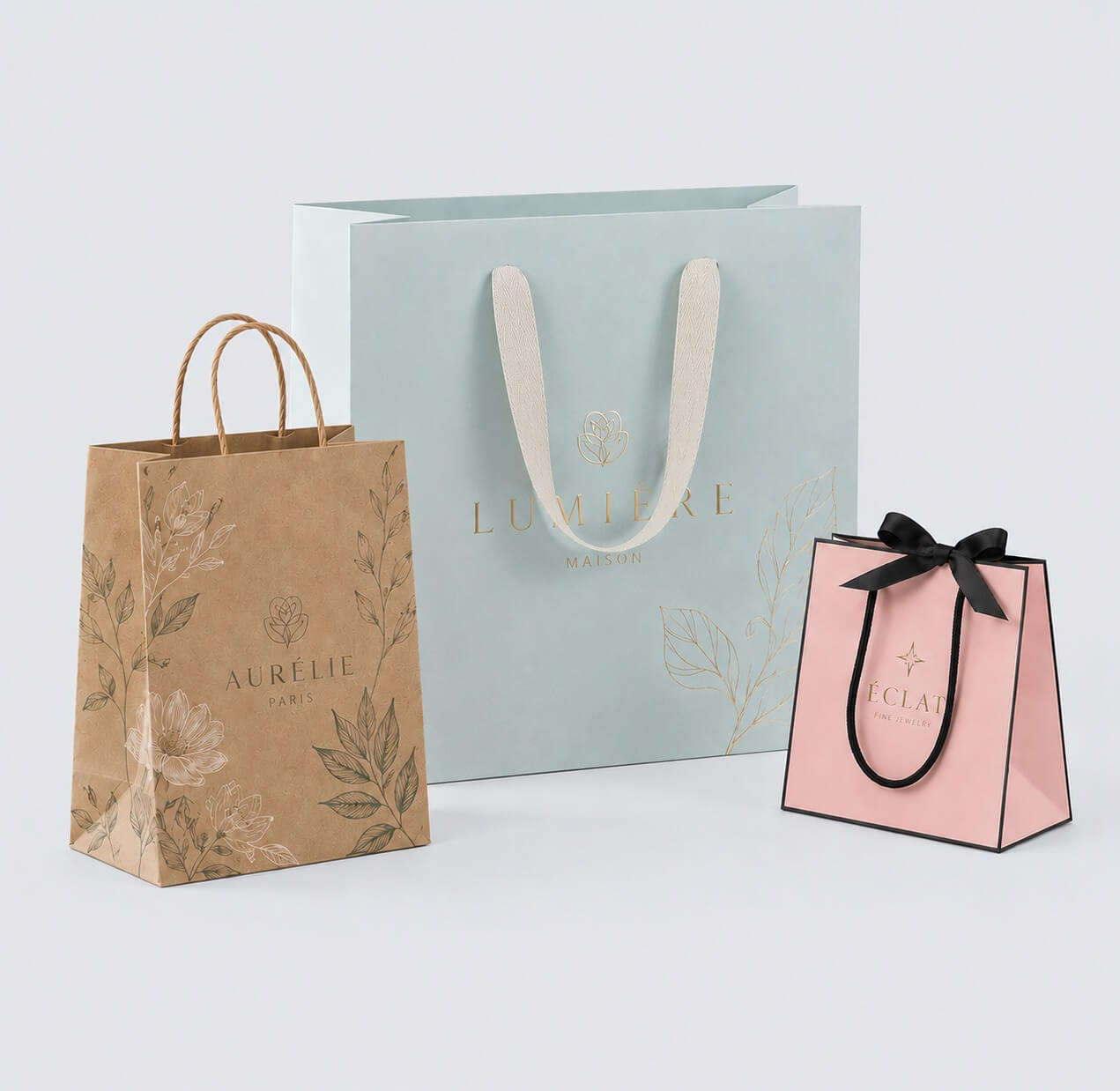

A finished package can make the manufacturing process look simpler than it really is. A rigid box, folding carton, or retail package arrives as one complete object, so it is easy to think of custom packaging as a single product purchased from a single factory. In reality, the finished box is the last stage of a connected manufacturing chain involving materials, components, converting processes, assembly, and quality control.
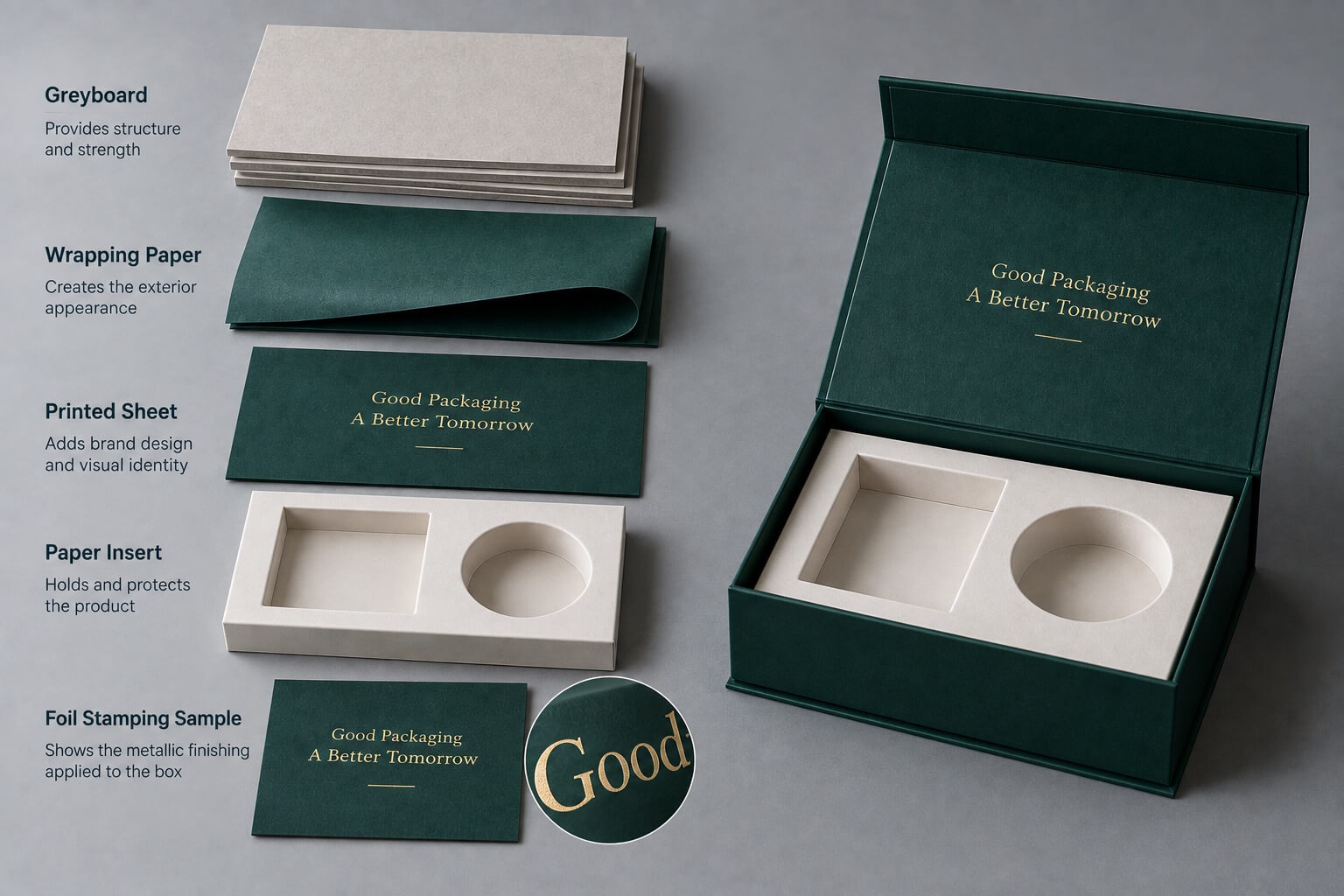
This distinction becomes more important as packaging becomes more customized. A project involving drawer boxes may combine greyboard, wrapping paper, printing, foil stamping, an insert, adhesive, and manual assembly. Folding cartons follow a different production route, while round boxes introduce their own forming and dimensional requirements. What the buyer sees as one package is therefore the result of several specifications being brought together and controlled as one product.
Understanding that chain helps explain something that is often misunderstood in packaging sourcing: the important question is not whether every material is produced inside one factory. It is whether every material and process can be controlled well enough to reproduce the approved package when production scales.
The Finished Box Starts With a Material and Component Specification
Before printing, die-cutting, wrapping, or assembly begins, a packaging project already depends on material specifications. Paperboard thickness, greyboard density, surface paper, corrugated grade, adhesive, insert material, and specialty components can all affect what happens later in production.
Take a wrapped rigid box as an example. The greyboard is hidden after assembly, but it still determines much of the physical behavior of the box. Variations in caliper, density, flatness, or moisture condition can influence panel dimensions before wrapping. Once covering paper, adhesive, and assembly tolerances are added, relatively small variations can accumulate at lid-to-base fits, drawer clearances, wrapped corners, or exposed edges. For this reason, the relationship between a manufacturer and a chipboard packaging supplier is not simply a purchasing issue; board specification and incoming-material consistency become part of dimensional control.
Sustainability requirements add another layer. Working with an fsc packaging supplier is not the same as selecting paper that simply looks recycled or environmentally responsible. When a project requires an FSC claim or label, the certified material must be handled within the applicable chain-of-custody system. In other words, sustainability can introduce documentation and traceability requirements alongside the physical material specification.
This is also why the work of creative green packaging suppliers should go beyond substituting one material for another. A lower-material or fiber-based solution still has to survive converting, assembly, packing, transport, and actual product use. A material choice is only useful when it works throughout the rest of the manufacturing chain.
Sourcing a Component Is Not the Same as Controlling a Component
Does a packaging manufacturer need to produce every component in-house? Not necessarily.
Specialty papers, magnets, ribbons, foam, certain insert materials, and other components may come from specialized upstream suppliers. What matters is how those components are specified and controlled before they enter final assembly. If a foam packaging supplier provides an insert material, for example, the relevant questions extend beyond whether the foam has arrived on time. Density, thickness, compression behavior, cutting tolerance, surface condition, and fit inside the finished box can all affect the result.
This creates an important distinction between purchasing and manufacturing control. A component may be externally sourced while its specification, approved sample, incoming inspection, dimensional tolerance, and final compatibility are still controlled by the packaging manufacturer.
The same logic applies to paper, greyboard, accessories, and finishing materials. Incoming components should not be evaluated only as individual pieces. They need to be evaluated in relation to the finished package. An insert can be dimensionally acceptable on its own and still cause problems if accumulated tolerances make it too tight inside the box. A wrapping paper can look correct as a flat sheet but behave differently after adhesive, folding, and corner wrapping.
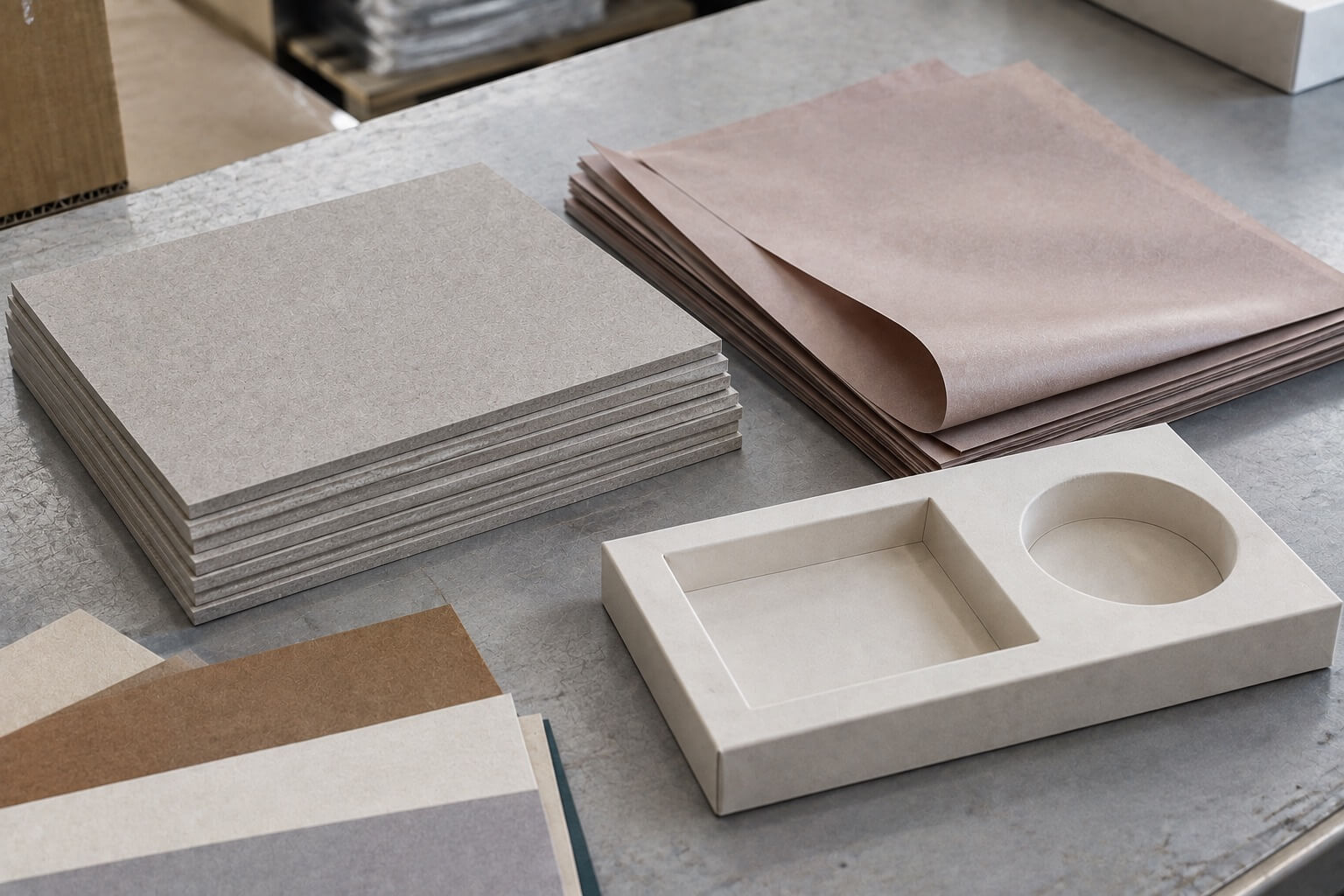
This is one reason physical sampling remains important. A sample does more than show what the package will look like; it allows materials, tolerances, finishing, inserts, and assembly relationships to be tested together before they become a production system.
Product Requirements Decide Which Parts of the Supply Chain Matter Most
Once the basic material and component system has been established, the product itself determines which variables require tighter control. This is where apparently similar paper boxes can follow very different manufacturing requirements.
For a luxury jewelry box packaging manufacturer, the outer box is only one part of the problem. Small jewelry items often require precise positioning, controlled insert openings, surface protection, and sufficient clearance for removal. A few millimeters of variation that might be unimportant in a larger gift package can become much more noticeable when a ring, pendant, or small accessory must sit in a defined position.
Tea creates a different boundary. Tea packaging suppliers may produce folding cartons, rigid gift boxes, paper tubes, or secondary packaging around a separately sealed product. Before a tea packaging supplier specifies the paper package, however, it is important to establish whether that package directly contacts the tea or simply contains an inner pouch, tin, or other primary pack. That distinction changes which material properties and compliance requirements belong to the paper packaging itself.
A similar principle applies to chocolate packaging suppliers. A presentation box holding individually wrapped chocolates is not technically equivalent to paper packaging intended for direct food contact. Product contact, grease exposure, temperature, insert construction, and transport conditions can change the material system even when the outer presentation looks similar.
For custom flower packaging suppliers, the variables change again. Fresh flowers, preserved flowers, and decorative gift arrangements do not create the same moisture, ventilation, support, or transportation requirements. The important lesson is not that every product needs a completely different box. It is that the product defines which parts of the packaging supply chain can remain standard and which must be controlled more carefully.
Those Requirements Eventually Become a Production Route
Once product conditions, materials, components, and tolerances are defined, the project begins to form a specific manufacturing route.
A relatively simple folding carton may move through printing, surface treatment, die-cutting, stripping, folding, gluing, inspection, and packing. A wrapped rigid box may require greyboard cutting or grooving, box forming, wrapping, finishing, insert installation, assembly, and additional inspection. Adding specialty papers, foil stamping, embossing, multiple inserts, ribbons, magnets, or other components introduces more interfaces where one process can affect the next.
This is why two packages with similar external dimensions can have very different manufacturing costs and production requirements. The difference may not be visible in a rendering. It may exist in the number of setups, the material yield, the amount of manual assembly, the tolerance required between components, or the number of inspection points.
It also explains a common sourcing question: why does MOQ change between packaging projects? MOQ is not determined by box size alone. Printing setup, tooling, specialty material purchasing quantities, finishing processes, assembly efficiency, and SKU fragmentation all influence the practical production quantity.
At Demei Packaging, most custom packaging projects start from 500 pieces, but the final MOQ depends on the box type, structure, materials, and finishing requirements. This is why an early quotation based on a reference image should not be treated as equivalent to a production quotation based on confirmed specifications.
Retail Use Adds Requirements Beyond the Factory
The manufacturing chain does not really end when the package leaves the production line. How the package will be packed, transported, assembled, filled, displayed, and opened can change decisions made much earlier.
This is particularly relevant to retail display packaging suppliers. A display package may need to arrive efficiently packed, assemble without excessive labor, remain stable after products are loaded, and maintain its appearance during the intended retail period. These requirements can influence board grade, flute direction, locking features, print placement, packing orientation, and carton configuration before production begins.
The same principle applies to luxury packaging suppliers. A premium appearance at the factory is not enough if wrapped surfaces scuff during packing, inserts move during transport, or tolerances change the opening experience between batches. Quality therefore has to be considered across the complete use path rather than at the final inspection table alone.
This is where packaging sourcing begins to move beyond comparing unit prices. Two quotations may describe boxes that look nearly identical while assuming different paper specifications, board grades, inserts, packing methods, tolerances, or inspection standards. Without understanding those differences, the lowest unit price does not necessarily represent the same manufacturing scope.
What Needs to Be Confirmed Before Production Begins?
By this stage, it becomes easier to understand why a production-ready packaging brief needs more than dimensions and artwork. The manufacturer may need the product size and weight, expected order quantity, material requirements, printing references, finishing, insert specifications, packing method, destination, and any relevant sustainability or product-contact requirements.
For products where fit is important, a physical product or accurate prototype may also be needed. This allows the package and product to be evaluated as one system rather than relying entirely on nominal dimensions. The same principle applies when multiple components must fit together: individual tolerances should be considered before production, because acceptable variation in several separate parts can accumulate during final assembly.
Brands that are still defining these specifications can use our FAQ as a starting point for questions about MOQ, sampling, production, and project preparation. For applications requiring more complex presentation or internal organization, structures such as shaped boxes may also require additional development before the production specification is fixed.
The objective is not to make the brief unnecessarily complicated. It is to resolve the variables that can materially change manufacturing before those variables become production problems.
A Packaging Supply Chain Is Ultimately a System for Repeatability
Can one packaging supplier coordinate materials, inserts, finishing, assembly, and final delivery? Yes. But coordination should not be confused with claiming that every raw material originates inside the same building.
The more useful measure is control.
A well-managed packaging manufacturer should be able to translate the approved sample into material specifications, process requirements, tolerances, inspection points, and assembly standards. Those controls then need to remain connected as materials move through printing, converting, finishing, assembly, inspection, and packing.
This is ultimately what separates a sample from a repeatable packaging product. The first acceptable box proves that a result is possible. A controlled supply chain is what makes that result reproducible across hundreds or thousands of units.
For custom packaging, that repeatability—not simply the number of processes listed on a supplier’s website—is the real output of the manufacturing supply chain.